
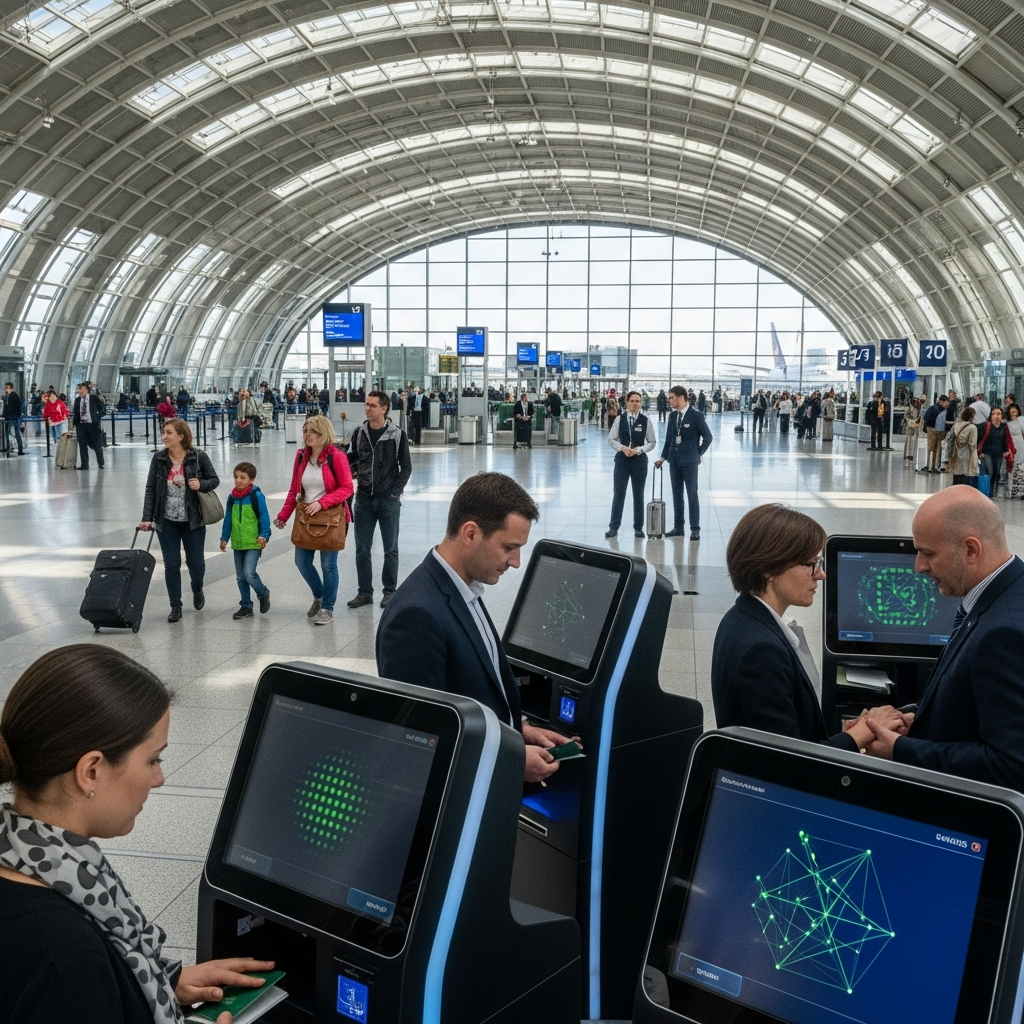

Europe’s vibrant cities and stunning landscapes beckon, but a significant shift in border control is transforming the journey for millions of non-EU travelers. The European Union’s new Entry/Exit System (EES) is here, digitizing how visitors enter and exit the 29-country Schengen Area. This essential guide cuts through the confusion, offering expert strategies to navigate potential delays, understand upcoming requirements like ETIAS, and ensure your European adventure remains smooth and stress-free. Prepare to embrace a new era of digital borders with confidence, making your next trip across the continent as efficient as possible.
Unpacking Europe’s Entry/Exit System (EES)
The European Union’s Entry/Exit System (EES) represents a monumental leap in border management. Officially launched on October 12, 2025, with full digital implementation targeted for April 10, 2026 (though some ports may stagger implementation until September 2026), the EES replaces the traditional passport stamp with an electronic record. Its core function is to meticulously track the entries, exits, and stay durations of non-EU citizens within the vast Schengen zone.
Who Does EES Affect and What’s Recorded?
The EES primarily targets third-country nationals – anyone who isn’t an EU citizen, or doesn’t hold a long-stay visa or EU residency permit. This includes travelers from major visa-exempt countries like the UK, USA, Canada, and Australia. EU passport holders will continue to use their faster, unaffected lines. Upon a traveler’s first entry under EES, the system captures biometric data, specifically a facial scan and four fingerprints. This data is then securely stored for three years or until your passport expires, simplifying subsequent verifications.
Children under 12 are generally exempt from fingerprinting, though a photograph will still be recorded for them. Refusal to provide mandatory biometric data will result in denied entry.
The Vision Behind Digital Borders
The move to digital borders isn’t just about modernization; it’s a strategic enhancement of security and enforcement. By accurately recording travel dates and biometric identifiers, the EU aims to:
Prevent overstays: Easily identify and manage travelers exceeding the 90-day limit within any 180-day period across the Schengen Area.
Combat identity fraud: Improve detection of forged passports and identity theft.
Streamline efficiency: Ultimately reduce border wait times through automation, especially for frequent visitors after initial registration.
Bolster internal security: Strengthen the collective security framework of the Schengen zone.
EES Coverage: Where It Applies
The EES will be active across 29 European countries. This includes 25 of the 27 EU member states (excluding Ireland and Cyprus, where manual checks will persist), plus the associated Schengen countries: Iceland, Norway, Liechtenstein, and Switzerland. Newer EU members like Bulgaria, Croatia, and Romania are also part of this extensive digital border framework.
Why the Delays? The Reality on the Ground
Despite the EES’s promise of efficiency, its initial rollout has been challenging, leading to significant disruptions for travelers. The European Commission has acknowledged the “complex and complicated” nature of the rollout, even while citing 23 million entries and exits recorded by early 2026.
Industry Insights and First-Hand Accounts
Travel experts and industry bodies confirm substantial issues. Airports Council International (ACI) Europe, representing over 600 airports, reports that EES checks have inflated border processing times by up to 70 percent. Peak periods have seen waits stretch to three hours or more, with specific incidents including four-hour queues at Geneva. Lisbon Airport even temporarily suspended EES checks for three months in late 2025 due to wait times exceeding five hours. Aéroports de Paris has also called for full suspension during busy periods.
By early January 2026, only about 35 percent of ports were fully “switched on” to the EES, indicating a staggered implementation that has contributed to varying experiences.
Primary Drivers of Congestion
The extended waiting times stem from several interlinked factors:
Initial Biometric Registration: The requirement for first-time EES users to register fingerprints and facial scans in person at the border adds considerable processing time, especially at automated kiosks that may require staff assistance.
Inadequate Infrastructure: Airports have reported a shortage of trained border staff and issues with automated machines. While self-service kiosks are being installed, their functionality and number are still catching up to demand.
System Outages and Glitches: Technical malfunctions and temporary system failures are not uncommon, forcing a reversion to slower manual checks, which are further hampered by existing border guard shortages.
Surging Passenger Volumes: As summer travel intensifies, the sheer influx of holidaymakers attempting initial biometric registration is expected to exacerbate existing issues, potentially leading to prolonged queues.
Contingency Measures: While member states can request delays for full EES implementation until September 2026, and a crucial contingency allows partial suspension of EES operations for up to six hours during peak times until September 2026, travelers cannot predict if or when these relief valves will be active.
Your Strategy for Smoother Schengen Travel
Given the current operational challenges, proactive planning and abundant patience are absolutely critical for non-EU travelers heading to Europe. Simply “giving yourself extra time” is no longer enough.
Before You Depart: Proactive Planning is Essential
Smart preparation is your strongest defense against travel disruptions:
Build in Significant Buffer Time: Add at least four hours of buffer time to your travel itinerary, particularly if you’re flying into or connecting through a major European hub like Frankfurt, Amsterdam, Paris Charles de Gaulle, or Madrid.
Choose Extended Layovers: If your journey involves connecting flights via busy European airports, prioritize options with extra-long layovers. This significantly reduces the risk of missing your onward connection.
Stay Continuously Updated: Monitor your airline and destination airport websites diligently for real-time information on queue lengths, potential delays, and reported system outages. Information can change rapidly.
Consider Off-Season Travel: EES operations are expected to improve with practice. Traveling in the shoulder seasons (e.g., September/October or April/May) may help you avoid the peak summer chaos and potential temporary system suspensions.
Utilize Dual Nationality: If you hold a valid EU passport in addition to your non-EU one, always use your EU passport to bypass EES entirely and access the typically faster EU citizen lines.
Prepare for Waits: Pack essential refreshments, snacks, and engaging entertainment for children. Long waits can be physically and mentally taxing, and being prepared can significantly improve your experience.
Pre-Departure Checks for UK Routes: For routes connecting the UK to the Schengen Area (e.g., Eurostar, Port of Dover, Folkestone’s LeShuttle), EES registration kiosks are set up at juxtaposed EU controls for pre-departure processing. Be prepared for this even before you leave the UK.
Navigating Your First EES Registration
Your initial entry into the Schengen Area under the EES will involve a specific process. Even if you’ve registered biometrics before, you will still join the non-EU passport control queue.
- Passport Scan: Present your passport at an automated self-service kiosk or to a border guard.
- Biometric Capture: Provide your fingerprints and have your photograph taken. Many locations are installing self-service kiosks or mobile apps to facilitate this process.
- Entry Questions: Be prepared to answer routine entry questions from border authorities regarding your trip’s purpose, accommodation, financial means, medical insurance, and return travel arrangements, similar to current procedures.
- <a href="https://www.thetimes.com/travel/advice/what-is-the-eus-new-entry-system-and-what-will-it-mean-for-my-holiday-8grrwsgk9?gaaat=eafs&gaan=AWEtsqfuTYOKdnTho1IyN0hQ53OiCvloA-hn1Ek-pWkZRFExgDTCKSCRs9x&gaats=69bc8256&gaasig=4IrXq1PBPz0TucBOKxpv8cQGC8zRJVMddoF62eF2lNPMyupu3rlHbEpXTFxsB8vTyGViDbN1eUJBO3lE8_R1Q%3D%3D”>www.thetimes.com
- etias.com
- www.muchbetteradventures.com
- www.travelandtourworld.com
- etias.com
Once your biometric data is registered, it remains on file for three years. Subsequent entries within this period should involve quicker verification through your stored biometrics, though you’ll still use the designated non-EU lines.
Beyond EES: Preparing for Future European & UK Border Controls
The EES is just one piece of a larger puzzle. Several other crucial digital border systems are on the horizon, requiring further traveler awareness and preparation.
The ETIAS Visa Waiver: Your Next Step for European Travel
Expected to launch in the last quarter of 2026, the European Travel Information and Authorisation System (ETIAS) will introduce a mandatory pre-travel authorization for citizens of over 60 visa-exempt countries, including the UK, USA, and Canada, who wish to visit the Schengen Area. Much like the US ESTA or Canada’s ETA, ETIAS requires an online application before you travel.
Purpose: ETIAS acts as a pre-screening system, verifying a traveler’s background against security databases before departure, while EES operates at the border for tracking actual entries and exits.
Cost & Validity: The application fee is set at approximately €20 (around £17). Once approved, the authorization is valid for three years or until your associated passport expires, allowing for multiple short stays (up to 90 days within any 180-day period).
Application Advice: Apply well in advance once the system opens. It’s recommended to apply at least 96 hours before booking flights or other travel. Only use official platforms, such as the EU’s dedicated ETIAS website, to avoid scams. Save your ETIAS confirmation email and application number.
Carrier Responsibilities: Airlines, ferry operators, and international coach companies are legally mandated to verify a traveler’s ETIAS authorization before departure. They face significant penalties for transporting passengers without valid authorization. This process typically occurs during online check-in, at the airport check-in counter, and potentially at the boarding gate, linking directly to the ETIAS central database. Carriers only receive a “valid,” “invalid,” or “not found” response, without accessing sensitive personal data.
Common Verification Failures: Issues like ETIAS expiration, passport renewal after authorization (breaking the digital link), typos in passport numbers, or revoked authorizations can lead to denied boarding. Ensure all passport details used for booking exactly match your ETIAS application.
UK’s Own ETA System and Dual Nationality Rules
In a reciprocal move, the UK is expanding its Electronic Travel Authorisation (ETA) system. From February 25, 2026, this system will mandate pre-travel clearance for many non-visa UK travelers, including those from the US, Canada, and Australia, before they can board flights or ferries to the UK. Like ETIAS, the ETA is a mandatory security clearance, not a visa, and processing can take several days. Apply via the official gov.uk/eta service.
Furthermore, from February 25, 2026, British dual nationals must travel with a valid UK passport when entering or departing the UK. This digital border framework means dual citizens previously using only their other nationality passport could face denied boarding if they lack the correct UK documentation. Checking passport validity well in advance is crucial.
Frequently Asked Questions
What is Europe’s new EES system, and who does it impact?
Europe’s Entry/Exit System (EES) is a new digital border control platform launched by the EU, fully implemented by April 10, 2026, which replaces passport stamping with electronic records. It digitally tracks entries, exits, and stay durations for non-EU citizens in the 29-country Schengen Area. It primarily affects non-EU passport holders, including those from the UK, USA, Canada, and Australia, requiring them to register fingerprints and a facial scan on their first entry. EU citizens, long-stay visa holders, and children under 12 (for fingerprints) are exempt from certain aspects.
What are the best strategies to avoid significant travel delays caused by the EES?
To minimize EES-related delays, proactive planning is crucial. Add at least four hours of buffer time to your travel schedule, especially when flying into major European hubs like Frankfurt or Amsterdam. If you have connecting flights, opt for extra-long layovers. Continuously monitor your airline and airport websites for real-time updates. Consider traveling in the off-season to avoid peak congestion. If you’re a dual national with an EU passport, use it to bypass EES lines. Also, be prepared for pre-departure EES checks at juxtaposed controls for UK routes.
How do EES and the upcoming ETIAS visa waiver differ, and when should I apply for ETIAS?
The EES and ETIAS are complementary but distinct. EES operates at the border, digitally recording your actual entry/exit and biometrics to track your stay. ETIAS is a pre-travel authorization, similar to the US ESTA, which screens visa-exempt travelers before* they depart. ETIAS is expected to launch in the last quarter of 2026. You should apply for ETIAS online well in advance, ideally at least 96 hours before booking your flights, using only official EU platforms to ensure you have authorization before travel.
The Evolving European Border Landscape: Patience and Preparedness
The European Commission reiterates that the EES rollout is complex but necessary for modernized border management and enhanced security. While initial challenges, system outages, and border guard shortages are real concerns, industry experts believe efficiency will steadily improve as the system matures and more travelers become familiar with the process.
For now, the overarching message for anyone planning to travel to Europe is clear: Patience and meticulous preparation are paramount. Staying informed about the latest regulations, implementing the suggested proactive strategies, and allocating ample time for border crossings will be your most effective tools against potential travel disruptions. Embrace the digital shift, plan wisely, and look forward to a rewarding European journey.
“,
“imagegenerationprompt”: “A modern, brightly lit airport terminal scene in Europe. Travelers of diverse ages and nationalities are moving through, some interacting with sleek, futuristic self-service kiosks at border control. Digital screens display abstract data patterns or system notifications. The overall mood is orderly and efficient, with a subtle hint of technology and global connectivity. Focus on a wide shot with depth of field, showcasing the interplay of human activity and advanced border technology