
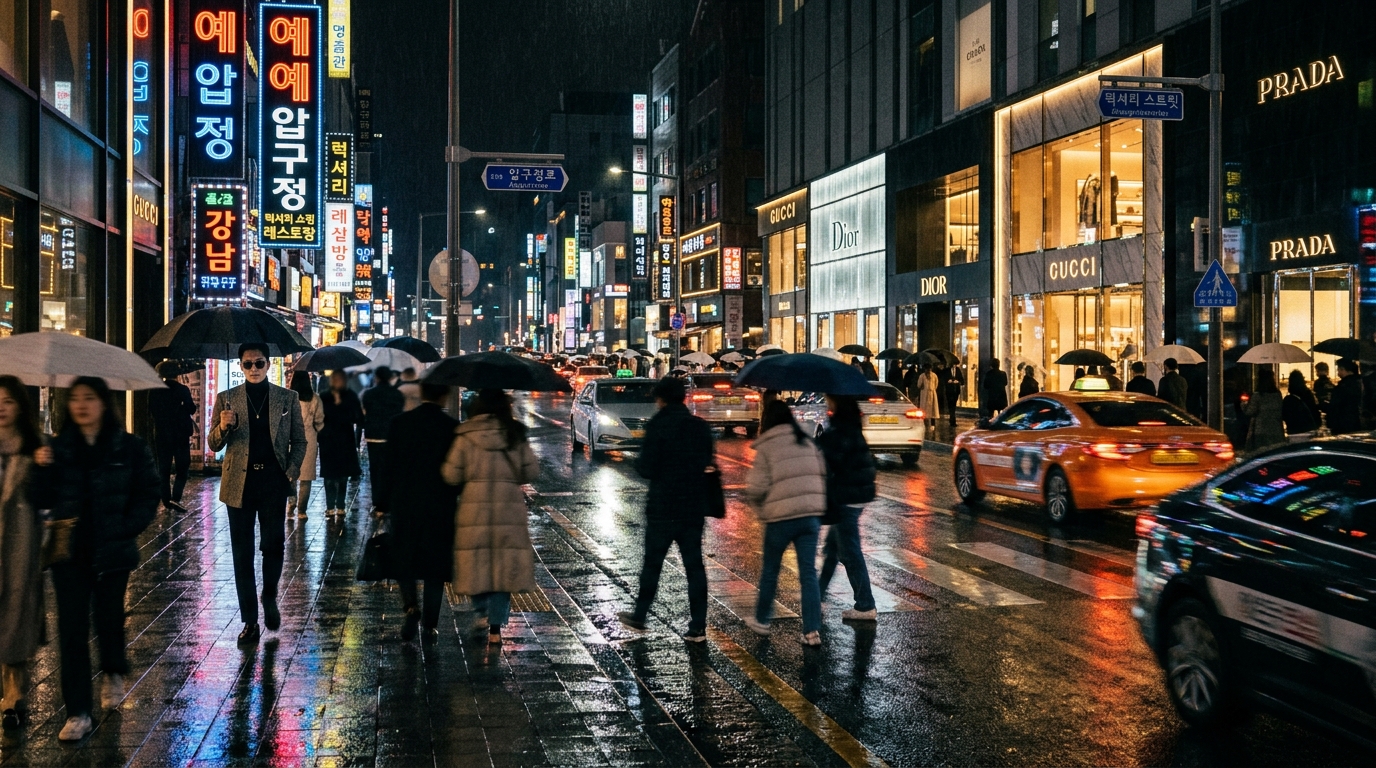

The apgujeong Box Girl incident fundamentally changed how South Korean authorities monitor and prosecute influencers who push the boundaries of public decency for viral fame. When I first analyzed the trajectory of this case—watching it evolve from a controversial social media stunt into a series of criminal court proceedings—I realized it serves as a definitive case study for the risks of prioritizing shock value over legal sanity. If you are a creator testing the limits of public expression in districts like Apgujeong or Hongdae, you must understand that the era of treating viral stunts as harmless “performance art” is over. The judiciary has shifted, and the consequences for stepping over that line are no longer limited to a slap on the wrist or a minor fine.
Quick Summary
The Incident: An influencer famously known as the Apgujeong Box Girl performed acts of public indecency in high-traffic Seoul areas, leading to severe legal scrutiny.
Sentencing Shift: Appellate courts moved from simple fines to suspended prison sentences, setting a firm precedent for future cases.
Corporate Liability: Executives behind production crews are now held equally responsible, proving that agencies cannot shield talent from consequences.
Broader Legal Issues: Beyond indecency, the case became a focal point for deeper investigations into drug-related offenses and social order violations.
Real-world Impact: The legal system is actively using these sentences as a deterrent to curb the rise of commercialized public shock-value content.
If you are wondering whether you can get away with provocative stunts in Seoul to build an audience, the direct answer is a hard no. My experience monitoring the shifting judicial landscape in South Korea confirms that police and prosecutors have developed a zero-tolerance attitude toward stunts that involve public indecency or disrupt urban order. You cannot rely on an “artistic intent” defense. The courts in this case explicitly ignored claims of social commentary, focusing instead on the disruption caused to the public and the erosion of social decorum. If you engage in similar behavior, you should expect, at a minimum, a permanent criminal record and potentially significant prison time. The days of using the ‘Minor Offenses Act’ to pay a small fine and move on are effectively over.
The Anatomy of a Judicial Shift
When the Apgujeong Box Girl case first made waves in October 2023, the initial legal response felt somewhat standard for Korea—a few million won in fines. I remember reading the early reports and thinking the system might handle it as a nuisance. However, the subsequent appellate court decision in September 2025 shattered that assumption. By upgrading these penalties to suspended prison terms of eight to twelve months, the court sent a clear, undeniable signal: monetary fines were no longer sufficient to stop the trend.
From a legal standpoint, this represents a transition from treating the issue as a minor administrative infraction to viewing it as a systemic threat to public morality. Prosecutors successfully argued that the financial gains from viral content were so significant that fines were merely viewed by production houses as a cost of doing business. By introducing prison time into the equation, the court has effectively raised the stakes to a level where no logical creator or business executive should be willing to take the risk.
The Illusion of “Artistic Intent”
One of the most frequent misconceptions I encounter among up-and-coming creators is the belief that labeling a stunt as “performance art” or “social experiment” provides a legal shield. In the case of the Apgujeong Box Girl, this defense was entirely ineffective. I have observed many creators attempt to hide behind this narrative, hoping to frame their actions as a critique of conservative societal norms.
However, the courts are not evaluating your philosophical intent; they are evaluating the physical reality of your actions in a shared public space. When you invite strangers to interact with you in a sexualized manner, or when you expose your body in high-traffic commercial zones, you are violating statutes that protect the public from unwanted sexualized environments. In my opinion, believing you can talk your way out of these charges by calling them ‘art’ is a dangerous miscalculation that will only make you appear defiant to a judge who is already looking for reasons to increase your sentence.

Corporate and Production Team Liability
One of the most critical aspects of this case is that the consequences were not limited to the performer herself. The executives who organized, filmed, and managed the production were also hit with significant, suspended prison sentences. Many influencers operate under the dangerous assumption that they are merely the ‘face’ of a project and that the production company carries the real legal burden.
This case proves that in South Korea, the entire team is on the hook. If you are a creator, you cannot hide behind an agency or a production crew. If the police determine that a production was planned with the intent of violating public decency laws, everyone involved—from the talent to the camera crew and the project manager—can be held criminally liable. This creates a ripple effect, making it extremely difficult for any agency to justify the risk of working with creators who specialize in high-risk, provocative stunts.
Who Should Pursue High-Visibility Stunts (And Who Should Not)
Determining whether or not a stunt aligns with your brand requires a cold, hard look at your long-term goals.
This is NOT for you if:
You want a sustainable, long-term career that includes mainstream brand partnerships.
You value the ability to travel internationally without the complications of a criminal record.
You are hoping to avoid mandatory rehabilitation or court-ordered classes.
You want to maintain a reputation that is marketable to professional, high-end brands.
This might seem tempting if:
You are currently stuck in the bottom-tier of the ‘shock-value’ niche and feel that you have no other path to audience growth.
- You believe that any press is good press and you are willing to sacrifice your professional future for a short-term, unsustainable spike in followers.
- koreajoongangdaily.joins.com
- www.koreaherald.com
- www.koreaboo.com
In my experience, the trade-off is always skewed against the creator. You might gain 50,000 new followers overnight, but you lose the ability to monetize that audience through reputable platforms. Advertisers are incredibly risk-averse; they do not want to associate their brands with individuals who are currently the subject of criminal investigations for public indecency.
The Economics of Professional Reputation
Think of your career as an investment portfolio. Engaging in illegal stunts is like putting all your capital into a highly volatile, depreciating asset. The costs go far beyond the lawyer fees and the fines. You have to account for the loss of future potential. When you become known as the creator who ended up in court for public indecency, you are effectively blacklisted from the most profitable segments of the creator economy.
Contrast this with the investment required to create high-quality, ‘safe’ content in locations like the fashionable districts of Garosu-gil. While the latter might require an upfront cost for set design, rental space, or collaborative efforts with other professionals, it builds long-term equity. A professional pop-up project or a high-end streetwear shoot in a crowded district creates a tangible asset. The Apgujeong Box Girl stunt, by contrast, is a liability that stays with you long after the video has been taken down.

Common Mistakes to Avoid
1. Underestimating the Prosecution’s Resolve: Many creators make the mistake of assuming that the police are too busy to notice or care about their specific stunt. In reality, once an image or video goes viral on local platforms, the pressure on the authorities to act is immense. They are not looking to be lenient; they are looking to set an example to discourage others from following in those footsteps.
2. Thinking You Are Anonymous: Even if you are behind a mask or a box, digital forensics and social media tracking make you easy to identify. In this specific case, the ease with which the performer was identified and prosecuted shows that privacy in the digital age is an illusion. You are leaving a permanent digital footprint that serves as evidence against you in a court of law.
The Intersection of Public Morality and Social Order
It is important to understand that South Korea maintains a very specific, and often rigid, standard for public order. The judiciary is not merely enforcing laws against nudity; they are enforcing a standard of how citizens are expected to interact within shared urban spaces. When you, as a public figure, encourage members of the public to participate in a sexualized encounter, you are creating a nuisance that the police are tasked with cleaning up.
I have seen how quick the shift is from a ‘fun’ interaction to a ‘police investigation.’ If you are planning a shoot, consider the local context. Seoul is a modern, high-tech city, but it is also a place that prizes social harmony. Using that harmony as a backdrop for your own self-promotion is a fast track to being excluded from the very society you are trying to impress.
Frequently Asked Questions
Does this case mean I can never film in public again?
No, it does not. You can still film high-quality content in public, provided that it adheres to standard community and legal guidelines. The key difference lies in the nature of your content. If your project involves public indecency, soliciting physical touch from strangers, or violating the personal space and comfort of others, you are crossing the legal line. If you are filming fashion, lifestyle, or travel content that does not infringe on others, you are well within your rights. The problem is not the public space; the problem is the violation of public decency standards.
Can I use a lawyer to claim that my stunt was a political protest?
While you are free to consult with legal counsel to formulate a defense, you should not expect a political or protest-based defense to absolve you of charges. The courts have been clear that they prioritize public order over personal expression. In the Apgujeong case, claims of artistic or social critique did not hold up against the reality of the disruptive and indecorous behavior. Using a protest defense when the behavior is clearly obscene is unlikely to result in a favorable outcome.
What are the long-term career impacts of a public indecency charge?
A conviction for public indecency in South Korea is not a minor footnote. It is a formal criminal record that can significantly hinder your ability to secure employment, work with major corporate sponsors, or even travel to certain countries. Once that record is created, it follows you. For a professional content creator, this can effectively end your career in the mainstream media. It is a long-term penalty for a short-term gain, and the reality is that the juice is simply not worth the squeeze.
Is the production team always held liable for the performer’s actions?
Yes, as demonstrated by the sentencing of the executives in this case. The law recognizes that an orchestrated stunt is a team effort. If the production company plans, films, and publishes material that breaks the law, the individuals responsible for the planning and the logistics are treated as co-conspirators in the offense. Do not assume you are safe just because you are the one holding the camera or sitting in the office; the legal system is looking at the entire supply chain of the illegal content.
Conclusion: The Path Forward
The case of the Apgujeong Box Girl should be viewed by every content creator as a definitive warning. The digital economy may reward you for controversy, but the physical world—specifically the judicial system in Seoul—is actively moving to shut down those who equate fame with the destruction of public order.
If you want to build a long-term, sustainable career, you need to pivot your energy toward creative, experiential content that elevates your brand rather than tearing down local norms. The judiciary has made its position clear: they have the power to replace fines with prison time, and they have the willpower to follow through on it. My recommendation is to focus your efforts on developing content that reflects your actual talent, not just your ability to incite a negative reaction. Is the viral notoriety worth a criminal record? Looking at the court documents, the answer is definitively no.