
Embarking on japan’s Golden Route offers a spectacular introduction to this captivating nation, guiding travelers through its most celebrated landmarks and cultural experiences. This classic two-week itinerary, primarily traversing Honshu island, expertly balances iconic cities with serene natural escapes, spiritual sites, and culinary adventures. While many visitors follow the well-trodden path, I’ve discovered that weaving in quieter corners and even considering authentic alternatives like the northern Tohoku region can significantly enrich the journey. This guide helps you navigate the highlights, providing practical advice and unique insights to make your Japan trip truly memorable, whether it’s your first visit or a deeper dive.
Quick Summary of Your Golden Route Adventure
Dynamic Tokyo: Immerse yourself in neon-lit streets, ancient temples, and quirky youth culture.
Scenic Escapes: Discover Hakone’s volcanic beauty, Mount Fuji vistas, and the majestic Japanese Alps.
Cultural Heartlands: Explore Edo-era elegance in Kanazawa, samurai history, and exquisite gardens.
Kansai Delights: Savor Osaka’s street food, Kyoto’s timeless temples, and Nara’s friendly deer.
Solemn Reflections: Experience Koyasan’s spiritual serenity and the poignant history of hiroshima and Miyajima.
Beyond the Path: Consider the less-crowded, culturally rich Tohoku region for a distinct perspective.
Unveiling Japan’s Golden Route: What to Expect
Your journey along Japan’s Golden Route is a carefully curated experience designed to offer a quintessential taste of the country’s diverse offerings. This popular route, as highlighted by National Geographic Traveller, focuses primarily on Honshu, blending major cultural and historical highlights with opportunities for reflection. The typical 14-day structure allows for a comprehensive yet unhurried exploration, moving from the ultra-modern pulse of Tokyo to the ancient tranquility of Kyoto, then west towards the poignant history of Hiroshima. It’s an efficient way to see Japan’s best.
Tokyo: A Pulse of Tradition and Innovation (Days 1-4)
Your Japan’s Golden Route adventure typically kicks off in Tokyo, a city where ancient traditions meet futuristic innovations. My first experience with Tokyo’s sheer scale left me a bit jet-lagged, but the city’s energy is absolutely contagious. I vividly recall the initial disorientation of Shinjuku’s neon glow, which quickly faded into fascination with its endless entertainment options, from karaoke to late-night bars and the lively drag shows of Kabukicho. Don’t miss the chance to wander through Harajuku for a glimpse of unique teen fashion or soak in the relaxed atmosphere of Shimokitazawa’s cafes and izakayas in Tokyo’s west.
Ancient Temples & Modern Art
Beyond the initial buzz, Tokyo offers profound cultural depth. Turn back the clock with a visit to Asakusa district’s lantern-lined Sensoji temple, Tokyo’s oldest, where the scent of incense hangs in the air. A stroll through Ueno Park provides access to cultural institutions like the Tokyo National Museum (tnm.jp). For a taste of the contemporary, the interactive digital art at teamLab Borderless in Azabudai Hills is a truly immersive experience, and scaling the 2,080-foot Tokyo Skytree offers unparalleled panoramic city views. Finding moments of quiet contemplation amidst the city’s pace became my personal strategy for managing its vastness.
Tokyo in May: Festivals & Weather
For those traveling in May, Tokyo offers particularly pleasant spring weather, with average temperatures around 20.0°C (68.0°F) and highs reaching 24.8°C (76.6°F). It’s an ideal time for sightseeing and outdoor activities. The month kicks off with Golden Week, a major holiday, and features a packed calendar of events. Look for the Kurayami Matsuri (Darkness Festival) at Okunitama-jinja Shrine, famous for its nocturnal mikoshi processions, or the grand Kanda-matsuri Festival at Kanda Myojin Shrine, held in odd-numbered years. The popular Sanja Matsuri in Asakusa in mid-May is another lively celebration of Tokyo’s downtown spirit. Gardens are lush with spring leaves, perfect for leisurely strolls, and Children’s Day on May 5 sees colorful carp-shaped streamers (koinobori) displayed across the city.
Beyond the Capital: Hakone & The Japanese Alps (Days 5-6)
Tokyo serves as an excellent base for various day trips, offering a welcome respite from urban density while still connecting you to key elements of the Golden Route.
Hakone’s Fuji Views & Onsen Rituals
Just an 80-minute ride on the scenic Odakyu Romancecar train brings you to Hakone, a hot springs resort town renowned for its onsen culture and views of majestic Mount Fuji. Soaking in an outdoor bath, like at Tenzan onsen in Hakone-Yumoto, truly captures the essence of Japanese relaxation. It’s an essential experience, reminding me of the perfect blend of natural beauty and cultural ritual that defines Japan.
Alpine Majesty: Tateyama Kurobe & Shirakawa
From Tokyo, the Shinkansen can whisk you to Omachi in Nagano Prefecture, gateway to the spectacular Japanese Alps. The Tateyama Kurobe Alpine Route, open from April 15 to November 30, is an engineering marvel. It involves a fascinating series of railways, cable cars, ropeways, and buses, ascending to a breathtaking 8,200 feet (2,500 meters). I highly recommend this for its stunning mountain vistas. Conclude your day with a night in Toyama, a city characterized by its serene rice paddies and traditional inns (ryokans). For winter travelers, the thatched-roof houses of Shirakawa village, a UNESCO World Heritage site, are a magical sight, though getting there requires extra planning and sometimes snow chains!
Kanazawa: Edo-Era Elegance & Serene Gardens
Just an hour by train from Toyama station lies Kanazawa, a beautifully preserved Edo-era city often called “Little Kyoto” but with its own distinct charm and far fewer crowds. It’s a fantastic addition to the Golden Route, offering a glimpse into Japan’s feudal past without the overwhelming tourist crush.
Samurai, Geisha, and Kenrokuen
Kanazawa boasts historic geisha teahouses, a captivating samurai district where you can walk through well-preserved residences, and one of Japan’s most highly prized landscape gardens, Kenrokuen. Staying in a traditional ryokan here, like Auberge Maki No Oto, felt incredibly authentic; my stay included a multi-course kaiseki dinner that was a culinary highlight of my entire trip. The city perfectly blends historical elegance with artistic flair, making it a compelling stop.
Kansai Delights: Osaka, Kyoto, Nara, & Beyond (Days 7-10)
Basing yourself in Osaka offers a strategic advantage for exploring the wider Kansai region. This vibrant metropolis is often seen as a culinary capital, and after a few days, I understood why; the smells from street food stalls are absolutely incredible.
Osaka: Japan’s Culinary Capital
Use your evenings in Osaka to dive into its famed street food scene. The lively Shinsekai district is the place to discover kushikatsu (deep-fried skewers), a local specialty. Meanwhile, Kuromon Market is a paradise for seafood lovers, offering incredibly fresh fish and shellfish. Navigating the sheer variety of food stalls can be a delightful challenge, but I found that following my nose (and the longest queues!) rarely led me astray.
Kyoto’s Timeless Temples: Navigating the Crowds
Kyoto is a mere 30-minute train ride from Osaka and is packed with temple highlights, making it a must-do day trip. While breathtaking, I must admit that the sheer volume of visitors, especially at popular spots, can sometimes detract from the serene atmosphere. Key sites include the shimmering golden Kinkakuji temple, the thousands of vibrant red torii gates winding up the hill at Fushimi Inari Shrine, and the vast, eighth-century Kiyomizudera temple with its iconic wooden stage offering city views. Plan to visit early in the morning to truly appreciate their splendor.
Nara’s Friendly Deer & Ancient Charm
Another excellent day trip from Osaka, about an hour away, is Nara. As Japan’s capital before Kyoto, Nara boasts equally impressive temples and, famously, hundreds of friendly deer that roam freely through Nara Park. Feeding the deer (with special crackers bought on-site) is an interactive experience that always puts a smile on my face, despite the occasional persistent nudge for more treats!
Iga’s Enigmatic Ninja World
For something truly unique, consider a day in the ninja capital and castle town of Iga, approximately two hours from Osaka by train. Here, you can delve into the fascinating history of ninjas at the Iga-ryu Ninja Museum, complete with secret passages and demonstrations. It’s a fun, quirky alternative to more traditional historical sites, especially if you’re traveling with kids or are a fan of Japanese pop culture.
Profound Reflections: Koyasan, Hiroshima & Miyajima (Days 11-13)
As your Japan’s Golden Route continues south, you’ll encounter sites that offer profound spiritual and historical insights.
Koyasan: A Mountain of Spirituality
Perched on a mountain plateau, Koyasan is one of Japan’s holiest places, offering a deeply reflective atmosphere for an overnight temple stay (shukubo). I highly recommend this experience; waking early for a Buddhist prayer ceremony at one of the many local temples, like Daienin, was a truly humbling and peaceful start to my day. By day, explore the bright red Konpon Daito Pagoda and the impressive Daimon Gate. By night, a guided visit to Okunoin Cemetery, with its towering ancient forest and moss-covered stone lanterns softly illuminated, creates a profoundly atmospheric and almost ethereal feeling. Getting to Koyasan from Osaka is a scenic 90-minute journey via train, bus, and funicular.
Hiroshima: A Legacy of Peace & Resilience
Visiting Hiroshima is a moving and essential part of understanding Japan’s modern history. I found it impossible not to be deeply affected by the site of the 1945 atomic bomb. In the heart of the modern city, about a half-day journey from Koyasan, the skeleton-like bombed-out dome stands across from the Hiroshima Peace Memorial Museum. This is an absolutely essential stop, offering powerful narratives and artifacts that demand reflection. While based in Hiroshima for two nights, be sure to sample the unique local okonomiyaki, a savory pancake stuffed with noodles, and visit the Hiroshima City Museum of Contemporary Art, Japan’s first contemporary art museum.
Miyajima’s Iconic Floating Torii
Finish your journey with one of Japan’s most iconic sights: the island of Miyajima. It’s famed for its brilliant red torii gate, which appears to float dramatically on the surrounding waters at high tide. You can visit Miyajima as a day trip from Hiroshima via train and ferry (around 1.5 hours) or take a direct boat from Hiroshima Peace Park (a quicker 45-minute, though more expensive, option). After capturing countless photographs, I enjoyed hiking around the green, hilly island and riding the ropeway up Mount Misen for expansive views across the Seto Inland Sea. It’s a stunning culmination to your Golden Route adventure.
Beyond the Classic Path: Discovering Tohoku & More
For travelers seeking a different side of Japan, one with fewer crowds and a distinct regional flavor, consider venturing north to Aomori in the under-explored Tohoku region of Honshu. This area offers a captivating blend of scenic trains, authentic samurai castles, local crafts, and abundant natural beauty, proving that Japan’s charm extends far beyond its most popular circuit. Condé Nast Traveler also champions exploring beyond the major hubs, recommending places like Kakunodate, a “Little Kyoto of the north,” for its similar historical feel without the crowds, or Naoshima for art aficionados.
Aomori: Authentic Charms of the North
Unlike many of Japan’s castles that are modern reconstructions, Hirosaki Castle stands as one of the country’s rare ‘original’ fortifications. Its resilience is remarkable, even undergoing a temporary relocation for restoration after the 2011 Tohoku earthquake. Exploring its interiors offers a tangible connection to feudal Japan that few other sites provide. This commitment to historical preservation impressed me far more than the newer, shinier castle rebuilds elsewhere. Aomori is also Japan’s agricultural heartland, particularly famed for its apples. You’ll find delicious apple pies in every cafe and can even sample local apple brandy. In autumn, some onsens uniquely fill their steaming waters with ripe apples, perfuming the air – an experience I wish I had tried!
Scenic Gono Line & Nebuta Matsuri
Traveling on the Gono Line, particularly aboard the Resort Shirakami train, offers a dazzling scenic journey along the west coast. Passengers are treated to breathtaking views of dramatic coastal rock formations emerging from the Sea of Japan, interspersed with picturesque orchards. One of Japan’s most famous summer festivals, the Nebuta Matsuri, lights up Aomori City for an entire week in August. Parades of enormous, illuminated handmade paper floats fill the nights, accompanied by rhythmic chanting of ‘Ra se ra se ra se ra’ and taiko drums.
Nature’s Embrace & Unique Crafts
Away from the coast, the Oirase Gorge offers a lush, tranquil escape. Characterized by ancient beech trees, thick moss, gushing waterfalls, and steely rock faces, a walking path extends up to nine miles along the waterway. This leads to the vast and deep Lake Towada, encircled by dramatic peaks. Aomori also preserves unique local crafts, notably Kogin-zashi, a traditional embroidery. At the Kogin Institute in Hirosaki, visitors can learn about this beautiful art form. Given its extensive coastline, Aomori offers abundant seafood experiences. In Aomori City, you can create your own ‘scattered sushi’, locally known as nokkedon, by selecting sashimi toppings for a bowl of rice at the fish market – a wonderfully customizable and fresh meal.
Practical Pointers for Your Japan Journey
Returning to Tokyo, the efficient Shinkansen will get you there in around four hours, allowing you to stock up on souvenirs before flying home. Stores like Don Quijote, Hands, and Loft in Shibuya are multi-floor emporiums where I always find everything from seaweed snacks and chopsticks to adorable stationery.
Navigating with the Japan Rail Pass
For transportation, the Japan Rail Pass can be a great value if you plan extensive Shinkansen travel, but do the math based on your specific itinerary. As of October 2023, the pass is available only for online purchase. A 7-day Ordinary Pass costs ¥50,000, a 14-day is ¥80,000, and a 21-day is ¥100,000. While the pass now includes access to the faster Nozomi and Mizuho Shinkansen trains, an additional access fee (e.g., ¥4960 from Tokyo to Kyoto) applies. For shorter trips or localized travel, individual tickets or regional passes might be more economical. I always calculate the cost of individual segments versus the pass price before committing. Google Maps is surprisingly accurate for public transport navigation.
When to Visit & What to Pack
Japan’s seasons offer distinct beauty; cherry blossoms in spring (late March/early April) and autumn leaves (October/November) are particularly popular, but also the most crowded. Consider late spring or early autumn for pleasant weather and slightly fewer tourists. If planning to be in Tokyo in March, check for special events like the World Baseball Classic, as Tokyo is a host city for pool play, adding an exciting, albeit busy, atmosphere. For packing, light clothing works for May, but a light coat is good for evenings.
Cash vs. Card & General Tips
One minor hiccup I encountered was ensuring I had enough cash for smaller, rural shops and attractions, as card payments aren’t universally accepted outside major cities. While English signage and communication aids have improved, carrying a translation app like Google Translate is suggested. Be aware that major holidays like Golden Week and Obon see price increases and high demand for accommodation and transport.
Frequently Asked Questions
How long does a comprehensive Japan Golden Route trip take?
The standard Golden Route itinerary typically spans around two weeks. This duration offers ample time to explore Tokyo, Hakone, Kanazawa, the Kansai region (Osaka, Kyoto, Nara), Koyasan, Hiroshima, and Miyajima without feeling rushed. While a condensed version might be done in 10 days, two full weeks allows for deeper immersion in each destination, enhancing your overall enjoyment and experience.
Is the Japan Rail Pass a cost-effective choice for this itinerary?
Whether the Japan Rail Pass is cost-effective depends on your specific Golden Route itinerary and the number of long-distance train journeys. For a two-week trip covering Tokyo, Hakone, Kanazawa, Osaka, Kyoto, and Hiroshima, it often provides significant savings compared to buying individual Shinkansen tickets. However, with the recent price increases and the additional fee for Nozomi/Mizuho trains, it’s crucial to calculate individual segment costs against the pass price before purchasing.
What are some unique cultural experiences to seek out on Japan’s Golden Route?
Beyond the major temples and city sights, look for authentic cultural experiences. These include staying overnight in a traditional ryokan or a temple at Koyasan, participating in a Buddhist prayer ceremony, exploring a local onsen, or attending a baseball game in Tokyo. For foodies, a deep dive into Osaka’s street food scene or crafting your own nokkedon in Aomori offers unique culinary immersion, reflecting regional flavors and customs.
Your Unforgettable Japanese Journey Awaits
The Japan’s Golden Route provides a quintessential taste of this extraordinary country, from its exhilarating metropolises to serene natural wonders and profound historical sites. While it offers a perfect introduction, remember that Japan is a country of endless discovery. Whether you stick to the classic path, venture north to the authentic charm of Aomori, or discover your own unique detours in its less-trammeled regions, each journey through Japan promises unparalleled beauty, captivating culture, and memories that will last a lifetime.
“,
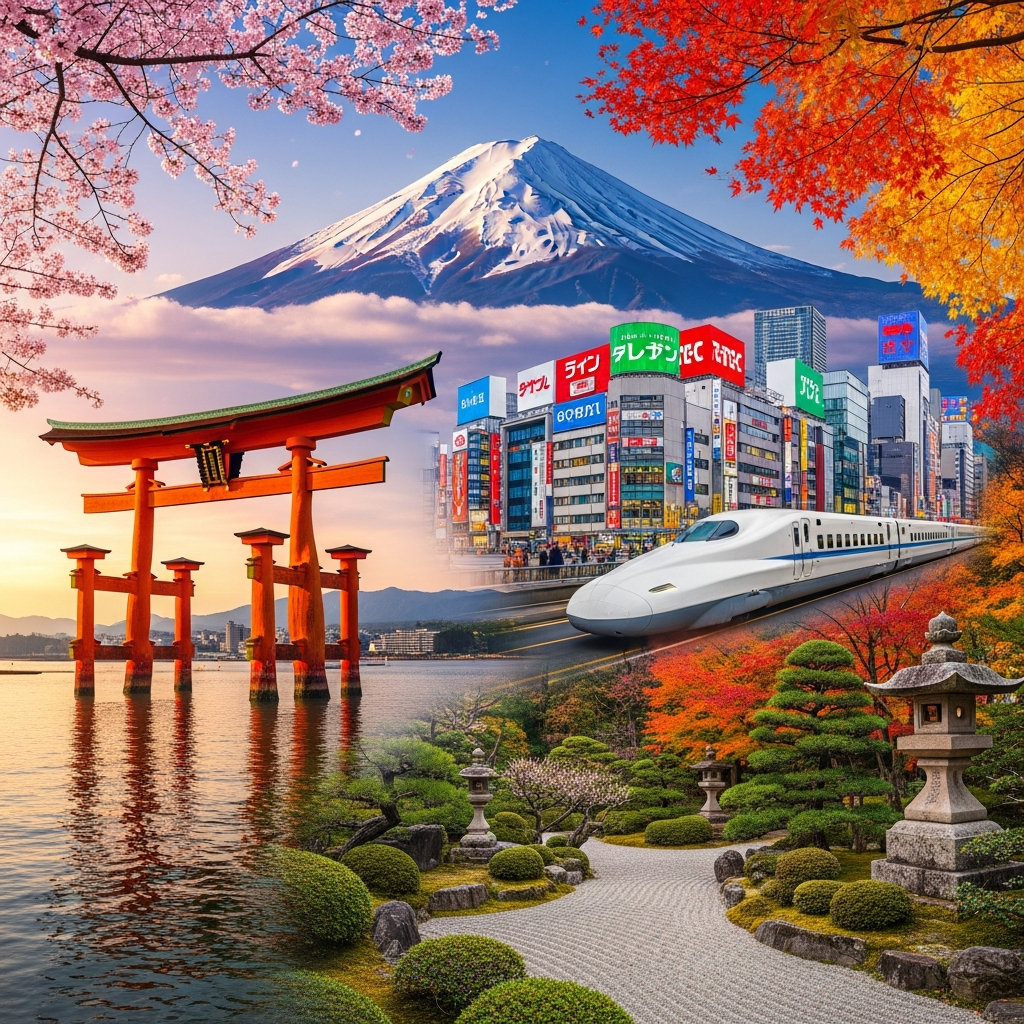
“imagegenerationprompt”: “A vibrant, panoramic view capturing the essence of Japan’s Golden Route. In the foreground, a traditional red torii gate (like Miyajima’s) partially submerged in water at high tide, with Mount Fuji visible in the distant background. In the midground, a bullet train (Shinkansen) streaks across a modern urban landscape with neon signs, contrasting with a serene, moss-covered temple garden. Lush cherry blossoms and autumn foliage frame the scene, suggesting seasonal beauty