
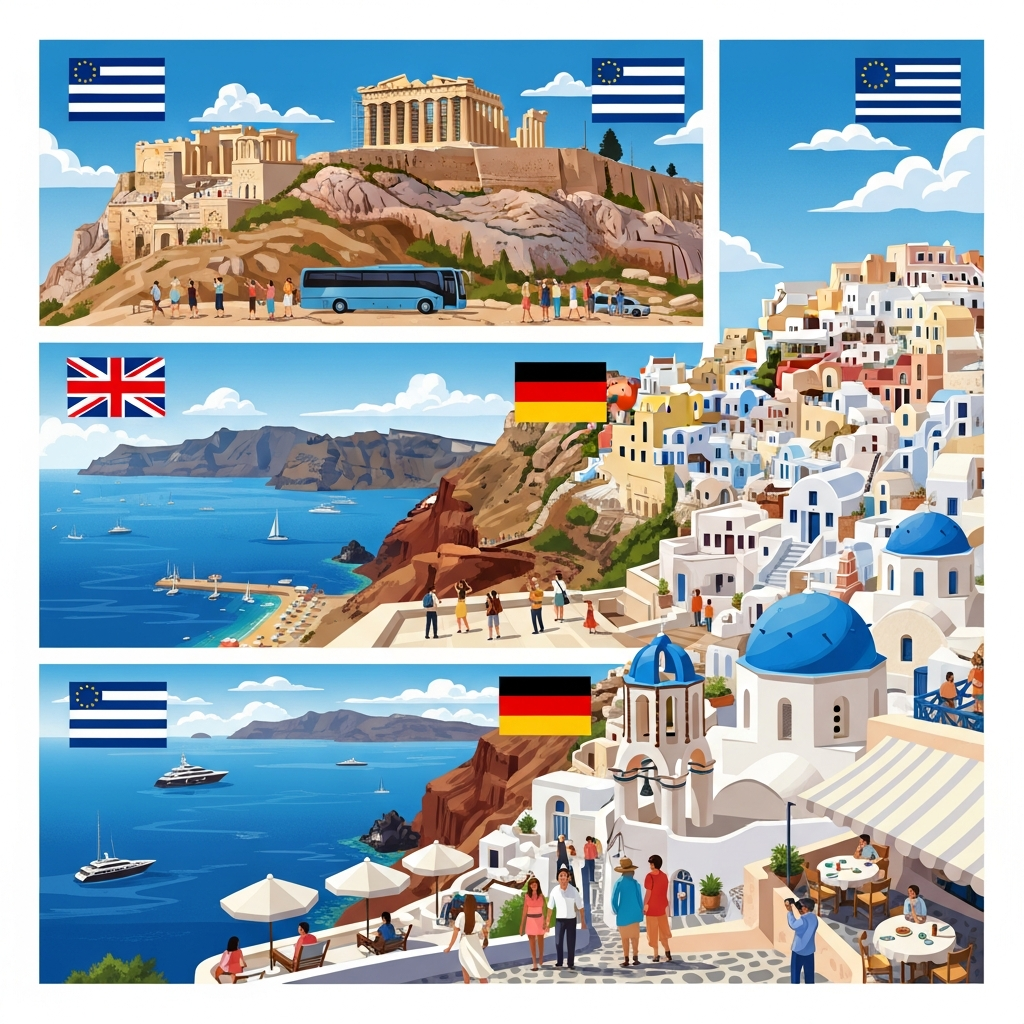

Greece solidified its reputation as a premier Mediterranean destination in 2025, experiencing an extraordinary year for tourism. This remarkable surge in international arrivals, significantly driven by visitors from Germany and the United Kingdom, delivered a substantial boost to the Greek economy. For anyone dreaming of a Mediterranean escape, understanding these travel trends is key to planning a rewarding Greek adventure. Greece’s appeal transcends its sun-drenched coastlines, offering rich history and vibrant culture, leading to record-shattering visitor numbers and reshaping European travel.
Greece’s Golden Era: Unprecedented Visitor Surge in 2025
In 2025, Greece emerged as Europe’s fastest-growing aviation and tourism hotspot. The nation welcomed an astounding over 31 million international air arrivals, marking a remarkable 22% year-over-year growth. This historic milestone shattered previous records, firmly establishing Greece as a dominant force in Mediterranean tourism. The impressive influx of visitors provided a robust foundation for economic growth, directly benefiting local businesses and communities across the country. Industry experts are projecting this golden era to continue, with approximately 38 million international visitors anticipated for both 2025 and 2026.
Strategic Pillars Fueling the Phenomenon
Several strategic factors converged to create this tourism success story. Enhanced flight capacities from major source markets, highly competitive pricing, and favorable exchange rates all played crucial roles. Targeted marketing campaigns also amplified Greece’s global appeal. Airlines and governments collaborated to boost accessibility, ensuring Greece offered both exceptional value and unforgettable experiences. This concerted effort positioned Greece as a top Mediterranean gateway for both leisure and cultural tourism, attracting a diverse range of global travelers.
Moreover, the tourism sector globally has shown remarkable resilience. Despite geopolitical tensions and rising fuel costs, the innate human desire to travel persists, with holidaymakers often shifting destinations rather than canceling plans entirely. This underlying resilience has significantly benefited Greece, reinforcing its stability as a preferred destination.
Leading the Charge: Key Source Markets for Greek Tourism
While Greece’s allure is universal, specific international markets proved pivotal in driving its 2025 success. Germany emerged as the undeniable leader, closely followed by robust contributions from the United Kingdom, the United States, and other European powerhouses. Overall, German travelers often prioritize reliability and safety, increasingly opting for package tours that offer professional crisis management and enhanced financial security.
Germany: Greece’s Top Contributor
Germany cemented its position as Greece’s top source market in 2025, with German tourists accounting for a remarkable 8.1 million arrivals. This represented an impressive 31% increase from the previous year. Major German carriers like Lufthansa Group, Eurowings, Condor, and TUI fly Deutschland dramatically expanded their flight offerings. Lufthansa alone increased flight frequency from key German cities by 34%, ensuring abundant capacity to popular Greek islands such as Crete, Rhodes, and Santorini, alongside major hubs like Athens and Thessaloniki.
German travelers are drawn to Greece’s year-round sunshine, rich history, and convenient flight options. Their preference for island experiences, cultural exploration, and nature activities aligns perfectly with Greece’s diverse offerings. Strategic airline promotions and flexible booking options further incentivized this strong demand, making Greece a top choice for Central European leisure travel. Across all German-Greece routes, average load factors reached an impressive 89%.
The United Kingdom’s Significant Impact
The United Kingdom demonstrated an impressive surge in contributions to Greece’s tourism in 2025. British air arrivals experienced an over five percent increase, surpassing the growth rates seen from several traditional markets. The UK consistently sent 5.1 million visitors to Greece, making it a pivotal market. This growth was fueled by enhanced flight capacities from carriers like British Airways, easyJet, and Ryanair to destinations such as Athens, Crete, and Rhodes. Favorable exchange rates between the pound and the euro also incentivized British tourists, offering competitive pricing compared to other European destinations.
Corfu, a stunning Greek island, exemplifies this trend, experiencing an unprecedented tourism surge. Visitors from the UK, Germany, Italy, and France are key drivers, transforming Corfu into one of Greece’s most lucrative destinations. The island alone generated nearly €1 billion in tourism revenue in 2025, with accommodation services contributing €614 million. British Airways and easyJet have significantly boosted their services to Corfu, further increasing its accessibility and popularity, which also benefits major hospitality brands like Marriott and Domes Resorts.
Expanding Global Horizons: Contributions from Beyond Europe
Beyond the leading European nations, Greece’s global appeal attracted significant numbers from other key regions:
United States: The US market showed impressive growth, with approximately 847,000 American travelers visiting Greece in 2025, marking a 12% year-on-year increase. This surge points to a strong demand for high-value tourism, with premium cabins averaging 82% load factors. Expanded transatlantic flight networks from major US cities by airlines like Delta Air Lines, United Airlines, and Aegean Airlines facilitated this growth. American Airlines has even announced new seasonal services for March 2026, with US arrivals projected to hit 950,000 by year-end 2026.
France: France remained a consistent contributor, sending 1.98 million visitors to Greece in 2025. French travelers are particularly drawn to Greece’s cultural attractions, such as the Acropolis and Olympia, with frequent flights from major French hubs to Greek cities and islands maintaining stable demand.
Italy: Benefiting from geographical proximity, Italy contributed over 2 million visitors in 2025. Italian carriers maintained high-frequency routes to major Greek destinations, making it a dependable source market for beach holidays and cultural tours.
Turkey: Turkey emerged as a critical connector market, facilitating 4.8 million passengers to Greece in 2025, with a 9.3% annual increase in Turkish arrivals. Turkish Airlines and Pegasus Airlines operated extensive weekly frequencies, leveraging Istanbul’s dual-hub system. This aviation corridor now ranks as the Mediterranean’s third-busiest international route pairing, underscoring Turkey’s geographic advantage.
Israel: Israeli carriers transported 1.9 million passengers to Greece, maintaining year-round frequency despite regional challenges. Notably, Israeli tourists to Greece recorded the highest average spending per visitor, exceeding €1,400 per person.
Other European and Emerging Markets: Greece also saw a growing influx from Scandinavia, the Netherlands, Poland, and Eastern Europe, with an average annual growth of about 3%. Emerging markets like Russia, China, and the Middle East also showed a sharp rise in visitors, underscoring Greece’s broadening appeal. Emirates, for instance, boosted flights to Athens and Thessaloniki, providing crucial access from countries like the UAE, Saudi Arabia, and India.
Strategic Investments and Sustainable Growth: Shaping Greece’s Tourism Future
Greece’s impressive tourism performance is not accidental; it stems from concerted strategic investments and forward-thinking initiatives. The nation is balancing rapid expansion with a growing focus on sustainability.
Expanding Air Connectivity and Airline Strategies
To meet the booming demand, major airlines aggressively expanded their capacity to Greece by more than 28% in 2025. Carriers like Lufthansa Group, Ryanair, easyJet, Aegean Airlines, and Emirates ramped up operations. They deployed more fuel-efficient aircraft, which not only boosted capacity but also led to more competitive fares. Average ticket prices saw a 12-15% reduction from the previous year, making Greece more accessible to a wider audience. This has been particularly beneficial for budget-conscious travelers seeking affordable Greek adventures.
Modernizing Airport Infrastructure for Soaring Demand
To accommodate soaring passenger traffic, Greece significantly invested in its airport infrastructure. Total infrastructure investments amounted to €890 million between 2023-2025, aimed at modernizing terminals, expanding parking, and improving baggage systems across 14 airports. Athens International Airport (ATH) experienced a 6.1% growth, handling 28.2 million passengers in 2025. Regional gateways such as Rhodes-Diagoras (RHO) saw a stunning 40% growth in passenger traffic, largely fueled by German visitors.
Heraklion-Nikos Kazantzakis (HER) on Crete emerged as Greece’s second-busiest gateway, serving 8.7 million passengers, while Thessaloniki (SKG) also saw consistent increases. Further capacity expansion is anticipated with the partial opening of the new Kasteli Airport on Crete by late 2026, projected to add an impressive 15 million travelers to Greece’s annual capacity. To balance growth with sustainability, Athens Airport slots will be capped at 32 million passengers annually starting in 2027, encouraging regional airports to absorb future increases.
Diversifying Destinations and Embracing Sustainability
One of the most significant changes to Greece’s tourism landscape is the proactive diversification of arrivals. To mitigate overtourism in the capital, the Greek government has actively promoted lesser-known destinations. This strategic shift aims to reduce pressure on high-traffic areas like Athens and popular islands like Santorini, while simultaneously boosting tourism revenues across various islands and regional airports. The explosive growth experienced by secondary airports is a testament to the success of these government-led initiatives, including better air connectivity, upgraded infrastructure, and more direct flights to diverse regions.
Corfu provides a prime example of successful regional development, where tourism now accounts for a significant 36% of its total economic activity. However, rapid growth brings challenges such as increased traffic congestion and pressure on infrastructure. In response, local authorities are prioritizing sustainable development. Efforts include improving critical infrastructure like ports, water supply systems, and roads. There’s also a concerted push to extend the tourism season beyond peak summer months by promoting off-season activities such as hiking, cultural tours, and spa retreats. This strategy ensures a more relaxed experience for tourists and reduces strain on resources, aligning with a growing emphasis on eco-friendly and wellness tourism across Greece’s hospitality sector.
Planning Your Ultimate Greek Getaway in 2026: Expert Advice
For travelers looking to visit Greece in 2026, the booming market presents both opportunities and considerations. You can expect continued competitive prices, especially during the shoulder seasons (May-June, September-October). These periods offer pleasant weather, fewer crowds, and potentially lower costs for flights and accommodation. This is particularly relevant as average airfares on key routes increased by 8-12% in 2025 and are projected to rise by an additional 5-9% for summer 2026 peak-season bookings.
For those traveling from Germany, the United Kingdom, or the United States, booking flights 90-120 days in advance is essential. Capacity expansion on major routes means higher demand, particularly for popular destinations like Athens, Crete, Rhodes, and Santorini. Utilizing secondary airports such as Munich (MUC), Stuttgart (STR), and Cologne (CGN) can sometimes yield better fares. While Greek airports have undergone improvements, anticipate potential peak-season immigration delays. Moreover, embracing lesser-known regions offers more authentic and unique experiences as Greece’s tourism infrastructure continues to expand nationwide. Consider package tours for added reliability and peace of mind.
Frequently Asked Questions
What key factors fueled Greece’s record tourism success in 2025, and what are the projections for 2026?
Greece achieved record tourism numbers in 2025, welcoming over 31 million international air arrivals, driven by a 22% year-over-year increase. Key factors included aggressive airline capacity expansion (over 28% increase), significant airport infrastructure investments totaling €890 million, competitive pricing due to favorable exchange rates, and targeted marketing campaigns. Strategic government efforts to diversify destinations beyond Athens also boosted regional growth. Experts project this success will continue, with approximately 38 million international visitors anticipated for both 2025 and 2026, marking a golden era for Greek tourism.
Which Greek destinations are experiencing notable growth, and how is local infrastructure evolving to support this surge?
Beyond major hubs like Athens, popular islands such as Crete, Rhodes, and Santorini saw significant growth, with occupancy rates reaching up to 95% during peak season. Corfu, in particular, experienced an unprecedented surge, generating nearly €1 billion in tourism revenue in 2025, largely due to increased flights from the UK and Germany. To support this, Greece invested €890 million in airport modernization, expanding capacity at Athens International Airport and regional hubs. The new Kasteli Airport on Crete, partially opening by late 2026, will add 15 million annual capacity, while Athens Airport will cap slots from 2027 to encourage regional development and sustainability.
What should travelers prioritize when planning a trip to Greece in 2026 to ensure a rewarding experience?
Travelers planning a Greek holiday in 2026 should prioritize booking flights 90-120 days in advance, especially for popular destinations and peak season, as airfares are projected to rise. Consider visiting during the shoulder seasons (May-June, September-October) for potentially lower prices, fewer crowds, and pleasant weather. Exploring secondary airports for better fares and embracing lesser-known regions offers more authentic experiences and helps support sustainable tourism. Additionally, travelers should be mindful of potential peak-season immigration delays and consider package tours for enhanced reliability.
Conclusion
The year 2025 marked a monumental moment for Greek tourism, firmly establishing the nation as a Mediterranean leader. With Germany leading the charge and the United Kingdom demonstrating remarkable growth, Greece’s appeal continues to broaden across global markets. Strategic investments in modern infrastructure, aggressive airline expansion, and a proactive approach to diversifying destinations have all contributed to this historic success. As Greece looks to 2026 and beyond, its commitment to delivering exceptional value, rich cultural experiences, and unparalleled hospitality firmly cements its position as a premier global travel destination. For both discerning visitors and the dynamic Greek tourism industry, the future indeed looks incredibly bright and sustainable.