
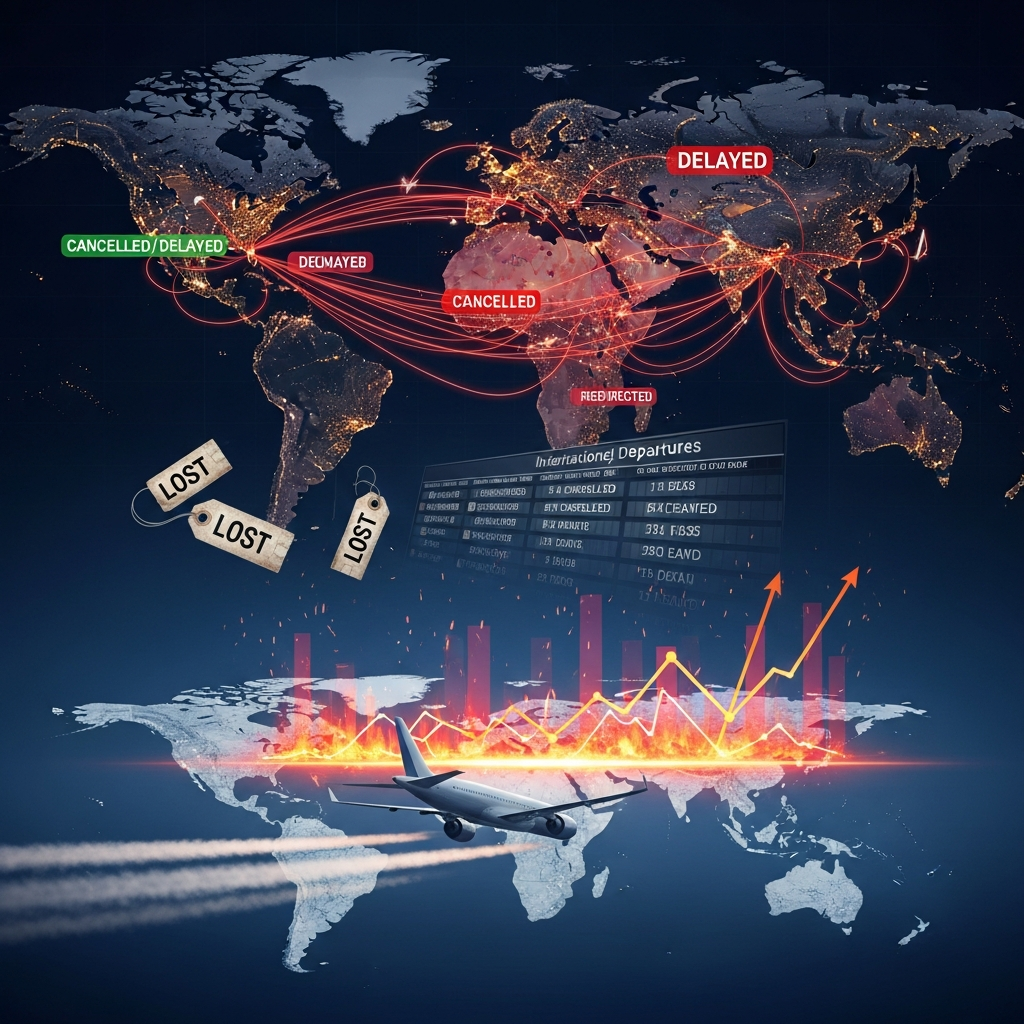

The escalating Middle East conflict has ignited a severe “global aviation crisis,” driving airfare prices sharply higher and threatening a widespread tourism downturn. This geopolitical instability is forcing airlines worldwide to hike fares, cut routes, and fundamentally rethink operations. Travelers face soaring costs, disruptions, and a volatile future for international mobility as the Middle East conflict creates unprecedented challenges across the travel sector.
The Geopolitical Fuse: Oil Prices & Global Markets
Strait of Hormuz: A Global Chokepoint Under Threat
At the heart of the crisis lies the Strait of Hormuz, the world’s most vital oil transit chokepoint. Any significant disruption here carries immense systemic risk. Iran’s reported blocking of this crucial maritime passage has sent shockwaves through energy markets. While approximately 4 million barrels per day (mb/d) can be rerouted through existing pipelines, a disruption beyond 10 mb/d would quickly overwhelm global strategic reserves and OPEC’s spare capacity. A prolonged closure, especially if flows are constrained beyond 15 mb/d, could see crude oil benchmarks surpass historical peaks.
Crude Oil Volatility: Repricing Risk in a New Era
The crude oil market has undergone a dramatic shift, transforming from low-volatility to a high-risk environment. March 2026 saw Brent and WTI crude post extraordinary gains, exceeding 25% in a single session. This was fueled by liquidity, hedging, and short-covering amid extreme uncertainty. Although a correction followed, prices did not fully retrace, signaling an embedded geopolitical risk premium. By March 19, Brent reached $113.08 per barrel, showing a market structurally repricing risk. Recent military actions, including U.S. and Israeli strikes on Iran and Iran’s retaliation in the UAE, further propelled oil prices upward by over 10%. Brent crude jumped to $82.37 per barrel, and West Texas Intermediate (WTI) climbed to $75.33 per barrel on March 1, 2026, marking significant peaks.
Aviation’s Perfect Storm: Costs Skyrocket, Capacity Shrinks
Jet Fuel Shockwaves: Airlines Face Unprecedented Pressure
The sustained oil price escalation is creating a structural cost shock for the aviation sector. Jet fuel, typically accounting for 25% to 35% of an airline’s total operating costs, is tracking crude prices upward. Reports indicate jet fuel prices skyrocketed from $90 to as much as $200 per barrel, reaching 94% higher than the annual average by late March. This severe compression of operating margins forces airlines into aggressive fare recalibrations and capacity rationalization. For a mid-sized airline, an extreme price surge could add US$700,000 to US$1,050,000 to daily costs, eroding profitability significantly.
Europe’s Airlines Adapt: Price Hikes and Strategic Shifts
Europe’s leading airlines are collectively warning passengers to brace for higher airfares. Airlines for Europe (A4E), representing 16 major airline groups including IAG (British Airways), Air France-KLM, and Lufthansa, confirmed this during talks in Brussels. While carriers had partially hedged against fuel price fluctuations, these protections are quickly unwinding, making cost absorption unsustainable. EasyJet’s chief executive, Kenton Jarvis, confirmed higher fares are inevitable. Ryanair CEO Michael O’Leary noted that prolonged fuel price increases would pose significant challenges. Paradoxically, the crisis presents a strategic opportunity for European long-haul carriers. With Gulf carrier hubs facing shutdowns, European airlines are adapting. Lufthansa added 40 flights to Asia, Air France-KLM boosted capacity to Asia and Africa, and British Airways announced new direct flights to Melbourne via Kuala Lumpur, specifically to bypass disrupted Middle Eastern airspace. However, Oxford Economics warns that nearly 28 million outbound trips from the Middle East to Europe are at risk, particularly impacting Turkey, France, and the UK. Mediterranean destinations like Spain, Portugal, and Greece might see some benefit.
ME3 and Asia: Epicenter of Disruption
The “ME3” – Emirates, Etihad Airways, and Qatar Airways – are particularly hard hit. Their business model relies heavily on Persian Gulf airspace as a central hub for long-haul connections. Airspace closures and airport damage, particularly in Doha, Dubai, and Abu Dhabi following strikes, have forced mass cancellations and rerouting. This creates four simultaneous shocks: mass cancellations, spiraling costs from detours, complex crew-management issues, and eroding passenger confidence. The ripple effect is global, as these airlines serve as major arteries connecting people worldwide.
Asian airline stocks plunged sharply following the conflict. Singapore Airlines’ shares dropped by 4.5%, canceling 16 flights on its Singapore-Dubai route. Qantas shares fell by 5.4%, Cathay Pacific by 2.8%, and Japan Airlines by 5.6%. Scoot also suspended flights to Jeddah, Saudi Arabia. If the conflict is prolonged, total losses for global aviation could exceed US$1 billion, potentially leading to permanent rerouting of flight networks and a shift in aviation power centers.
Global Ripple Effects: Travel Bans, Rerouting & Economic Strain
Country-Specific Impacts: North America, Europe, Asia Brace for Change
Across the globe, countries are feeling the pinch. In the United States, rising gasoline prices reduce discretionary spending on travel, impacting domestic road trips and leisure flights. Canada faces rising costs, affecting rural tourism. Germany’s travel ecosystem sees a dual shock: higher transportation costs and weakening economic momentum, leading to increased fares for Lufthansa and reduced international holidays. The United Kingdom expects higher ticket costs across all routes, reducing discretionary travel and potentially weakening inbound tourism to major cities like London. France’s tourism sector will see reduced international demand, though luxury tourism might show resilience.
South Korea, heavily dependent on Middle Eastern oil, faces sustained fuel pressure. China, despite strategic reserves, would likely see international airfare rise, shifting focus to domestic tourism. Both China and Vietnam are reportedly limiting fuel exports to safeguard domestic supplies. Japan’s near-total dependence on Middle Eastern oil makes it extremely vulnerable, with potential outbound travel collapse and weakened inbound tourism compounded by a weaker yen. India’s travel sector faces one of the most direct impacts due to its heavy reliance on Gulf routes, with airfares potentially surging and outbound tourism collapsing.
Australia’s Proactive Stance: Entry Restrictions & Travel Warnings
In response to escalating global instability, Australia has imposed temporary entry restrictions for visa holders through the Migration Amendment (2026 Measures No. 1) Act 2026. This new “arrival control determination” mechanism aims to prevent a surge in visa overstays. The UK Foreign Office has also issued extensive global travel warnings, specifically highlighting disruption from the Middle East conflict. These warnings caution against airspace closures, flight delays, and cancellations affecting numerous popular destinations, including Australia, Thailand, India, Singapore, Vietnam, New Zealand, Japan, Indonesia, Maldives, Cambodia, Fiji, and Nepal. Air New Zealand, for example, cut 5% of its flights (around 1,100, impacting over 44,000 passengers) from March to May due to the crisis.
Emergency Repatriation & Strategic Pivots
The ongoing instability has led to widespread airspace closures and flight disruptions, stranding thousands of travelers. Countries like Ireland, India, Canada, Germany, the UK, France, China, and Australia are coordinating emergency repatriation efforts with major airlines such as Lufthansa, Emirates, KLM, IndiGo, and Qantas. This collaboration includes travel advisories, rebooking options, temporary shelter, and charter flights, underscoring global cooperation in crisis management. The crisis also influences traveler behavior, prompting a shift towards closer-to-home destinations, with reports showing a 42% increase in bookings to Portugal within two weeks.
Japan’s Unexpected Resilience
Despite the broader global tensions, Japan demonstrated remarkable tourism resilience in February 2026. It saw a historic surge in international tourist arrivals, reaching 3,466,700 visitors, a 6.4% increase year-on-year. This occurred despite a sharp 45.2% decline in Chinese visitors due to escalating diplomatic tensions. Strong inflows from South Korea, Taiwan, Europe (UK, Germany, France), North America (US, Canada), and Australia bolstered overall growth, particularly during Lunar New Year celebrations. Japan’s government initiatives and cultural appeal continue to diversify its tourism base, providing a model for navigating geopolitical challenges.
Navigating the New Normal: Strategic Implications
The Call for Industry Support: Green Taxes & SAF Mandates
Airlines for Europe (A4E) bosses are urging European leaders to support the industry by cutting “green taxes.” They argue that EU airlines face a competitive disadvantage against non-EU carriers due to stringent regulatory obligations. The group emphasized that recent airspace shutdowns highlight the critical role EU airlines play in maintaining global connectivity. Furthermore, airlines called for amendments to the EU’s upcoming mandates for Sustainable Aviation Fuel (SAF), requesting a postponement of the minimum 0.7% blend of eSAF by 2030, citing its current unavailability. However, EU Transport Commissioner Apostolos Tzitzikostas indicated this request was unlikely to be granted, stressing that it’s the industry’s responsibility to invest in these fuels. This stance drew criticism from clean transport advocacy groups.
What Travelers Need to Know Now
The current geopolitical landscape signals a significant shift towards a structurally constrained outlook for the global travel sector. For travelers, this means anticipating higher costs, increased volatility in flight schedules, and the potential for last-minute policy changes. Flexible booking options and comprehensive travel insurance are more critical than ever. It is vital to meticulously check the latest travel advice for all countries, including transit points, and to seek updates directly from airlines and tour operators before departure. Monitoring local and international media for real-time information and subscribing to travel advice email alerts are also essential steps.
Frequently Asked Questions
How does the Middle East conflict specifically drive up global airfares?
The Middle East conflict directly impacts global airfares through a chain reaction. Escalating tensions, particularly around the Strait of Hormuz, drive crude oil prices significantly higher. As jet fuel is a direct derivative of crude oil and represents 25-35% of airline operating costs, its price surges dramatically. Airlines, facing these unprecedented cost increases and rapidly unwinding hedging protections, are forced to transfer these expenses to passengers through higher ticket prices. This cost pass-through is compounded by increased war-risk insurance premiums and longer routes due to airspace closures, further escalating operational expenses.
Which regions and airlines are most impacted by airspace closures and route changes?
The Middle Eastern airlines (ME3: Emirates, Etihad, Qatar Airways) are among the most severely affected, as their business model relies heavily on Persian Gulf airspace as a central hub. Closures and airport damages in Doha, Dubai, and Abu Dhabi have forced mass cancellations and significant rerouting. Asian carriers like Singapore Airlines, Qantas, Cathay Pacific, and Japan Airlines have also seen substantial stock plunges and flight adjustments due to their connections through the region. European airlines, while adapting routes and capacity, are also grappling with soaring fuel costs, with countries like the UK, Germany, and France facing reduced inbound and outbound tourism.
What can travelers do to mitigate the impact of rising costs and travel uncertainty?
Travelers can take several proactive steps to mitigate the impact of the global airfare surge and travel uncertainty. Firstly, book flights early to potentially secure better rates before further price increases. Secondly, opt for flexible booking options and consider travel insurance that covers geopolitical disruptions or cancellations. Regularly check travel advisories from government agencies for all destinations and transit points. Additionally, stay updated directly with airlines and tour operators. With a potential shift towards closer-to-home destinations, exploring alternative travel plans might also be a wise strategy to reduce costs and minimize exposure to volatile regions.
The global travel and tourism sector is undoubtedly at a critical juncture, facing structural challenges from persistent geopolitical tensions and energy insecurity. The ripple effects of Middle East instability are far-reaching, dictating not just airfare prices but the very patterns of international mobility. Resilience, adaptability, and international cooperation will be paramount for both travelers and industry stakeholders as they navigate this complex and evolving global landscape. The coming months will determine whether airlines can adapt swiftly enough to navigate this crisis, potentially leading to a permanent restructuring of global aviation, including new hubs, shifted corridors, and revised financial strategies to cope with long-term volatility.