

Finding the best digital nomad backpack is arguably the most critical equipment decision you will make before transitioning to a location-independent lifestyle. When your entire office, wardrobe, and life fit into a single piece of luggage, the margins for error are incredibly slim. If you choose a bag that is too small, you will find yourself constantly leaving essential gear behind. If you buy something too large, you will face hefty budget airline fees and chronic back pain.
I vividly remember my first major remote work trip to Thailand five years ago. I made the classic amateur mistake of bringing a 65-liter, top-loading hiking backpack. Every time I needed my laptop at a cafe, I had to dump my clothes, toiletries, and shoes onto the floor just to reach my tech sleeve. It was embarrassing, inefficient, and ultimately led me on a years-long quest to understand exactly what makes a travel bag functional for professionals on the move.
Quick Summary
Size matters most: The sweet spot for one-bag travel is between 35L and 40L. This maximizes packing space while remaining compliant with most international carry-on restrictions.
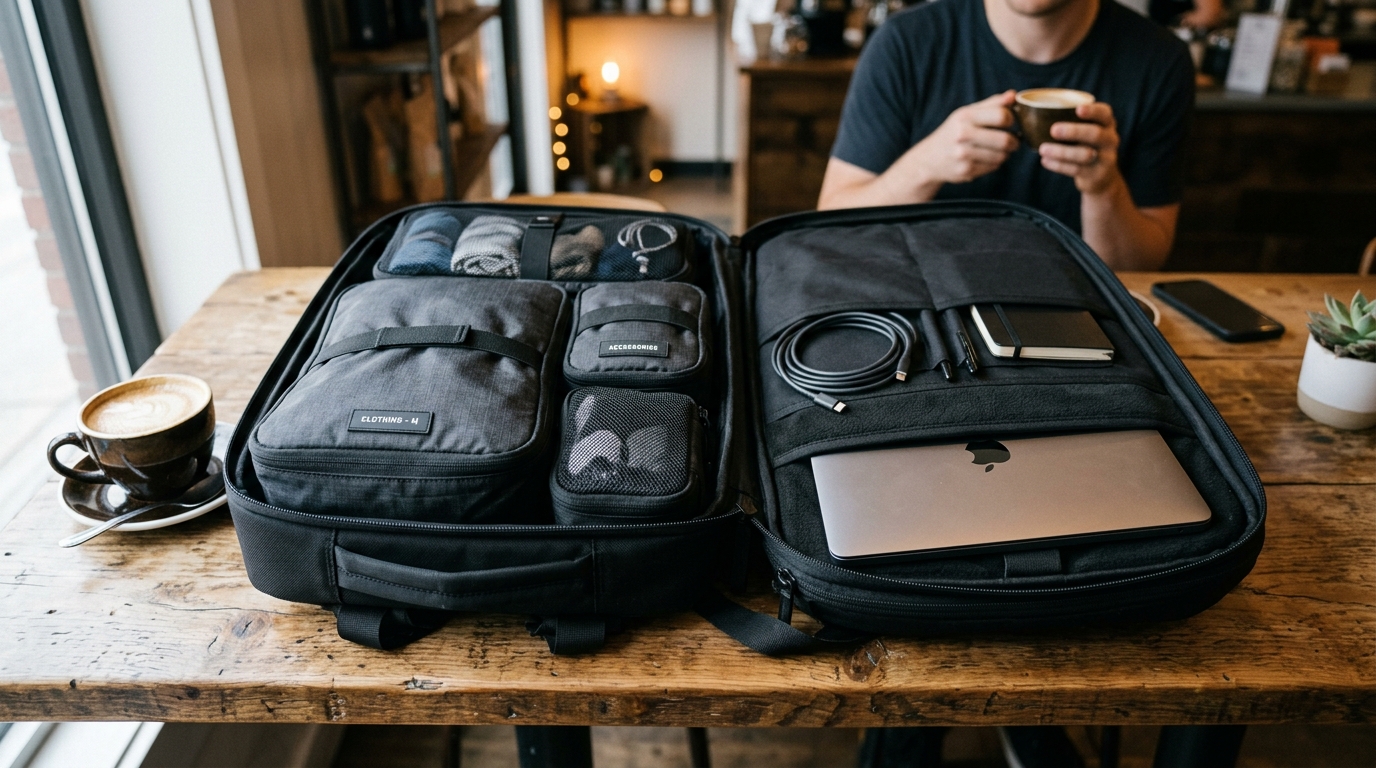
Clamshell access is non-negotiable: Choose a bag that opens flat like a suitcase to prevent you from digging blindly for your laptop chargers.
Prioritize a “false bottom” laptop sleeve: Your laptop must be suspended slightly above the actual bottom of the bag to prevent shattered screens when you drop your bag on concrete.
Watch the empty weight: Heavy-duty materials are great, but if the bag weighs 5 pounds empty, it eats into strict 7kg (15lb) international weight limits.
Expect to spend $150 to $300: This is the price floor for durable, weather-resistant materials and reliable YKK zippers that won’t fail during transit.
The Direct Answer: What You Need to Know Now
If you want the straightforward answer right away: The best digital nomad backpack is a 35-liter to 40-liter clamshell-style travel bag made from high-denier nylon or X-Pac material, featuring a dedicated, suspended tech compartment.
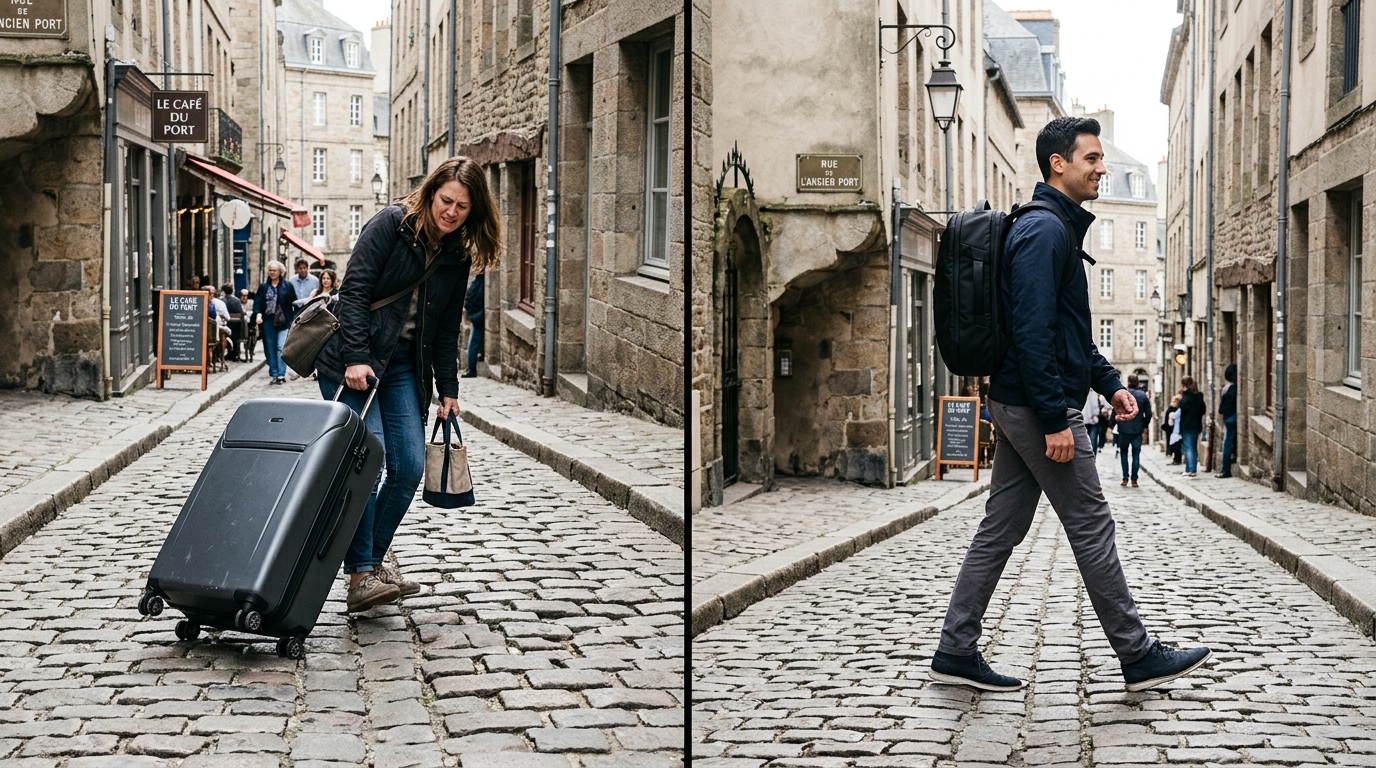
If you are traveling through Europe or Asia on strict budget airlines, you need to stay under 40 liters and target a bag weight of under 3.5 pounds empty. For most remote workers, the ideal setup involves a 35L main bag paired with a packable 15L daypack that you can deploy once you reach your destination. Do not buy a top-loading hiking bag, and do not buy a traditional rolling suitcase if you plan on visiting destinations with cobblestone streets or limited elevator access.
Why Standard Backpacks Fail Full-Time Travelers
When people first start researching travel gear, they often look in their closet, see a standard high school or college daypack, and think, “This will work fine.” It almost never does. Traditional backpacks lack the structural integrity required to carry 20 pounds of dense gear comfortably over long distances.
Standard bags usually lack load-bearing waist belts, sternum straps, and internal frame sheets. Furthermore, their fabric is rarely treated for sustained weather resistance. When I got caught in a sudden monsoon rainstorm in Hanoi, my standard canvas daypack soaked through in less than two minutes. The resulting panic to dry out my MacBook Pro cost me an entire day of productivity.
Digital nomad specific bags bridge the gap between technical hiking gear and professional urban briefcases. They utilize the ergonomic weight distribution of mountaineering equipment but strip away the dangling straps, bright neon colors, and excessive exterior webbing so you don’t look entirely out of place walking into a high-end coworking space in Tokyo.
Sizing: The 30L vs. 40L vs. 45L Debate
Choosing the right capacity is a delicate balancing act. Capacity is measured in liters, and your choice here determines everything from your wardrobe variety to your airline fees.
The 30L to 35L Category (The Minimalist)
Bags in this range usually measure around 19 x 13 x 7 inches. This is the realm of true minimalists.
If you travel exclusively in warm climates (requiring fewer heavy layers), do laundry once a week, and carry minimal tech (just a laptop and a phone), this size is perfect. The massive advantage here is that 30L bags can often pass as a “personal item” on strict airlines like Ryanair, Spirit, or EasyJet, allowing you to slide them completely under the seat in front of you.
The 40L Category (The Goldilocks Zone)
This is where most remote workers land. A 40L bag usually hits the exact maximum dimensions for standard overhead carry-on bins (22 x 14 x 9 inches).
At 40 liters, you can pack two pairs of shoes, five to seven days’ worth of clothing, a full tech pouch, a toiletry kit, and a light jacket. It gives you breathing room. However, you must be incredibly disciplined about weight. Even though a 40L bag fits the dimensional limits of an overhead bin, fully packed it can easily exceed the 7kg (15.4 lbs) weight limit enforced by carriers like AirAsia or Jetstar.
The 45L+ Category (The Overpacker)
Bags pushing 45 liters are tempting because they offer almost as much space as a traditional rolling suitcase. However, I strongly advise against them for extended nomadic travel.
Once a backpack exceeds 40 liters, it protrudes awkwardly from your back, shifting your center of gravity outward. This leads to severe shoulder fatigue and lower back pain. Additionally, a 45L bag looks massive on your shoulders, immediately drawing the attention of gate agents who will force you to put it into the sizing bin. If it doesn’t fit perfectly, you will be checking it for a $60+ fee at the gate.
Key Features That Actually Matter for Remote Workers
Not all travel bags are created equal. When evaluating your options, ignore the marketing jargon and look closely at these four critical elements.
1. The Clamshell Opening
If there is only one piece of advice you take from this guide, let it be this: only buy a bag that opens clamshell-style (also known as panel-loading). This means a zipper runs around three sides of the bag, allowing the front flap to open entirely like a suitcase.
Top-loading bags force you to pull everything out to reach an item at the bottom. Clamshell bags allow you to see all your gear at a glance, making packing and unpacking in tight hostel lockers or cramped Airbnb bedrooms significantly easier.
2. Dedicated, Suspended Laptop Compartment
Your laptop is your livelihood. A simple unpadded sleeve in the main compartment is unacceptable.
Look for an independent, padded laptop compartment located flush against the back panel (which keeps the heaviest item closest to your center of gravity). Crucially, check if it has a “false bottom.” A false bottom means the laptop sleeve stops an inch or two above the actual physical bottom of the bag. If you drop your bag onto a hard tile floor, the bottom of the bag hits the ground, but your laptop remains safely suspended in the air.
3. Advanced Ergonomics and Harness Systems
If you are carrying 20 pounds of gear, the shoulder straps alone are not enough.
You need load lifters—small straps at the top of the shoulder straps that pull the bag closer to your body, taking the pressure off the top of your shoulders. You need a sternum strap to keep the shoulder straps from splaying outward. Finally, for bags over 35 liters, a padded hip belt is essential. A properly fitted hip belt transfers up to 80% of the bag’s weight from your shoulders directly to your hips and legs.
4. Weather Resistance and Zippers
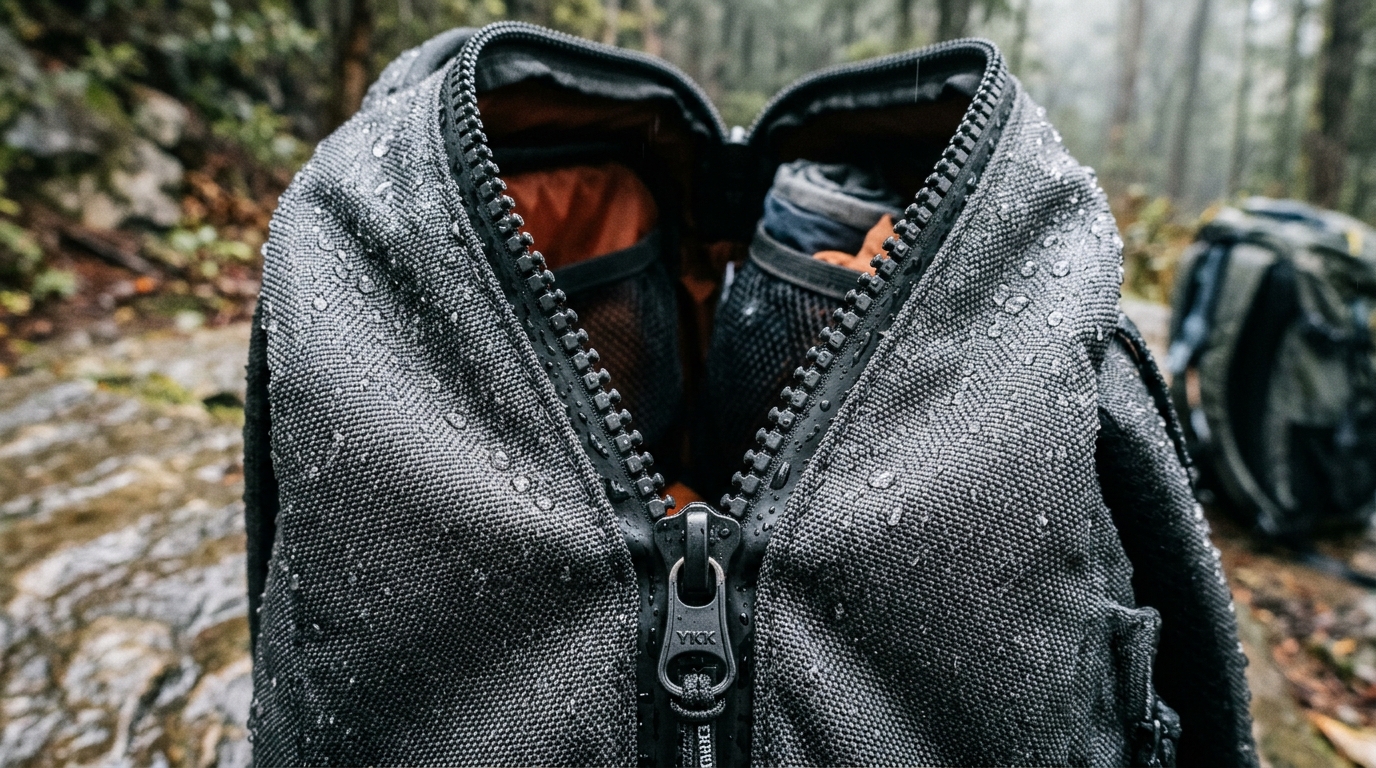
Most bag failures happen at the zippers. You should only consider bags that use genuine YKK brand zippers, specifically size #8 or #10 for the main compartments. Cheaper unbranded zippers will invariably split under the pressure of a tightly packed bag.
For weather resistance, look for materials coated in durable water repellent (DWR) or TPU. Additionally, YKK AquaGuard zippers feature a polyurethane coating that seals the zipper teeth, preventing water from seeping into the tech compartments.
Material Science: Which Fabric Should You Choose?
The fabric dictates how your bag will wear over time, how heavy it is, and how professional it looks. Here are the three most common materials in high-end travel bags.
1680D Ballistic Nylon: Originally developed for military flak jackets, this is incredibly durable and highly abrasion-resistant. It has a slightly shiny, professional appearance. The main downside is weight; it is a very heavy fabric.
1000D Cordura Nylon: A classic travel bag material. It has a rougher, matte, almost canvas-like texture. It scuffs slightly more easily than ballistic nylon but resists tearing exceptionally well. It is an excellent middle ground for weight and durability.
X-Pac (VX21 or VX42): This is a modern sailcloth material recognized by its subtle diamond grid pattern. It is fully waterproof, exceptionally light, and incredibly tear-resistant. The tradeoff? It is expensive, very rigid (it doesn’t stretch at all when you try to overpack), and produces a distinct “crinkly” sound when handled.
Who Should Use a Digital Nomad Backpack (And Who Should Not)
Despite the hype, the “one bag” backpack lifestyle isn’t universally perfect for everyone.
This is ideal for:
Remote workers who move locations frequently (every few days or weeks).
People traveling to regions with poor infrastructure, uneven sidewalks, or dirt roads (like Southeast Asia or South America).
Travelers wanting to avoid lost luggage anxiety and bypass baggage claim entirely.
Budget-conscious nomads looking to avoid restrictive airline checked bag fees.
You might want to skip this if:
You are a “slow nomad” who rents an apartment for 3 to 6 months at a time. If you move infrequently, the daily carrying convenience of a backpack matters less, and the massive volume of a large roller suitcase is far more practical.
You suffer from chronic back, shoulder, or knee pain. A 20-pound bag will aggravate existing injuries regardless of how good the harness system is.
You require substantial specialized equipment (e.g., professional drone pilots, videographers, or musicians) that simply will not fit in a 40L space.
Cost Comparison: Budget vs. Mid-Range vs. Premium
How much should you actually spend? While it is possible to travel with a $40 bag, the poor ergonomics and lack of protection often lead to ruined electronics or physical pain. Here is a realistic breakdown of the market.
Price TierPrice RangeExpected LifespanKey CharacteristicsPopular ExamplesBudget$50 – $1201 – 3 YearsBasic nylon, standard zippers, minimal laptop padding, generic back panels.Decathlon Forclaz 40L, Cabin Max BackpackMid-Range$150 – $2505 – 10 YearsBranded YKK zippers, 500D-1000D materials, false bottom tech sleeves, solid warranties.Aer Travel Pack 3, Osprey Farpoint 40Premium$250 – $400+LifetimeX-Pac or Ballistic Nylon, advanced suspension systems, bespoke hardware, lifetime guarantees.Peak Design Travel 45L, Goruck GR2, Tortuga Travel Pro
When evaluating price, I calculate “Cost Per Wear.” If you spend $300 on a premium bag and use it every single day for three years while traveling the world, the bag costs you roughly 27 cents per day. It is an investment in protecting thousands of dollars of tech equipment.
Common Mistakes to Avoid When Choosing Your Bag
Through personal trial and error, and talking to hundreds of remote workers, I see the same mistakes repeated constantly.
Mistake 1: Ignoring the Bag’s Empty Weight
Many premium bags are massively over-engineered. They feature thick foam padding, heavy metal buckles, and dense fabrics. This results in bags that weigh 4.5 to 5.5 pounds completely empty.
If you are flying an airline with a strict 7kg (15.4 lbs) limit, a 5-pound bag consumes one-third of your total weight allowance before you even pack a single t-shirt. Always check the empty weight specifications. Ideally, aim for a bag under 3.5 pounds.
Mistake 2: Buying “Just In Case” Capacity
It is human nature to buy a larger bag “just in case” you need to buy souvenirs or pack a heavy winter coat. This is a trap. If you have extra space, you will invariably fill it with useless items.
A larger bag becomes heavier, bulkier, and harder to maneuver. Instead, buy a strictly sized 35L bag and force yourself to curate your packing list. If you truly run out of space, buy a cheap $5 canvas tote bag at your destination for overflow items on travel days.
Mistake 3: Overlooking the “Professional” Aesthetic
Digital nomads often blur the lines between rugged travel and professional meetings. If you buy a bright orange, strappy hiking backpack, you will feel entirely out of place walking into a corporate client meeting or an upscale coworking facility in London or Tokyo. Opt for clean lines, subdued colors (black, navy, or olive), and stowable straps.
How to Pack Your Digital Nomad Bag Correctly
Even the best backpack in the world will feel terrible if packed poorly. Weight distribution is a science.
Always place your heaviest items (laptop, power banks, toiletry liquids, and shoes) as close to your spine as possible, and as low in the bag as possible. This lowers your center of gravity and prevents the bag from pulling backward against your shoulders.
Use packing cubes. I was highly skeptical of packing cubes at first, thinking they just added unnecessary weight. I was completely wrong. Packing cubes allow you to compress your clothing significantly and act as internal drawers. When you reach your Airbnb, you simply pull out the cubes and place them on a shelf—no unpacking required.
Frequently Asked Questions
Can I use a 40L or 45L bag as a “personal item” on airplanes?
Generally, no. A personal item must fit entirely under the seat in front of you. Most airlines restrict personal items to roughly 18 x 14 x 8 inches (about 25L to 30L). A 40L bag will almost always need to go in the overhead bin, meaning you must pay for a standard carry-on allowance. If you try to sneak a 40L bag as a personal item on budget carriers, you risk heavy fines at the gate.
Are waterproof zippers really necessary for travel?
They are highly recommended but not strictly required. While waterproof (AquaGuard) zippers prevent moisture ingress during light rain, no backpack with zippers is fully submersible. If you frequently travel in tropical, rainy environments like Southeast Asia during monsoon season, you should carry a lightweight, elastic rain cover regardless of how water-resistant your zippers claim to be.
How do I safely clean a premium travel backpack?
Never put a structured travel backpack in a washing machine, as the agitator can destroy the internal plastic frame sheets and ruin the water-repellent coatings. Instead, spot clean the bag using warm water, a mild non-detergent soap (like Dr. Bronner’s), and a soft-bristle brush. Let it air dry completely in a well-ventilated, shaded area to prevent mildew.
Should I use compression bags or regular packing cubes?
Regular packing cubes are generally better for digital nomads. Vacuum or heavy-duty compression bags shrink your clothes down, but they do not reduce weight. In fact, because they allow you to fit more items into the same space, travelers using compression bags frequently go over airline weight limits. Standard packing cubes provide organization without encouraging extreme overpacking.
Conclusion: The Final Verdict
Choosing the best digital nomad backpack is about finding the perfect intersection of capacity, durability, and comfort. Your bag is your mobile home, your office drawer, and your closet all rolled into one.
For the vast majority of remote workers, a clamshell-opening backpack between 35L and 40L, featuring a suspended laptop sleeve and high-quality YKK zippers, will absolutely transform the way you travel. Avoid the massive 45L+ behemoths, steer clear of top-loading hiking gear, and invest in a mid-range to premium bag that will protect your expensive electronics.
If you take the time to measure your torso, analyze your packing habits, and prioritize ergonomics over aesthetics, you will save yourself countless baggage fees, backaches, and travel frustrations on the road ahead.