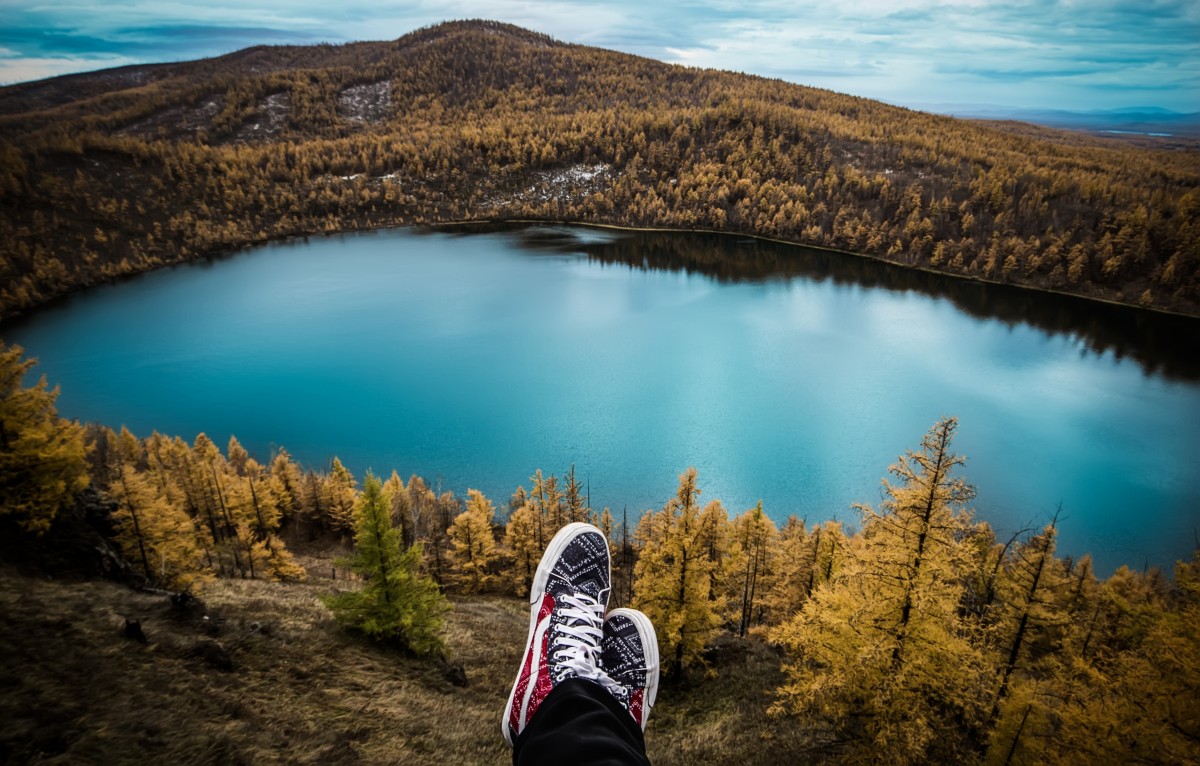
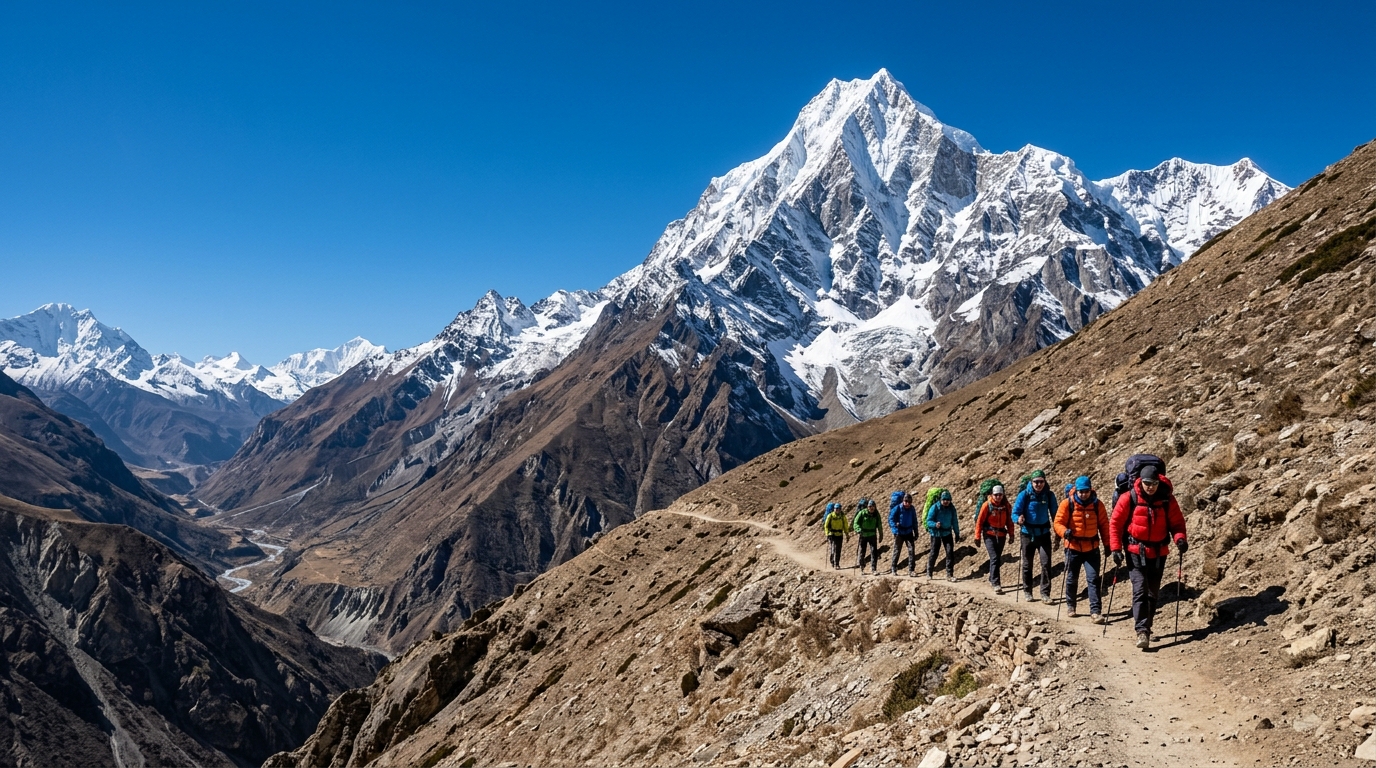

trekking the Annapurna circuit in october is widely considered the absolute pinnacle of Himalayan hiking, offering crystal-clear skies, stable weather, and a front-row seat to some of the world’s most dramatic alpine environments. After the summer monsoon washes away the atmospheric dust and haze, the autumn air turns incredibly crisp, revealing the jagged, snow-capped peaks of Annapurna I, Dhaulagiri, and Manaslu in staggering detail. However, this optimal weather window is not a well-kept secret. The trails swell with thousands of international hikers, transforming the quiet mountain paths into a highly social, fast-paced, and logistically demanding environment.
When I first attempted this route during peak season, I assumed I could just figure out the logistics on the fly. I was entirely wrong. Teahouses were turning hikers away by early afternoon, the temperature swings tested my gear to its limits, and the sheer altitude forced me to respect the mountain in ways I had not anticipated. If you are preparing to tackle this iconic 160 to 230-kilometer route, you need a strategy. This guide breaks down exactly what to expect from the terrain, the teahouse economy, and your own body during Nepal’s busiest trekking month.
Quick Summary
Weather is optimal but highly variable: Expect daytime temperatures of 15°C to 20°C in the lower valleys, but prepare for freezing nights (-10°C to -15°C) above 4,000 meters.
Trail conditions are highly stable: Dry paths heavily reduce the risk of landslides, avalanches, and mud that plague the route in summer and winter.
The teahouse rush is real: You must start trekking by 6:30 AM to secure a bed in the next village. Late arrivals often sleep on dining room floors.
Acclimatization is non-negotiable: Taking two nights in Manang (3,540m) is mandatory to prevent Acute Mountain Sickness (AMS) before attempting the pass.
Budgeting requires cash: Expect to spend $25 to $40 USD per day, with prices scaling upward alongside the elevation. ATMs do not exist on the upper trail.
Guides are crucial for logistics: Beyond navigation, a guide will pre-book your accommodations, shielding you from the daily stress of finding a bed.
Direct Answer: Should You Hike the Annapurna Circuit in October?
Yes, you absolutely should hike the Annapurna Circuit in October if your primary goal is guaranteed mountain visibility, dry trails, and an energetic, communal trekking environment. Because the monsoon has just retreated, the landscape is vibrantly green in the lower valleys, the air is devoid of dust, and the severe winter storms have not yet arrived to block the high passes. It is statistically the safest and most visually rewarding month to cross the formidable Thorong La Pass at 5,416 meters.
However, you must accept a major trade-off: you are exchanging wilderness solitude for weather reliability. If you want a quiet, introspective retreat where you will not see another soul for hours, October is the wrong choice. The trail is heavily trafficked, teahouses are loud and crowded, and the logistical competition for beds can cause daily anxiety if you are unguided. But if you want the quintessential, bustling Himalayan trekking experience with perfect photography conditions and the chance to share a yak-dung fire with hikers from twenty different countries, October is exactly when you need to be there.
Understanding the Weather and Temperature Extremes
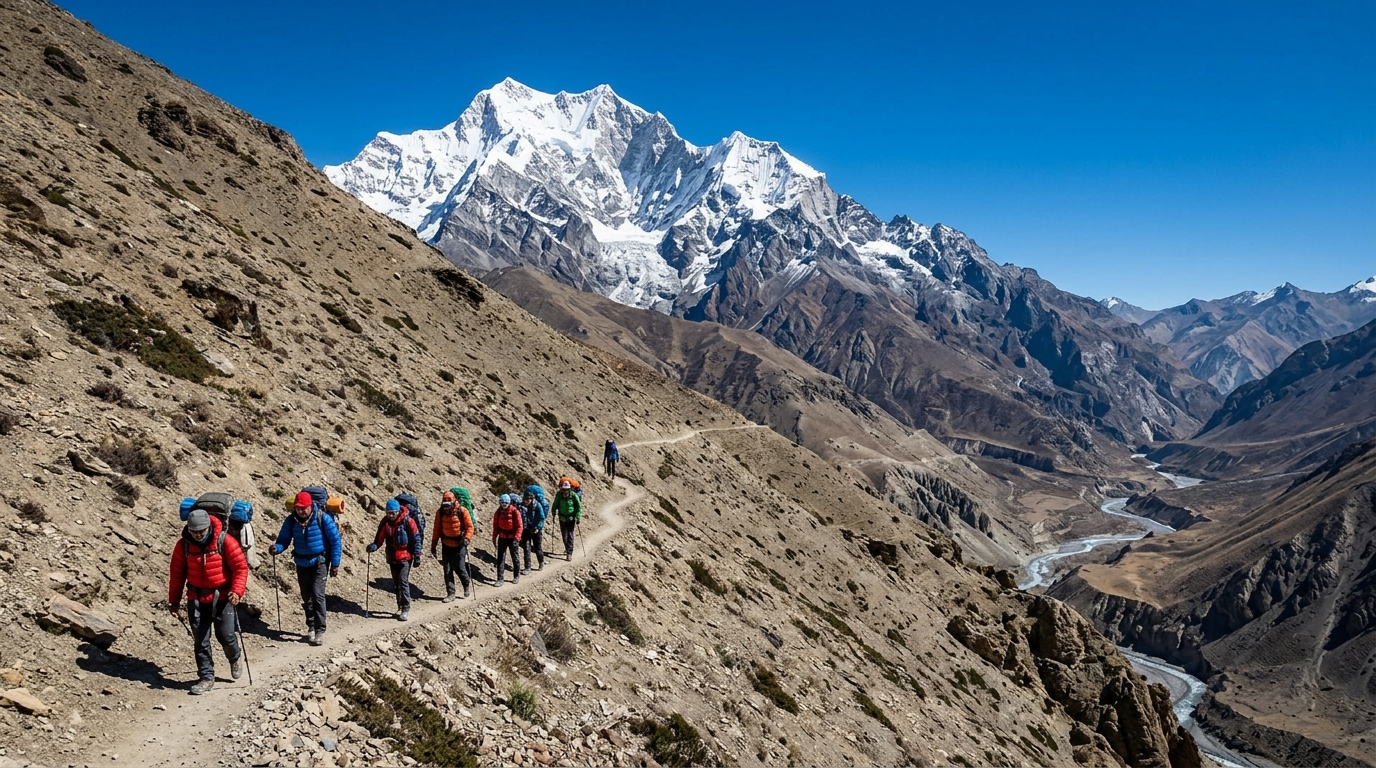
The defining characteristic of the Annapurna Circuit in October is the severity of its daily temperature swings. Because the barometric pressure is highly stable, you rarely have to worry about sudden, trip-ending snowstorms, but the daily thermometer readings require serious respect.
The Daytime Heat
In the lower regions, specifically when starting near Besisahar or Syange (around 800m to 1,500m), the daytime sun is intense. You will hike in shorts and a moisture-wicking t-shirt, sweating heavily as temperatures hover around 20°C to 25°C. Even as you ascend to mid-elevations like Chame (2,670m) or Pisang (3,300m), the direct alpine sun feels incredibly hot due to the thinning atmosphere. UV exposure is severe, and hikers routinely suffer from sunburned scalps and noses.
The Freezing Nights
The moment the sun dips behind the towering peaks—usually between 3:00 PM and 4:00 PM—the warmth vanishes instantly. I distinctly remember sitting outside a bakery in Manang; one minute I was applying SPF 50, and ten minutes later, I was shivering violently and sprinting to my room to grab a fleece and an 800-fill down jacket.
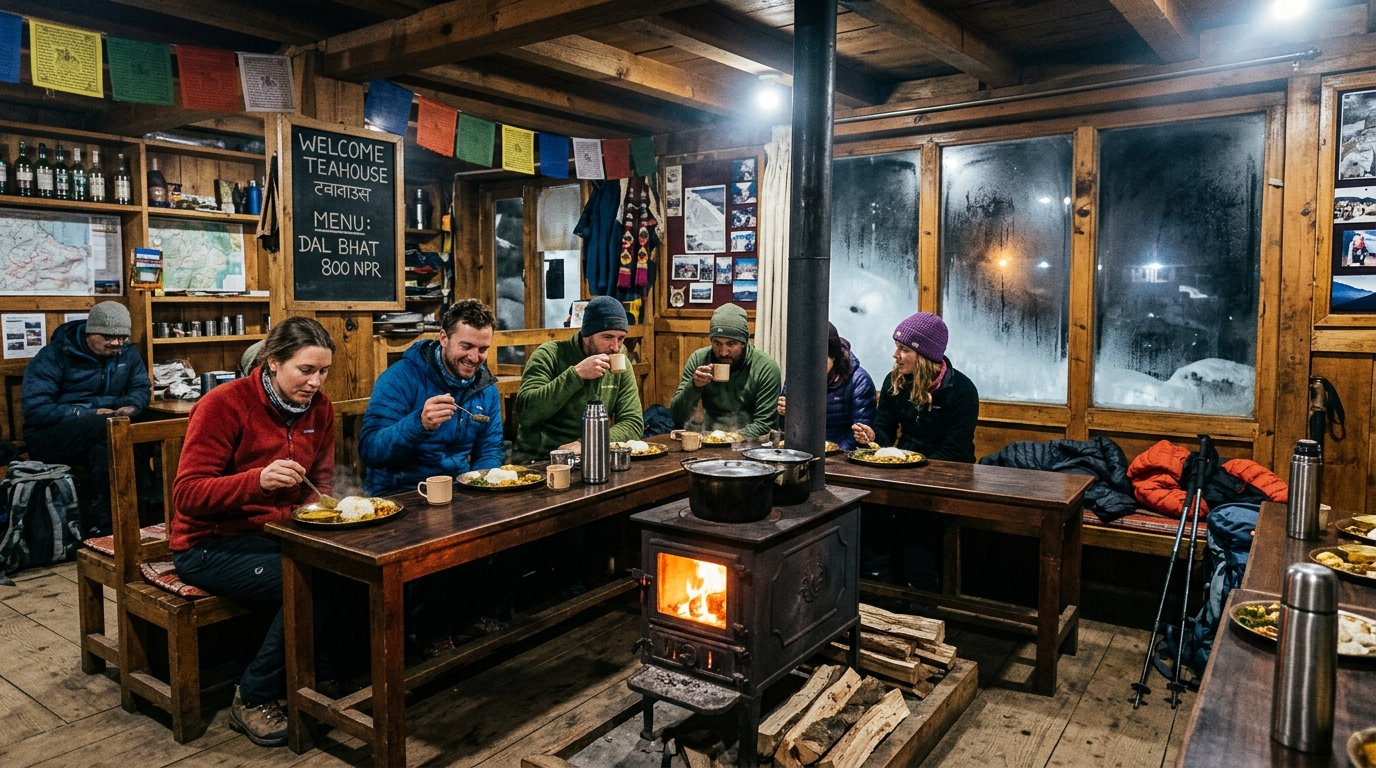
As you push higher to Yak Kharka (4,050m) and Thorong Phedi (4,450m), nighttime temperatures consistently plunge to between -5°C and -15°C. Teahouse bedrooms are simply uninsulated plywood boxes with thin glass windows. The only heat source is the central iron stove in the communal dining hall, and once the fire dies down at 8:30 PM, the indoor temperature perfectly matches the freezing air outside.
Navigating the Terrain: Jeep Tracks vs. The NATT
The physical trail is at its best in October. The monsoon rains of July and August have packed down the dirt, leaving firm, stable footpaths. Landslide zones, particularly the sketchy sections between Syange and Tal, are mostly dried out and significantly safer to cross.
However, we have to talk about the road. Over the last decade, the Nepalese government has carved a dusty, unpaved jeep track deep into the circuit, reaching all the way to Manang on the eastern side and Muktinath on the western side. Walking on this road is miserable. Jeeps rumble past, kicking up massive, choking clouds of fine dirt that get into your lungs, eyes, and camera lenses.
To preserve the trekking experience, local authorities created the NATT (New Annapurna Trekking Trails). These are alternative, hiker-only footpaths marked by red and white painted blazes. They route you off the jeep road, taking you higher up along ridges, through dense pine forests, and across suspension bridges. Finding and sticking to the NATT markers is vital for your sanity. Walking the road is a common mistake that ruins the experience for many uneducated trekkers.
The Teahouse Economy and Daily Budget
Trekking in Nepal is economically unique. While prices have risen steadily over the years, the Annapurna Circuit operates on a strictly regulated, community-based financial model. Here is a realistic breakdown of what you will spend during an October trek.
Permits and Fees
Before you step foot on the trail, you need proper documentation. There are multiple checkpoints along the route, and trekking without permits results in massive fines or expulsion from the conservation area.
| Item | Cost (USD) | Notes |
|---|---|---|
| ACAP Permit | $25 | Annapurna Conservation Area Project fee. Mandatory. |
| TIMS Card | $15 | Trekkers’ Information Management System. Mandatory. |
| Licensed Guide | $25 – $35/day | Nepal requires foreign trekkers to hire a licensed guide. |
| Porter | $20 – $25/day | Can carry up to 20kg, often shared between two trekkers. |
Accommodation and Food Scaling
Accommodation works on a reciprocal business model. The actual bed in a teahouse is incredibly cheap—often as low as $2 to $5 per night. However, the strict condition is that you must eat your dinner and breakfast at that specific lodge. If you sleep there but eat elsewhere, they will charge you a massive penalty fee for the room.
Food prices are set by local village committees and printed on identical menus. Because every grain of rice and bottle of gas must be carried up the mountain by mules or porters, prices scale exponentially with elevation.
Lower Elevations (Besisahar to Chame): $20 to $25 per day
Mid Elevations (Pisang to Manang): $25 to $30 per day
High Elevations (Yak Kharka to High Camp): $35 to $45 per day
To stretch your budget, follow the local mantra: “Dal Bhat Power 24 Hour.” Dal Bhat is the staple Nepalese meal consisting of lentil soup, rice, and vegetable curry. It is the only meal on the menu that comes with unlimited refills. Ordering a pizza at 4,000 meters will cost you $8 and leave you hungry; ordering Dal Bhat costs $6 and provides thousands of slow-burning calories.
The Strategic October Itinerary
While the total trek usually takes 12 to 16 days, success is determined entirely by how you manage the critical elevation gains in the middle of the route. You cannot rush this mountain. Below is the strategic progression required to cross the pass safely.
The Upper Route to Manang
When you leave the village of Pisang, the trail splits. You have two choices: the lower valley route or the upper route via Ghyaru and Ngawal. Take the upper route. It demands a brutal, lung-busting 400-meter vertical climb right out of the gate, but it rewards you with the most spectacular, sweeping views of the Annapurna massif on the entire trek. Furthermore, climbing to 3,600 meters and dropping back down to Manang perfectly aligns with the physiological rule of altitude acclimatization.
The Manang Standstill (3,540m)
Manang is a sprawling stone village that serves as the ultimate bottleneck for the circuit. You must spend a minimum of two nights here. This is not a suggestion; it is a medical necessity.
During your “rest day” in Manang, you cannot sit in a bakery eating apple pie all day. You need to “climb high, sleep low.” I highly recommend taking the grueling day hike up to the Ice Lake (4,600m). When I attempted this, the thin air made me feel like I was breathing through a crushed straw. By the time I reached the lake, my head pounded with a dull, rhythmic ache. But after descending back to Manang for the night, my body had triggered the necessary red blood cell production, making the subsequent days significantly easier.
The Push to Thorong Phedi and High Camp
Leaving Manang, the landscape changes drastically from pine forests to a harsh, arid alpine desert. You will trek to Yak Kharka (4,050m), then proceed to Thorong Phedi (4,450m). Thorong Phedi sits at the base of a massive rock wall.
Many trekkers choose to sleep at Thorong Phedi to avoid the extreme cold higher up. I did this, and it was a mistake. If your body is handling the altitude well, push the extra 45 minutes up a dangerously steep scree slope to High Camp (4,800m) and sleep there. Waking up at Thorong Phedi at 3:30 AM and having to climb that vertical wall in the freezing dark, running on a stomach full of dry porridge, is deeply miserable. Sleeping at High Camp shaves an hour off your summit day.
The Climax: Crossing Thorong La Pass
Thorong La Pass (5,416m) is the physical crux of the journey. In October, the pass is generally free of deep snow, making it vastly safer than in the spring or winter. However, the wind is a serious threat. By 10:00 AM, gale-force winds whip through the saddle, dropping the wind chill to dangerous levels and kicking up sharp ice particles.
You must leave High Camp by 4:30 AM, hiking by headlamp. The ascent is a slow, agonizing trudge. At 5,000 meters, there is roughly 50% less oxygen in the air than at sea level. Every step requires conscious effort. Reaching the summit—marked by a chaotic web of colorful prayer flags—is an emotional release.
But the day is only half over. You then face a brutal 1,600-meter descent to the temple town of Muktinath. This descent takes 4 to 5 hours and will absolutely shred your knees. Trekking poles are mandatory here.
Managing Acute Mountain Sickness (AMS)
No matter how many marathons you have run at sea level, altitude can drop you. During peak season, helicopters routinely evacuate incredibly fit hikers from Manang because they tried to ascend too quickly.
Listen to your body. A mild headache, fatigue, and slight shortness of breath are normal. However, severe nausea, vomiting, a staggering gait (ataxia), a resting heart rate over 110 BPM, or a wet cough are massive red flags. These are symptoms of High Altitude Cerebral Edema (HACE) or High Altitude Pulmonary Edema (HAPE), both of which are lethal. The only cure is immediate descent.
Many trekkers use Diamox (Acetazolamide) to accelerate acclimatization. Consult a travel clinic before your trip. Note that Diamox has side effects: it causes a strange tingling sensation in your fingers and toes, and acts as a powerful diuretic. Waking up three times a night to urinate in a freezing outhouse at 4,000 meters is an annoying, but necessary, reality of taking the drug.
Surviving Peak Season: Crowds and Culture
Trekking the Annapurna Circuit in October means sharing the trail with a massive, rolling community. Because the weather is flawless, lodges operate at 100% capacity.
If you are trekking without a guide, the daily routine becomes a race. You must hit the trail by 6:30 AM to ensure you arrive at the next village by 1:00 PM. If you arrive late, you will find every room booked. Teahouse owners will never turn a trekker out into the freezing night, but they will charge you to sleep on a wooden bench in the dining hall.
However, October also coincides with Dashain and Tihar, Nepal’s two largest national festivals. Trekking through the lower Gurung and Thakali villages during this time is culturally spectacular. You will see children flying kites, locals riding towering bamboo swings, and villages illuminated by oil lamps and candles during Tihar. The celebratory mood among the local porters and teahouse owners adds an incredible layer of warmth to the journey.
Who Should Trek the Annapurna Circuit (And Who Should Not)
Choosing this specific trek during this specific month requires an honest assessment of what you want out of a hiking experience.
This is ideal for:
Social and solo hikers: If you love meeting people, playing cards by the bhukhari fire, and sharing trail stories, the October crowds provide an incredible sense of community.
First-time high-altitude trekkers: The infrastructure in October is fully operational. If you get sick, there are clinics in Manang, and teahouses are frequent enough that you are never truly isolated in an emergency.
Photographers: The air clarity provides unparalleled opportunities for crisp, long-distance mountain photography without the haze of spring or the clouds of summer.
You might want to skip this if:
You seek absolute wilderness isolation: The trail is highly congested. You will constantly be passing or being passed by large groups, and teahouse dining halls are loud and packed.
You hate logistical stress: If the thought of racing other hikers for a bed causes you anxiety, and you refuse to hire a guide to manage bookings, October will frustrate you.
- You have strict time constraints: If you only have 10 days, forcing the circuit increases your risk of altitude sickness exponentially. Look into the shorter Annapurna Base Camp (ABC) trek instead.
- www.nepaltrekkingplanner.com
- nepalguidetreks.com
- www.acethehimalaya.com
- www.havenholidaysnepal.com
- nepalgatewaytrekking.com
- overlandtreknepal.com
- radianttreks.com
Common Mistakes to Avoid
Many trekkers sabotage their own trips through easily preventable errors. Do not make these mistakes.
Mistake 1: Carrying Too Much Weight
I packed like I was heading into the deep, unsupported wilderness. I brought three pairs of thick hiking pants, a massive solar charger, and a heavy hard-shell jacket. This was a critical error. You end up wearing the exact same clothes every single day. The sweat dries. Nobody cares what you smell like. Every extra kilogram on your back feels like ten kilograms above 4,000 meters. Bring one pair of trekking pants, two merino wool base layers, a fleece, a high-quality down jacket, and a lightweight rain shell. Keep your pack under 10 kilograms.
Mistake 2: Ignoring Hydration in the Cold
At high altitudes, the air is incredibly dry, and you lose significant moisture simply by breathing. You need to drink four to five liters of water a day to stave off altitude sickness. However, because the air is freezing, trekkers often avoid drinking water so they do not have to stop and pee in the cold. This leads directly to dehydration-induced AMS. Bring a high-capacity water filter (like a Katadyn BeFree or Sawyer Squeeze) so you do not have to buy expensive, environmentally damaging plastic bottles, and force yourself to drink.
Frequently Asked Questions
Do I need to hire a guide for the Annapurna Circuit in October?
Yes. The Nepal Tourism Board recently updated laws stating that foreign trekkers must hire a licensed guide. While checkpoint enforcement can occasionally be inconsistent, having a guide in October is highly recommended regardless of the law. They will call ahead to pre-book your teahouse rooms, entirely removing the daily anxiety of racing other trekkers for a bed.
How cold does it actually get at night?
While daytime lower-elevation temperatures reach 20°C, nighttime temperatures above 4,000 meters (Yak Kharka, Thorong Phedi) consistently drop to between -10°C and -15°C. Teahouse bedrooms have zero heating or insulation. You absolutely must bring a sleeping bag rated for at least -10°C (15°F), or you will suffer through sleepless, shivering nights.
Can I use credit cards or ATMs on the trail?
No. You must bring all the cash you need for the entire trek from Kathmandu or Pokhara. There is an ATM in Chame and another in Jomsom, but they are notoriously unreliable, often broken, or empty. Carry enough Nepalese Rupees to cover your daily budget ($30-$40/day), plus a $200 to $300 emergency buffer.
Is there cell service and Wi-Fi along the route?
Connectivity is surprisingly good. If you buy an Ncell or Nepal Telecom (NTC) SIM card in Kathmandu, you will have 4G data in major hubs like Chame, Pisang, and Manang. Wi-Fi is available at most teahouses for a small fee (around $2 to $3), but speeds crawl to a halt in the evening when fifty trekkers log on simultaneously.
Final Recommendations for Your Trek
Trekking the Annapurna Circuit in October is a monumental physical undertaking wrapped in a vibrant cultural experience. The reward for your burning lungs and aching knees is a front-row seat to the most dramatic, imposing landscapes on earth, bathed in perfect autumn sunlight.
To ensure your trip is a success, train your cardiovascular system heavily before arriving, keep your backpack as light as possible, and embrace the communal chaos of the teahouses. Do not let the new jeep roads deter you; simply use the NATT markers to stay on the alpine footpaths. Most importantly, respect the altitude. Take your rest days in Manang seriously, step out into the freezing pre-dawn air at High Camp with confidence, and enjoy every agonizing, spectacular step over Thorong La Pass.