
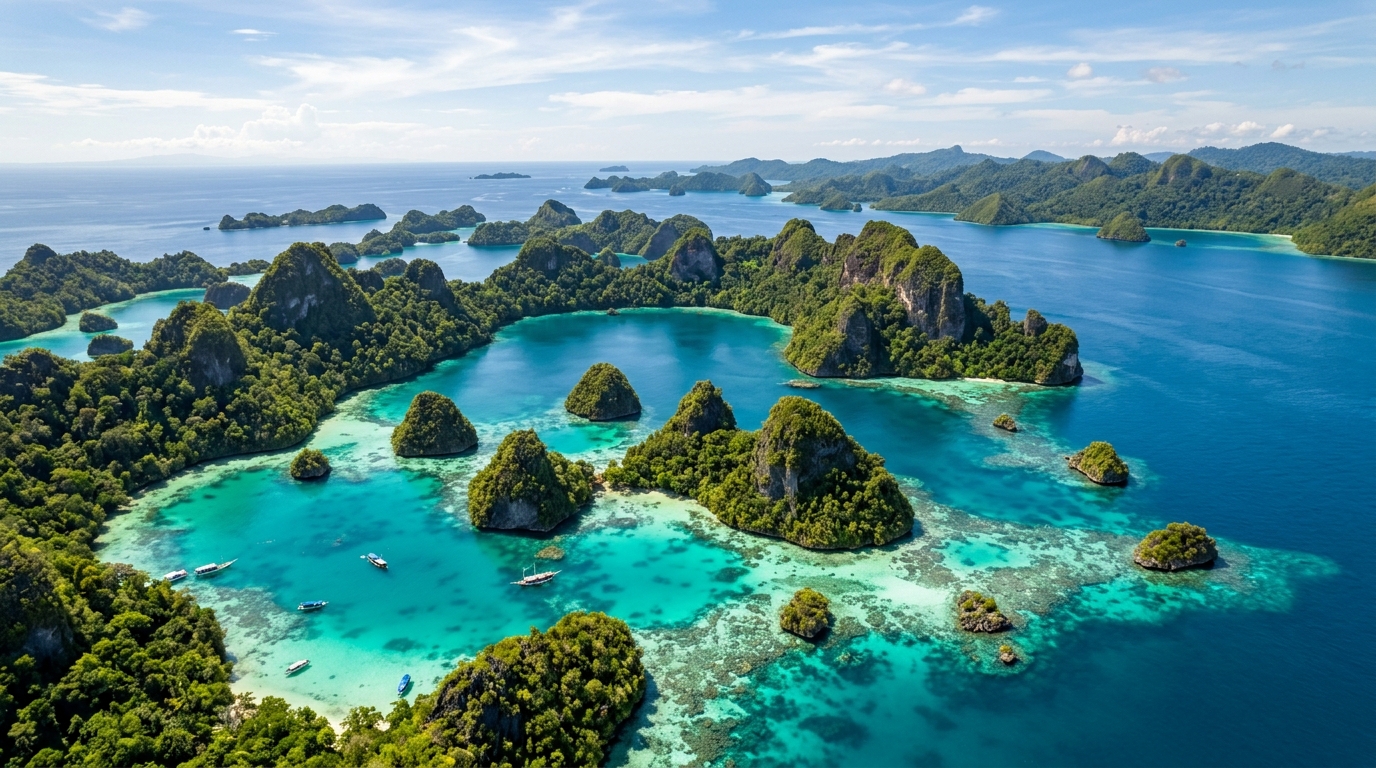

Every comprehensive Raja Ampat travel guide must begin with a stark, unavoidable reality check: getting to the far eastern edge of Indonesia is grueling, expensive, and completely worth the massive effort. Located off the coast of Southwest Papua, this sprawling archipelago of over 1,500 islands, cays, and shoals sits at the geographical heart of the Coral Triangle. Marine biologists routinely refer to this massive 4.9-million-acre protected zone as the most biodiverse marine environment on the planet.
When I first began researching my own expedition here, I assumed the transit would be similar to reaching the Gili Islands or Nusa Penida. I was entirely wrong. Raja Ampat strictly demands meticulous planning, a healthy travel budget, and a willingness to trade modern conveniences for raw ecological wonder. If you are reading this to make practical decisions about your upcoming trip, you need hard data on boat charters, cash management, and homestay realities. This guide bypasses the glossy social media aesthetics to deliver the exact logistical framework you need to survive and thrive in the “Four Kings” archipelago.
Quick Summary
Prime Travel Window: The dry season runs from September to April, offering the calmest seas and maximum underwater visibility for diving.
The Logistical Bottleneck: Reaching the islands requires flying into Sorong (SOQ), taking a two-hour public ferry to Waisai, and then chartering a highly expensive private speedboat to your final island accommodation.
Unmatched Biodiversity: The region is home to 75% of the world’s known coral species and over 6,000 distinct species of fish.
Cash is Mandatory: There is only one reliable ATM in the main town of Waisai, and island homestays absolutely do not accept credit cards.
Accommodations are Rustic: Unless you are paying $300+ per night for a luxury eco-resort, expect basic overwater huts with limited electricity (dusk to 11 PM only) and traditional bucket showers.
Mandatory Fees: Every independent traveler must pay a combined marine park and visitor fee of approximately 1,000,000 IDR ($61.50) upon arrival at Waisai harbor.
The Direct Answer: How to Approach Raja Ampat
If you want the absolute best way to experience this region without completely draining your savings, you must approach the logistics in a highly specific order. First, book a direct domestic flight to Domine Eduard Osok Airport (SOQ) in Sorong from a major hub like Jakarta, Bali, or Makassar. You must time your flight to align with the Waisai public ferry schedule, which strictly departs Sorong at 9:00 AM and 2:00 PM daily.
Once you arrive at Waisai (the capital of Waigeo island), you will pay your mandatory marine park fees. From here, your path entirely depends on your budget. For extreme luxury and privacy, you will take a private resort boat to Misool. For the budget-conscious traveler or dedicated scuba diver, you should arrange a shared speedboat to Kri Island, which serves as the backpacker and budget diving hub of the region. Expect to spend a minimum of $40 to $60 USD per day if staying in local Papuan homestays, or upwards of $350 USD per day for private eco-resorts. Do not plan a trip here for less than seven days; the transit alone will consume at least two full days of your itinerary.
The Logistical Reality: Getting to the Edge of the Earth
The most significant barrier to entry—and the primary reason Raja Ampat remains uncrowded—is the intense transit required to reach the outer islands. It is not an exaggeration to say that managing your transportation will be the most stressful part of your journey.
Surviving the Sorong to Waisai Ferry
After stepping off a red-eye flight into the suffocating humidity of Sorong, you must immediately secure transport (usually via the Grab app or local motorbike taxis) to the ferry harbor. The Bahari Express ferry is your only reliable option to cross the strait to Waigeo.
When I took this ferry, a local divemaster gave me a crucial tip that saved my sanity: always pay the extra $10 USD for the VIP class upgrade. The standard cabins are overwhelmingly crowded, loud, and poorly ventilated. The VIP section offers aggressive air conditioning, plush sofas, and a quiet environment that allows you to sleep off your jet lag during the two-hour crossing.
The Speedboat Bottleneck
Arriving in Waisai is only the halfway point. To reach the actual idyllic islands like Kri, Mansuar, or Arborek, you need a smaller boat. Public transit between these smaller islands is highly erratic and essentially non-existent for tourists on a schedule. You must charter a private speedboat.
Because all fuel must be shipped into the region, speedboat charters are astronomically expensive, often costing more than your flight from Jakarta. A one-way drop-off to Kri Island can cost over $50 USD, while a day-trip charter to remote viewpoints can exceed $240 USD. The smartest strategy is to coordinate with your homestay host weeks in advance so they can bundle your pickup with other arriving guests, effectively splitting the fuel costs.
Decoding the Geography: The “Four Kings”
The name Raja Ampat translates to the “Four Kings,” representing the four massive main islands of Waigeo, Batanta, Misool, and Salawati. However, the region actually consists of hundreds of smaller satellite islands where most of the tourism occurs. Understanding this geography is vital for organizing your itinerary.
Waigeo and the Dampier Strait (The Accessible Hub)
Waigeo is the largest island and the administrative capital. The dense cluster of islands just south of Waigeo—located in the famous Dampier Strait—is where 80% of independent travelers spend their time.
Kri Island is the undisputed capital of budget diving. It pioneered the homestay and eco-resort trend back in the 1990s. Today, it offers dozens of accommodations and budget-friendly dive shops like Soul Scuba Divers, where a single tank dive costs around 750,000 IDR (approx. $46 USD). Neighboring Mansuar offers larger village environments and basic medical clinics, while Arborek is a tiny, densely packed sandbank famous for its community-based tourism and authentic Papuan village atmosphere.
Misool (The Exclusive Sanctuary)
Located far to the south, Misool is a drastically different environment. It is geologically distinct, featuring massive, maze-like karst limestone formations, hidden sea caves, and stingless jellyfish lakes. Because it is incredibly remote, it caters almost exclusively to high-end luxury travelers. Resorts here, such as the famous Misool Eco Resort, command massive premiums but offer unparalleled privacy and access to private marine reserves. If you are an avid sea kayaker, the calm, crystal-clear southern lagoons of Misool are widely considered the best paddling waters on earth.
Diving and Snorkeling the Coral Triangle
No Raja Ampat travel guide is complete without a deep dive into the oceanic data. The sheer density of marine life here defies global expectations. To put it in perspective, the entire Caribbean Sea holds roughly 62 species of stony corals. Raja Ampat boasts over 550 species, representing a staggering 75% of the world’s total coral diversity.
High-Octane Scuba Diving
Make no mistake: diving here is generally not for absolute beginners. The geography creates intense funnels for ocean currents. Dive sites like Blue Magic, Mike’s Point, and Cape Kri frequently feature massive drift currents, sudden down-currents, and depths exceeding 20 meters (66 feet).
During a dive at Manta Ridge, we had to use reef hooks—essentially metal hooks attached to a line that you clip to your BCD—just to anchor ourselves to a rock while the current ripped past us. The payoff? We watched half a dozen oceanic manta rays with 15-foot wingspans hover effortlessly in the current above a cleaning station. Because of these conditions, an Advanced Open Water certification is heavily recommended for the premier sites.
World-Class Snorkeling
If you are not certified, you are not missing out. The coral reefs here grow remarkably close to the surface. Snorkelers floating just beneath the wooden piers at Arborek Jetty or the shallow house reefs of Kri Island will routinely encounter blacktip reef sharks, massive schools of fusiliers, entirely camouflaged wobbegong sharks, and green sea turtles. The snorkeling here easily rivals the deepest dives in other parts of the world.
Terrestrial Expeditions: Beyond the Reef
It is a massive mistake to view this destination solely as an underwater attraction. The rugged terrestrial environments hold endemic wildlife that you simply cannot see anywhere else on the planet.
The Mating Dance of the Birds of Paradise
Because the islands were historically cut off from major landmasses, they developed highly exclusive bird species. Waigeo and Batanta are the only places on earth where you can witness the Red Bird of Paradise and Wilson’s Bird of Paradise in the wild.
To see them, you must embrace exhaustion. You will wake up at 4:30 AM in total darkness, pay a local guide around 150,000 IDR ($9.25 USD), and hike deep into the humid jungle of Saporkren village. Standing in absolute silence as the sun rises, you can watch the brightly colored males clear a stage in the canopy and perform frantic, elaborate dances to attract females. It is a profound, National Geographic-level encounter.
Wayag vs. Piaynemo Viewpoints
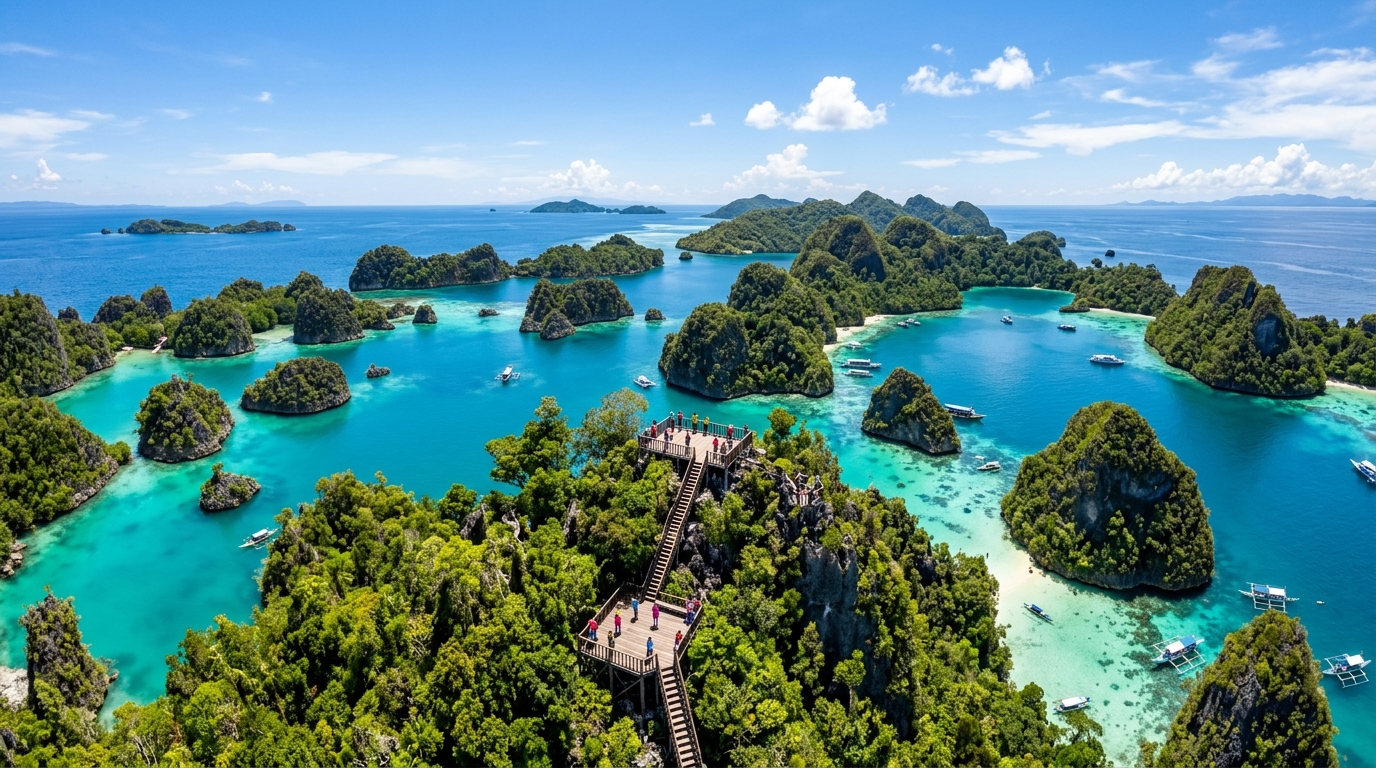
The iconic postcard image of Raja Ampat features a sprawling lagoon filled with emerald, mushroom-shaped islands. Most people assume this is one specific place. In reality, you face a major logistical trade-off between two different viewpoints: Wayag and Piaynemo.
Wayag Island offers the most expansive and famous view. However, it requires a punishing 6 to 8-hour round-trip speedboat ride from Waigeo across open ocean, and the boat charter can cost upwards of $246 USD.
Piaynemo, conversely, is the highly recommended alternative for budget and time-conscious travelers. Located much closer to the main islands, the boat ride is shorter and far cheaper. You still climb a massive wooden staircase to the summit, and the resulting panoramic view of the karst islands is equally striking.
Accommodation Reality Check: Homestays vs. Eco-Resorts
Your daily lifestyle in Raja Ampat will be entirely dictated by where you sleep. There are no massive, concrete hotel chains here. You are generally choosing between two extremes.
The Papuan Homestay Experience
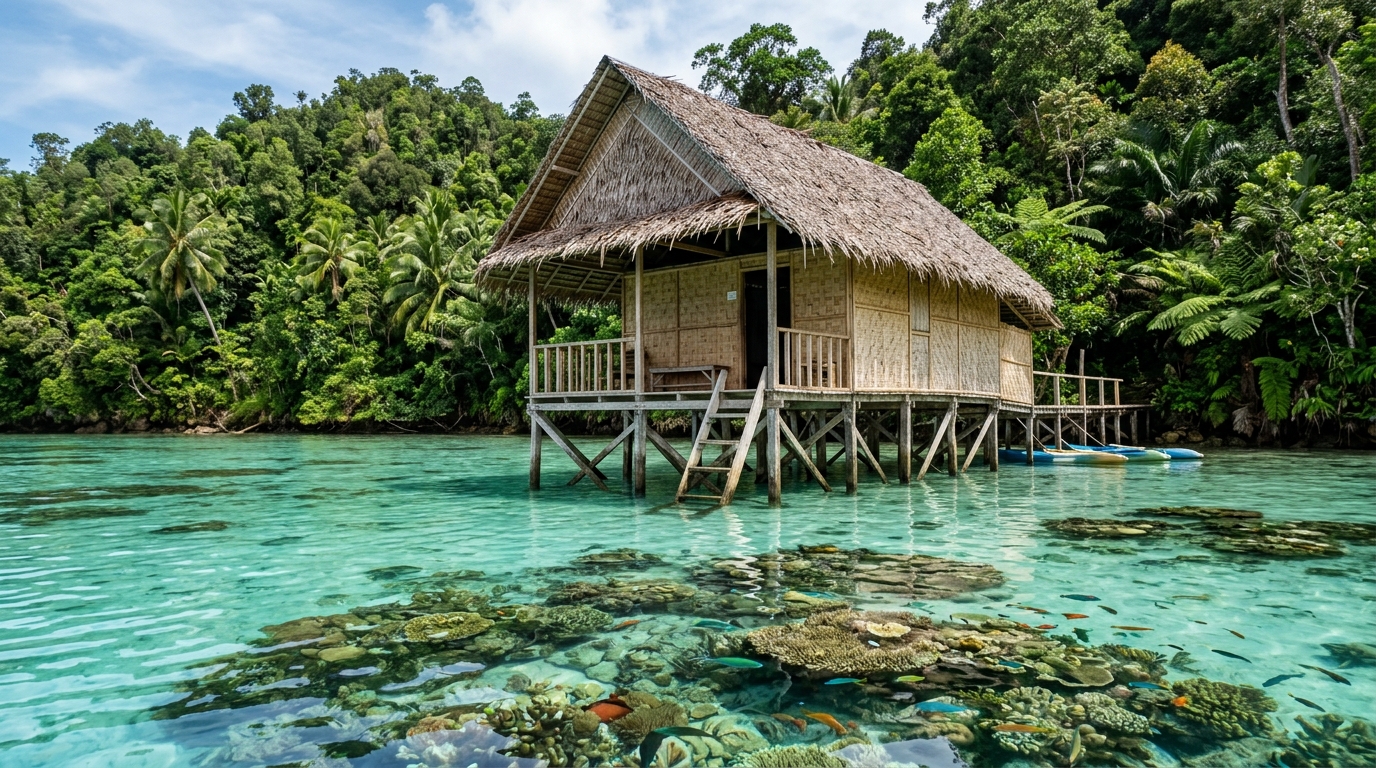
The term “budget” is highly relative in West Papua. A standard Papuan family-run homestay, bookable through the excellent Stay Raja Ampat portal, costs between 500,000 IDR ($31 USD) and 800,000 IDR ($49 USD) per person, per night.
These are entirely rustic. You will sleep on a thin mattress on the floor of a bamboo hut. You will use a traditional “mandi” (a bucket and scoop) for a shower, using cold, often slightly brackish water. Electricity relies entirely on diesel generators that only run from dusk until roughly 11:00 PM. This means you have exactly five hours to charge your camera batteries, and you will sleep with a small fan rather than air conditioning. The humidity is oppressive; my damp boardshorts never completely dried during my entire ten-day stay.
However, the value proposition is incredible. That $31 fee includes three massive meals a day—usually rice, locally grown vegetables, and fresh-caught fish—eaten communally with your Papuan host family.
The Private Eco-Resort Route
If the idea of a bucket shower terrifies you, you will need to spend heavily. Mid-range options like the Raja Ampat Biodiversity Nature Resort on Waigeo offer comfortable beds, attached bathrooms, and ceiling fans.
For actual luxury, places like Wai Resort (which maxes out at 14 guests) charge upwards of $312 USD per night. For this premium, you receive 24-hour electricity, private beachfront access, professional dive guides, and a deeply curated, hyper-exclusive digital detox.
Budget Breakdown and Mandatory Fees
Before you set foot on a boat, you must register at the Waisai harbor tourist center. Every visitor, regardless of nationality or travel style, must pay the Raja Ampat Marine Park Entry Permit (PIN) and a visitor fee.
Currently, this consists of a 700,000 IDR ($43 USD) marine park tariff and a 300,000 IDR ($18.50 USD) entry ticket. You will be given a physical plastic card or tag. You absolutely must keep this credential on your person or attached to your dive bag at all times. Marine patrols frequently approach tourist boats on the water; if you cannot produce your PIN, you will be heavily fined and forced to return to port.
A Realistic Daily Budget Scenario:
Accommodation & Food: $35 – $50 USD (Homestay)
Diving (2 tanks): $90 – $110 USD
Boat Transfer (Shared): $15 – $30 USD per day average
Miscellaneous (Snacks, Guide tips): $10 USD
Total Backpacker Daily Target: $150 – $200 USD per day.
Common Mistakes to Avoid
When traveling to a region this remote, minor logistical errors compound quickly into vacation-ruining disasters. Avoid these two massive pitfalls.
Mistake 1: Relying on ATMs and Credit Cards
I learned about the financial infrastructure of West Papua the hard way. I arrived with my credit card and a small handful of Indonesian Rupiah, assuming I could just find an ATM near my homestay. This was a catastrophic error. There is exactly one reliable ATM network, and it is located in Waisai town. Once you step onto the speedboat to head to Kri or Gam, plastic currency ceases to exist. Homestays do not have card readers, and you cannot Venmo boat captains. You must literally withdraw millions of physical Rupiah in Jakarta, Bali, or Sorong before you start your island hopping.
Mistake 2: Ignoring Foot Protection
The powder-white beaches are stunning, but the shallow waters hiding just offshore are treacherous. The sandy seabed near the homestays is frequently home to highly venomous stonefish, sharp sea urchins, and resting stingrays. Walking barefoot into the ocean to cool off is incredibly dangerous. You must pack and aggressively use hard-soled reef shoes or keep your diving fins on whenever your feet touch the ocean floor.
Who Should Visit Raja Ampat (And Who Should Not)
This archipelago is not a generic tropical getaway. It requires a specific mindset to enjoy.
This destination is ideal for:
Dedicated Scuba Divers: Especially those with Advanced Open Water certifications who want to experience the absolute peak of global coral biodiversity and intense drift dives.
Resilient Eco-Travelers: People who genuinely enjoy a digital detox, are comfortable with bucket showers, and want to support direct community-based tourism.
Wildlife Enthusiasts: Birdwatchers and photographers desperate to see endemic species like the Birds of Paradise and giant oceanic mantas.
You might want to skip this if:
You require modern luxury on a budget: You cannot get cheap luxury here like you can in Bali. If you want AC and infinity pools for $50 a night, go to Thailand.
You need high-speed internet: Wi-Fi is largely nonexistent at homestays. While the Telkomsel 4G cellular network reaches the main islands, it frequently drops out during storms.
- You suffer from severe seasickness: Moving between islands requires hours on small, open fiberglass speedboats battling rough, unpredictable ocean swells.
- www.timeout.com
- www.retirementtravelers.com
- www.lonelyplanet.com
Frequently Asked Questions
When is the exact best time to visit Raja Ampat?
The optimal travel window is the dry season, which runs from October to April. During these months, the wind drops, the ocean flattens out, and underwater visibility peaks. You should actively avoid July and August; heavy rains and severe winds frequently cause harbormasters to cancel all boat travel, effectively stranding you on your island.
Is malaria a serious concern in the islands?
Yes, the entire West Papua region is a recognized malarial zone. You should visit a travel clinic well before departure to secure prophylactic medications like Malarone. Furthermore, your best defense is physical: use DEET-based repellents heavily, wear long sleeves at dusk, and ensure your homestay mosquito net is tightly tucked under your mattress every single night.
Do I need to be an advanced scuba diver to enjoy the trip?
Absolutely not. While strong drift currents make the famous deep-water sites inaccessible to novices, the shallow-water snorkeling is world-class. Because the coral shelves grow right up to the island shores, snorkelers can easily swim with reef sharks, turtles, and massive schools of fish in three feet of water directly off their homestay porches.
How do I communicate with homestay owners to book boats?
WhatsApp is the absolute lifeblood of Indonesian logistics. Before you arrive, you should communicate via WhatsApp with your homestay host to arrange your specific speedboat pickup from Waisai harbor. Do not rely on emails, as internet connectivity on the islands is too weak to load heavy platforms consistently.
Final Recommendations for Your Journey
Executing a trip to the edge of the Coral Triangle is not for the faint of heart, but the rewards are historically profound. The 1,500 islands of Raja Ampat offer a rare glimpse into a pristine, unaltered ocean ecosystem that has largely vanished from the rest of the planet.
To ensure your trip succeeds, buffer your travel itinerary. Never book tight connecting flights on the same day as your ferry ride, as delays are a cultural guarantee in Papua. Withdraw your cash early, invest in reef-safe sun protection, and embrace the rusticity of the Papuan homestays. If you respect the local conservation rules and surrender to the slow, unpredictable rhythm of island transit, Raja Ampat will easily ruin every other dive destination on earth for you.