
Finding a reliable <a href="https://travelatlas.quantosei.com/2026/04/09/thailands-best-kept-secrets/" title="Off the Beaten Path thailand: 10 Best Kept Secrets”>isaan travel guide is the single most critical step if you want to experience a side of Thailand entirely untouched by mass commercialization. Most travelers flock to the crowded southern beaches or the digital nomad hubs of the north, completely bypassing the massive northeastern plateau that accounts for a third of the country’s landmass. Bordering Laos and Cambodia, Isaan is the agricultural heartland of Thailand, characterized by spicy, uncompromising food, towering ancient Khmer ruins, and rural landscapes where traditional life still dominates the daily rhythm.
Traveling here requires an adjustment in expectations. You will trade generic resort buffets for street-side stalls serving ferocious papaya salad, and you will swap packed tourist minivans for empty, winding roads passing endless rubber plantations and prehistoric archaeological sites.
Quick Summary
Rent your own wheels: Public transit between rural provinces is slow and sparse. A rental car is mandatory for an effective multi-province itinerary.
Time it right: The cool, dry months from November to February are optimal. The hot season (March to May) is physically punishing, and rainy season floods block access to key natural sights.
Prepare for heat and spice: Isaan food is the fiery backbone of Thai cuisine. The climate is similarly extreme, routinely exceeding 100°F (38°C) by April.
Cash remains king: Credit cards are useless outside major provincial capitals. You must carry small-denomination Thai Baht or possess a domestic bank account for PromptPay QR codes.
Zero English spoken: Outside of major hotel desks, English proficiency is essentially zero. Offline translation apps are an absolute necessity.
The Direct Answer: How to Actually Tackle Northeast Thailand
If you want to explore this massive region correctly, abandon the idea of seeing “all of Isaan” in a single week. The distances are simply too vast. To execute a proper trip, fly from Bangkok into either Udon Thani (UTH) in the north or Ubon Ratchathani (UBP) in the east. From there, rent a vehicle and commit to a focused, regional loop over 7 to 10 days.
Hiring a private driver for daily excursions from a single base city is cost-prohibitive and heavily restricts how far off the beaten path you can wander. By driving yourself, you unlock the rural spaces between cities—which is where the actual magic of the region lies. A highly recommended introductory route is the Northern Mekong Loop: starting in Udon Thani, driving north to Nong Khai to trace the Laos border, and pushing west into the mountainous Loei province. This specific triangle offers a heavy concentration of history, dramatic scenery, and excellent road conditions without forcing you into exhausting six-hour daily drives.
Why Isaan Feels Like an Entirely Different Country
To understand this region, look at its geography. Isaan is physically separated from central Thailand by the Phetchabun mountain range, creating a massive, elevated plateau. For centuries, this isolation meant the area developed its own distinct cultural identity, heavily borrowing from the ancient Khmer Empire to the south and the Lan Xang Kingdom (modern-day Laos) to the north.
When you step off the plane, the differences hit you immediately. The local dialect sounds much closer to Lao than standard Thai. The music, driven by the rhythmic, reedy sound of the khaen (a traditional bamboo mouth organ), blasts out of pickup trucks and rural night markets. The word “Isaan” itself derives from the ancient Sanskrit word Ishan, translating to the “northeast direction.”
I learned about the reality of Isaan logistics the hard way. During my first visit, I booked the cheaper local bus from Korat to Nong Khai, thinking I would save a few hundred baht and get a more “local” experience. Turns out, the three-hour delay waiting in the sweltering 100°F heat for a non-air-conditioned bus completely wrecked my itinerary. The pace of life here is incredibly slow, and attempting to rush it using underfunded public transit is a recipe for immense frustration.
The Northern Route: Udon Thani, Nong Khai, and Loei
If you prefer tracing the Mekong River and enjoying cooler mountain climates, focus your trip on the upper northeastern provinces.
Udon Thani: Sights and Prehistoric Mysteries
Udon Thani serves as the perfect gateway. It is a major commercial hub where you can easily secure a rental car and stock up on supplies.
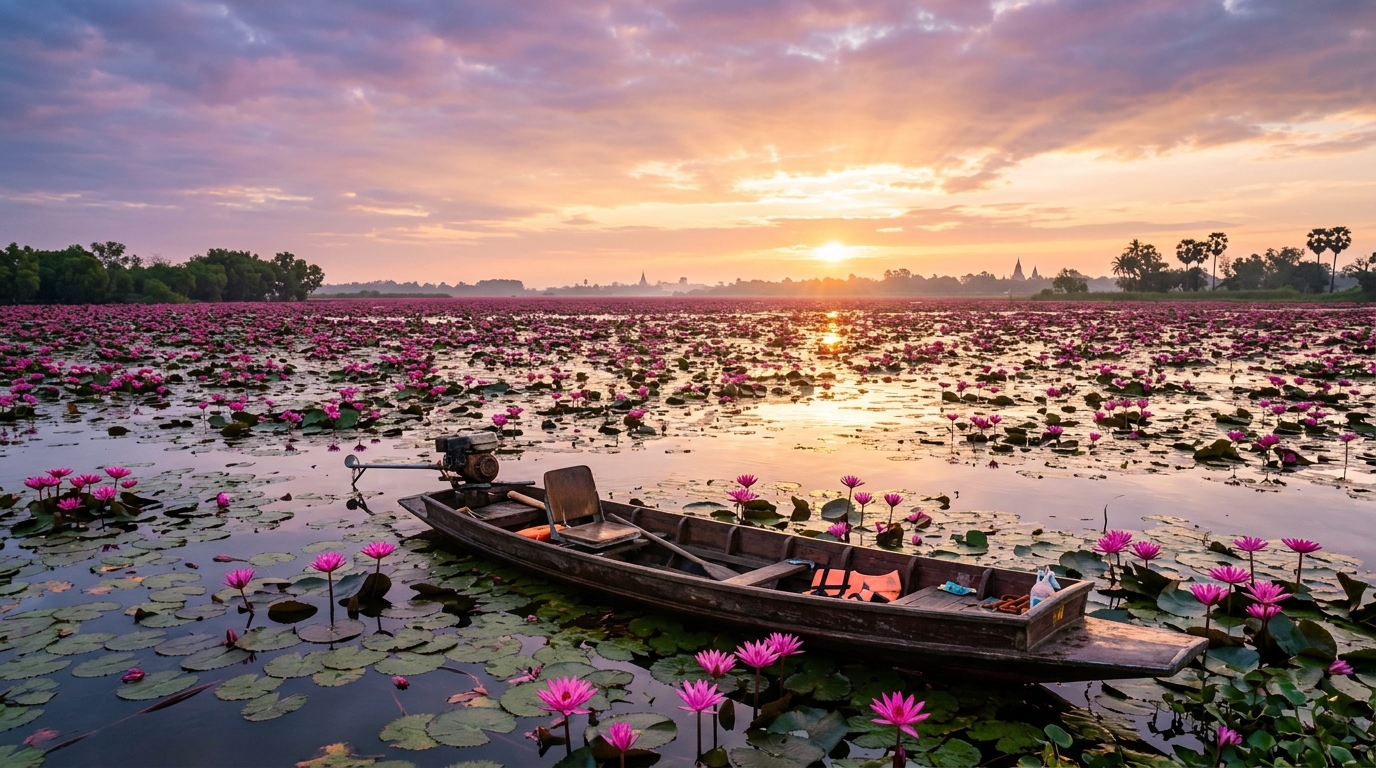
If you are visiting between December and February, you must wake up before dawn to visit the Red Lotus Sea (Talay Bua Daeng). Located just south of the city, this sprawling lake erupts into millions of pink lotus blooms during the cool season. You can hire a small wooden boat for about 500 THB ($14 USD) to glide through the flowers as the sun breaks over the horizon. The flowers close tightly by 10:00 AM as the heat rises, making early arrival mandatory.
Further out, history enthusiasts should drive an hour outside the city to Phu Phra Bat Historical Park. This site features massive, bizarre rock formations estimated to be 3,000 years old. Initially carved by ancient river erosion, these sandstone pillars were later modified by ancient religious groups into shrines and meditation chambers.
Nong Khai: Riverside Surrealism
Driving one hour north from Udon Thani brings you to Nong Khai, a relaxed town sitting directly on the Mekong River, looking straight across the water at Laos.
The absolute standout attraction here is Sala Kaew Ku. Built in 1978 by the eccentric mystic Bunleua Sulilat, this sprawling sculpture park features hundreds of towering, imaginative concrete statues. The park blends Hindu and Buddhist imagery into slightly intimidating scenes, culminating in a massive, multi-story Buddha sheltered by a terrifying seven-headed Naga serpent. Afterward, grab dinner at Macky’s Riverside Kitchen, an excellent local spot right on the water.
Loei and Chiang Khan: The Mountain Retreat
Pushing west brings you to Loei province, a mountainous area famous for its dramatic highland national parks. If you enjoy hiking, Phu Kradueng National Park is a legendary bucket-list destination for Thai locals. The challenging trek to the summit reveals a broad sandstone plateau dotted with pine woodlands and waterfalls. (Note: The park is strictly closed from June to September to allow the ecosystem to recover from the dry season).
Further north in Loei lies Chiang Khan, a highly photogenic, slow-paced wooden town right on the Mekong. It is famous for its riverside cycling, evening street food markets, and the traditional morning offering of alms to local monks as the sun rises.
The Eastern Route: Ubon Ratchathani’s Natural Wonders
For a different flavor of Isaan, fly into Ubon Ratchathani (often just called Ubon). This city sits at the far eastern edge of the country and serves as a basecamp for some of Thailand’s most dramatic geological formations.
If you base yourself in Ubon or at a nearby boutique property like Kaysorn Siri Resort, you have access to incredible day trips. A 90-minute drive east brings you to Pha Taem National Park. Situated directly on the cliff edges overlooking the Mekong River and Laos, this park is famous for housing 3,000-year-old prehistoric cliff paintings. Because of its extreme eastern location, it is geographically the very first spot in Thailand to see the sunrise every morning.
In the late afternoon, head to Wat Sirindhorn Wararam Phu Prao (Wat Phu Prao). This hilltop Lanna-style temple sits near the Laos border. Its standout feature is a magnificent “Tree of Life” mural carved into the rear facade that actually glows in the dark after the sun sets.
During the dry season (January and February), you can drive out to Sam Phan Bok, heavily marketed as the “Grand Canyon of Thailand.” This dramatic rock formation along the Mekong River translates to “three thousand holes,” featuring bizarre, eroded craters. You can only view this in the dry season; during the rainy months, the entire site is completely submerged under the river.
The Southern Route: The Ancient Khmer Highway
Long before modern borders existed, the lower portion of Isaan was a vital artery of the ancient Khmer Empire. Consequently, the region is littered with 11th and 12th-century stone temples that predate Cambodia’s famous Angkor Wat.
Korat and Phimai
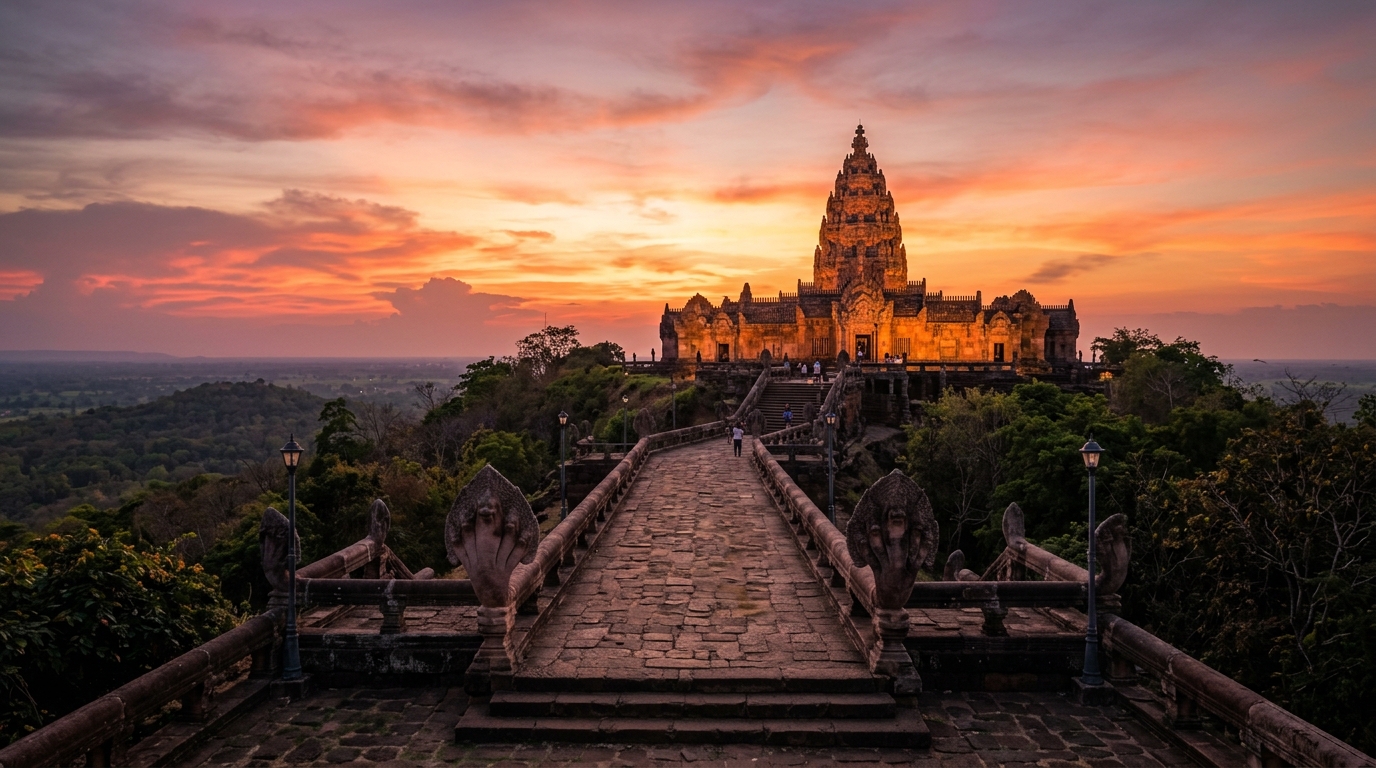
Nakhon Ratchasima, universally known locally as Korat, is the wealthy “gateway city” to Isaan. While the city itself features rather uninspiring modern architecture, it is the jumping-off point for Phimai Historical Park. Phimai shares a direct architectural style with Angkor Wat. Visitors enter by crossing a Naga bridge—representing the guardians of heaven—passing through crumbling perimeter walls to a massive central sanctuary. When I visited in November, there were exactly two other foreigners in the entire complex.
Buriram and Phanom Rung
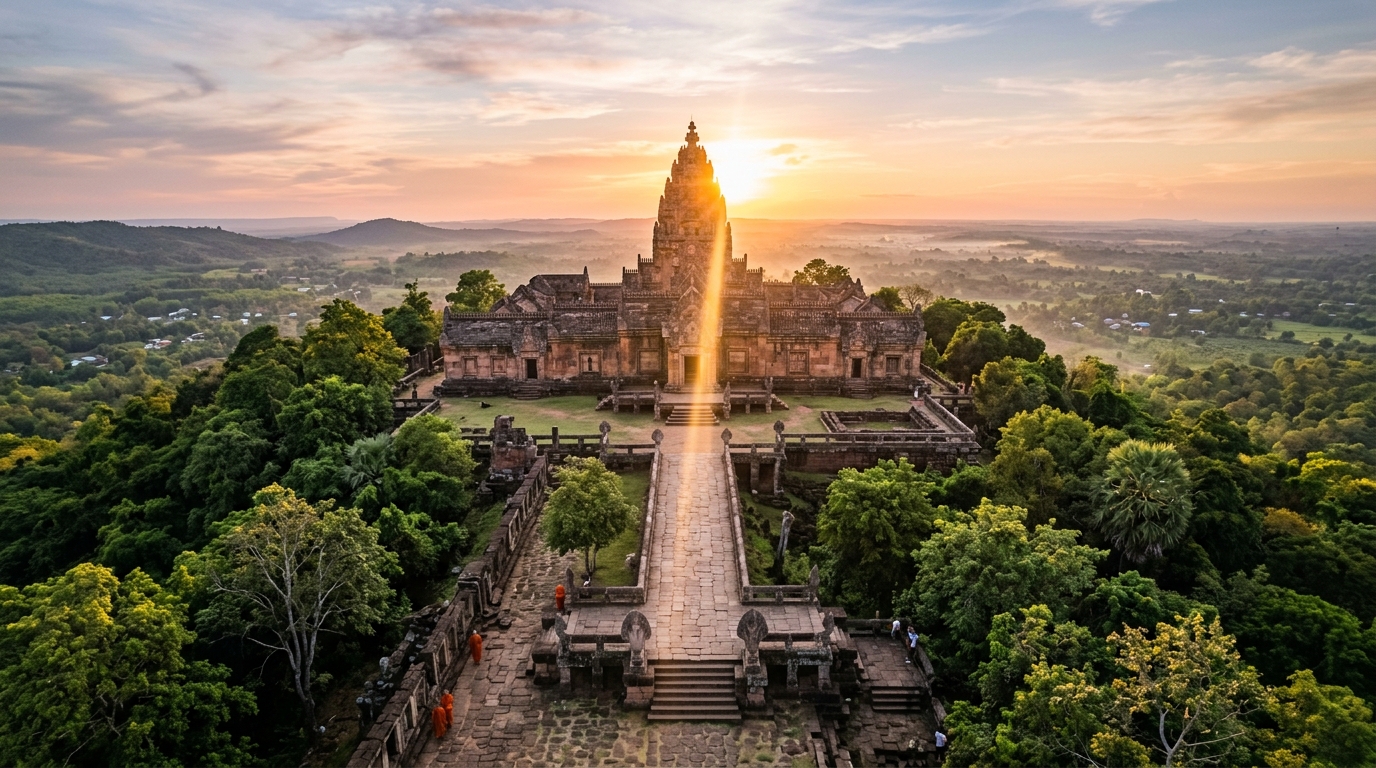
The absolute crown jewel of lower Isaan is Phanom Rung Historical Park in Buriram. This massive, meticulously restored Khmer temple complex sits at the summit of an extinct volcano. Built from pink sandstone, it features a long, dramatic processional walkway.
If you time your visit for the equinoxes in March or September, you can witness a spectacular solar alignment. During these specific dates, the rising or setting sun aligns perfectly, sending a single blinding shaft of light straight through all 15 doorways of the main temple. It is a brilliant display of ancient astronomical engineering.
Further south, hugging the Cambodian border, is Prasat Ta Muen Thom. This lesser-known complex sits right on the Ancient Khmer Highway. It sees almost zero foot traffic, allowing you to wander through its ancient stone houses and four serene ponds in complete silence.
The Food: Why Isaan Cuisine Burns (In a Good Way)
Isaan food is unapologetic. It does not tone down its flavors to appease foreign palates. The cuisine relies heavily on fresh herbs, intense lime juice, roasted chili powder, and pla ra—a pungent, fermented fish sauce that adds deep umami to almost every dish.
I confidently told a vendor at a Korat night market I wanted my papaya salad “spicy like a local.” My mouth was physically on fire for two hours, and I drank three bottles of water before I could speak normally again. If you have a low tolerance for heat, you must explicitly ask for “mai pet” (not spicy) or “pet nit noi” (a little spicy).
Regional Dishes You Must Order
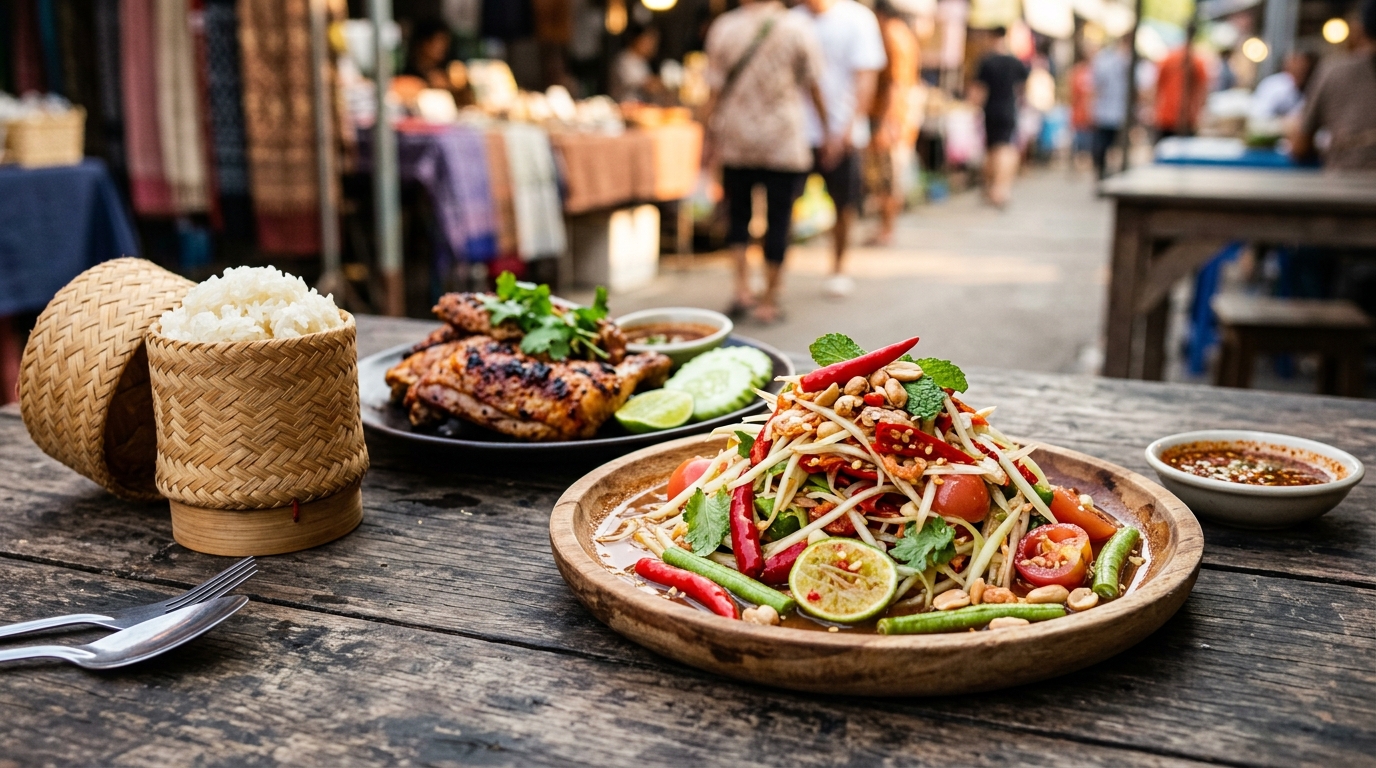
Som Tam (Papaya Salad): The definitive Isaan dish. Shredded green papaya pounded in a wooden mortar with garlic, chilies, fish sauce, lime, and tomatoes.
Larb: A minced meat salad heavily seasoned with fresh mint, cilantro, shallots, lime juice, and toasted rice powder for crunch. Traditional rural versions are sometimes served raw with blood, though cooked versions (pork, chicken, or duck) are standard.
Kai Yang (Grilled Chicken): You will smell the charcoal smoke long before you see the vendor. Whole chickens are marinated in garlic and lemongrass, then slow-grilled. It is mandatory to eat this with your hands alongside a basket of sticky rice.
Cost Breakdown: Budgeting for the Northeast
One of the most compelling reasons to explore the northeast is the economic reality. Because the region lacks luxury tourist infrastructure, prices reflect local agricultural wages rather than inflated tourist economics.
Here is a realistic comparison of what you might spend daily in Isaan versus a heavily touristed area like Phuket:
| Expense Category | Average Daily Cost in Isaan | Average Daily Cost in Phuket |
|---|---|---|
| Accommodation (Mid-range) | $20 – $35 USD | $80 – $150 USD |
| Local Transport | $30 USD (Car Rental) | $15 – $40 USD (Taxis/Tuk-Tuks) |
| Dining (Street Food/Local) | $5 – $10 USD | $15 – $30 USD |
| Attraction Entry Fees | $1 – $3 USD | $15 – $50 USD (Island tours) |
| Total Estimated Daily Budget | $56 – $78 USD | $125 – $270 USD |
Renting a motorbike is even cheaper (around $5-$8 USD per day), but given the massive distances between cities, a standard car rental is significantly safer and more practical for inter-provincial travel.
Who Should Visit Isaan (And Who Should Definitely Not)
Northeast Thailand requires a specific type of traveler to truly appreciate its offerings.
This region is ideal for:
Independent road-trippers: If you love the freedom of renting a vehicle, pulling over at random roadside grill stands, and navigating by GPS, you will thrive here.
Culinary purists: If your primary motivation is to eat highly authentic, uncompromising regional food, Isaan is the undisputed culinary capital of the country.
History and archaeology buffs: Those interested in 11th-century Khmer architecture and 3,000-year-old Bronze Age history will find world-class sites without the suffocating crowds of Ayutthaya.
You might want to skip this if:
You need ocean swimming: There is zero coastline here. If your vacation goal involves white sand and beach clubs, you must head south to the islands.
You panic without English speakers: Outside of hotel reception desks, English proficiency is incredibly low. You must be comfortable using translation apps and pointing at menus.
You expect luxury infrastructure: While you can find comfortable business hotels, five-star luxury resorts with day spas and infinity pools are virtually non-existent in the rural provinces.
Common Mistakes to Avoid in Northeast Thailand
1. Ignoring the March-May hot season
Thailand is generally warm year-round, but the Isaan plateau during the hot season is an entirely different beast. Temperatures frequently exceed 100°F (38°C) with suffocating humidity. Because most of the region’s attractions are outdoors (archaeological parks, cliffside temples, national parks), visiting during April guarantees you will be miserable by 11:00 AM. Furthermore, the region suffers from chronic drought during these months, meaning the landscape turns brown and dusty. Always aim for the cool season (November to February).
2. Assuming your credit card will save you
I have watched countless tourists attempt to hand a Visa card to a rural gas station attendant or a night market vendor, only to be met with total confusion. Outside of major shopping malls, Isaan operates strictly on cash and the Thai PromptPay QR code system. Because PromptPay requires a domestic Thai bank account, tourists cannot use it. You must carry a significant stack of Thai Baht in small denominations (20, 50, and 100 notes) at all times to pay for meals, park entries, and minor expenses.
Frequently Asked Questions
What is the absolute best month to visit Isaan?
January is the undisputed best month. The weather is cool and dry (often requiring a light jacket in the mornings), the Red Lotus Sea is in full bloom in Udon Thani, and water levels in the Mekong are low enough to expose the incredible rock formations at Sam Phan Bok.
Is it safe to drive a rental car in Northeast Thailand?
Yes, but it requires high situational awareness. The major highways connecting big cities like Korat, Khon Kaen, and Udon Thani are well-paved and multi-lane. However, rural driving can be chaotic. You must actively watch out for stray dogs, slow-moving farm tractors, and motorbikes driving on the wrong side of the shoulder. Never drive on rural Isaan roads after dark due to poor lighting.
Do I need to hire a local guide for the historical parks?
It is not strictly necessary if you do your research beforehand. Most major sites like Phanom Rung or Phimai have basic English plaques, though they lack deep narrative detail. If you are deeply interested in Khmer history, hiring a guide locally at the park entrance for a few hundred Baht will vastly improve your understanding of the architecture.
How many days do I need for an Isaan trip?
At minimum, you need 5 full days just to complete a focused, single-region loop (like the Udon Thani to Nong Khai corridor). If you want to see both the northern Mekong towns and the southern Khmer ruins, you need an absolute minimum of 10 to 14 days of dedicated driving.
Conclusion and Next Steps
Exploring Northeast Thailand strips away the commercial polish found in the southern tourist hubs and replaces it with raw authenticity, ancient architecture, and the boldest flavors in Southeast Asia. Whether you are watching the sunrise over the Mekong River in Loei, standing completely alone inside a 1,000-year-old Khmer temple in Buriram, or navigating the spicy depths of a night market, the experiences here feel earned.
If you are ready to execute this trip, your first actionable step is to secure a domestic flight from Bangkok to either Udon Thani or Ubon Ratchathani during the cool season. Book your rental car well in advance, map out a conservative three-province driving loop, and prepare yourself for an incredible adventure completely off the standard tourist trail.