
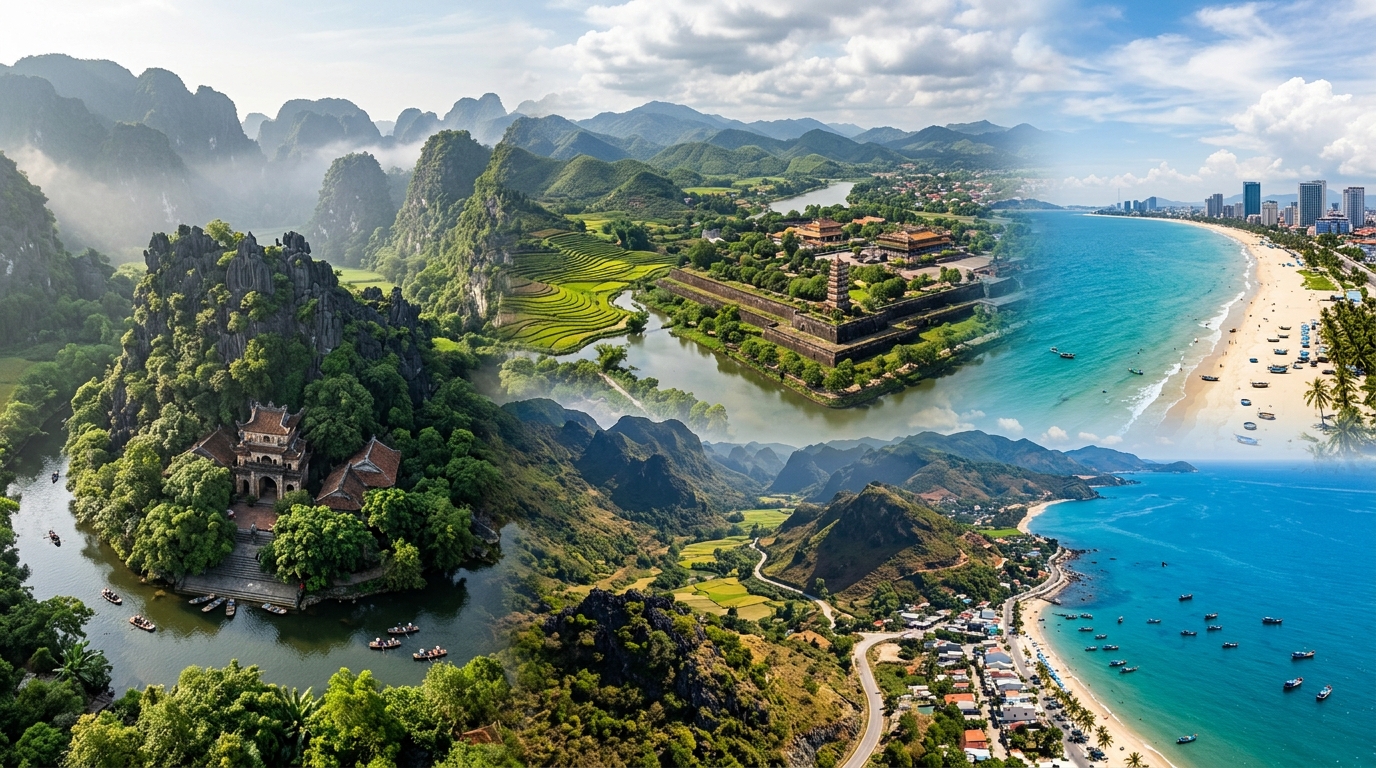

Crafting your first time Vietnam itinerary is objectively intimidating, largely because the country stretches roughly 1,000 miles from the mountainous Chinese border down to the tropical Gulf of Thailand. I remember staring at a map before my inaugural trip, completely overwhelmed by the sheer scale of the logistics. How do you fit thousands of years of imperial history, three distinct climate zones, and a dozen major cultural hubs into a standard two-week vacation?
The hard truth is that you cannot see everything, and trying to do so will ruin your trip. If you plan poorly, you will spend half your vacation sitting in airport terminals or freezing in a summer dress in the northern mountains. If you plan correctly, you will navigate one of the most culturally dense, visually spectacular, and culinarily satisfying countries on earth with absolute ease.
This guide breaks down a comprehensive, field-tested 14-day route, drawing from hard data and real transit logistics.
Quick Summary
The Optimal Direction: Traveling North-to-South (hanoi to Ho Chi Minh City) is significantly better for chronological history and climate acclimation.
The Core Pillars: A proper 14-day route must include Hanoi, a northern natural wonder (Ha Long/Lan Ha Bay), Hoi An, and Ho Chi Minh City.
Transport Reality: Domestic flights are essential. Do not try to take overnight buses for long-haul routes unless you want to lose entire days of sightseeing.
Budgeting: Expect to spend $110 to $165 per day for a very comfortable mid-range travel experience featuring boutique hotels and private transfers.
Weather Warnings: Vietnam has three distinct climate zones. Winter in the north drops to 10°C (50°F), while the south simultaneously roasts at 34°C (93°F).
The Direct Answer: Your 14-Day Route Blueprint
If you only have two weeks and want a definitive answer on what to do, here is your exact blueprint.
Fly into Noi Bai International Airport in Hanoi. Spend your first three days absorbing the deep history and incredible street food of the northern capital. On day four, take a two-day overnight cruise in the limestone karsts of Lan Ha Bay or Bai Tu Long Bay. On day six, take a domestic flight south to Da Nang, transferring immediately to the ancient trading port of Hoi An for four days of coastal relaxation and custom tailoring. Finally, fly south again to Ho Chi Minh City for your final four days, dedicating time to the Cu Chi Tunnels and a full-day excursion through the Mekong Delta, before flying home out of Tan Son Nhat International Airport.
This classic North-to-South route solves the major logistical challenges of a Vietnam trip. It limits your domestic flights to just two short hops (under 90 minutes each). It provides a natural progression of Vietnamese history, moving from ancient imperial roots to hyper-modern commercialism. Most importantly, it prevents the crushing exhaustion that comes from changing hotels every single night.
Why North-to-South is the Superior Strategy
Vietnam’s elongated geography forces you to pick a starting point. You either start at the top and move down, or start at the bottom and move up. Both work, but they offer vastly different psychological and physical experiences.
Starting in Hanoi provides a superior chronological context. Hanoi is a deeply historical city, dating back to 3,000 BCE, rooted in ancient traditions and Confucian history. As you move south, you slowly transition into the commercial, rapid-paced, modernized energy of Ho Chi Minh City.
Furthermore, this route naturally helps you manage the climate shock. If you arrive from North America or Europe, landing in Hanoi’s milder temperatures gives your body time to adjust. By the time you reach the aggressive 35°C tropical heat and heavy humidity of the south, you are already acclimatized.
Phase 1: The North (Days 1 to 5)
The north requires you to slow down. It is visually dramatic, highly traditional, and demands a degree of physical effort to fully appreciate.
Days 1-3: Hanoi (The Cultural Heart)
Hanoi operates at an intoxicating frequency. It is a city of layers, where 11th-century temples sit adjacent to Brutalist-style government buildings and French colonial villas.
Base yourself in the Old Quarter or the slightly quieter Ba Dinh District. The Old Quarter is historically organized by artisan guilds—Hang Bac is Silver Street, while Hang Gai sells silk. You will spend your first day dodging aggressive scooter traffic, but by day two, you will understand the rhythm.
Your mandatory historical stops include the Temple of Literature (Vietnam’s first university, built in 1070), the Ho Chi Minh Mausoleum (note: closed on Mondays and Fridays, and requires shoulders and knees to be covered), and the Hoa Lo Prison.
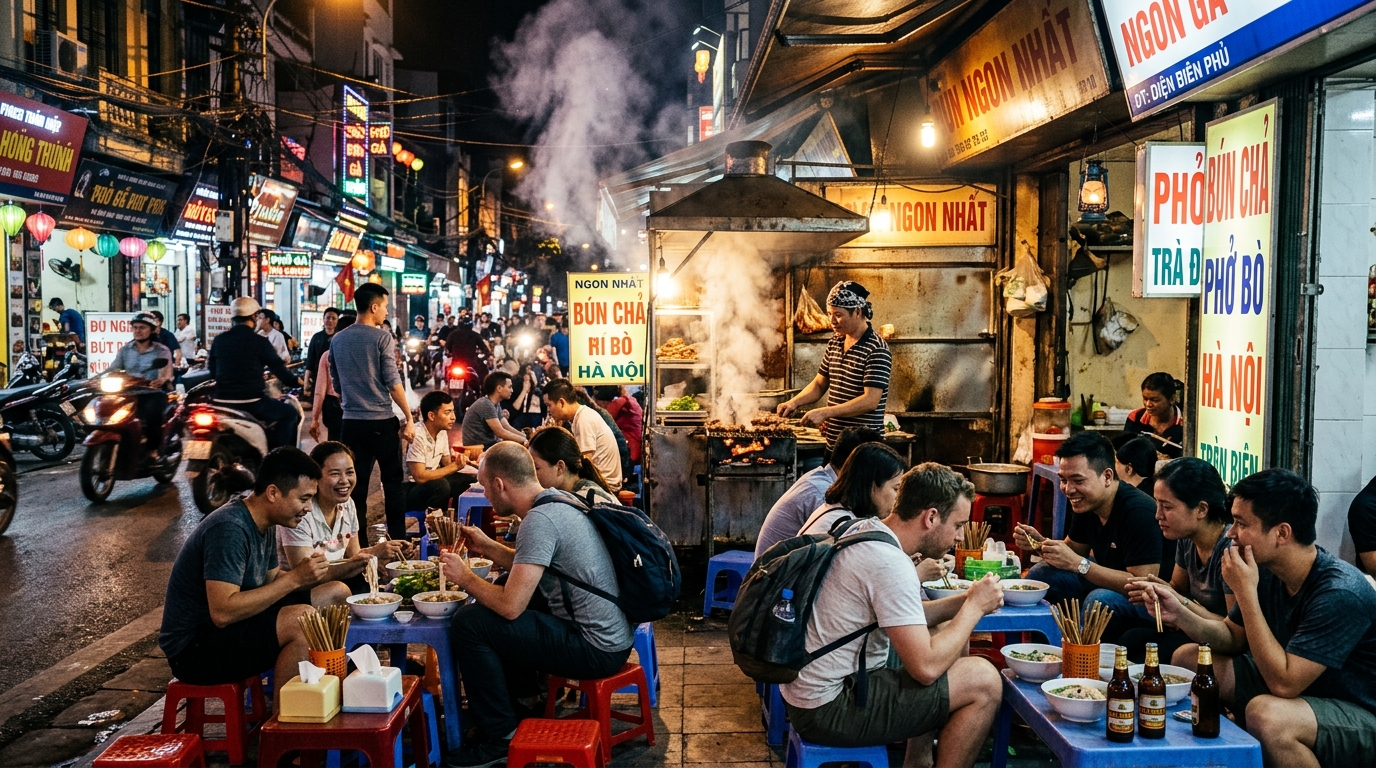
For culinary exploration, Hanoi is unmatched. I recommend seeking out Bun cha (grilled pork and noodles) at Huong Lien—famous for hosting Barack Obama. You also must try Egg Coffee. Go directly to Cafe Giang, where the drink was invented in the 1940s during a severe milk shortage. It blends robusta coffee with heavily whipped egg yolk and sugar, tasting exactly like liquid tiramisu.
Days 4-5: The Coastal Karsts (Ha Long, Lan Ha, or Bai Tu Long)
Located about three hours east of Hanoi, the Gulf of Tonkin features thousands of towering limestone karsts erupting from jade-green waters.
Here is an honest downside: standard Ha Long Bay is overcrowded. My top recommendation is to book a cruise that specifically sails into Lan Ha Bay or Bai Tu Long Bay. These are southern and northern extensions of the exact same geological formation, but they see a fraction of the boat traffic.
Do not book a rushed day trip. I booked a cheap day-trip ferry on my first visit thinking I would save some money. I ended up enduring six hours of driving round-trip just to spend two rushed, crowded hours on the water. It was a massive mistake. Book a proper 1-night overnight cruise. Waking up on the water surrounded by silent, fog-draped limestone cliffs is an essential experience.

Phase 2: Central Vietnam (Days 6 to 10)
Central Vietnam offers a necessary mid-trip slowdown. You will trade the chaotic streets of the capital for ancient imperial architecture, long stretches of sand, and world-class tailoring.
Day 6: Transit and The Hai Van Pass
Take a morning flight from Hanoi to Da Nang (1.5 hours). From Da Nang, you have a choice. You can take a quick 45-minute taxi directly to Hoi An, or you can take the scenic route over the Hai Van Pass.
The Hai Van Pass is a coastal mountain road made famous by the television show Top Gear. The views of the ocean crashing against the mountainside are spectacular. However, do not attempt to drive this yourself if you are an inexperienced motorcyclist. The hairpin turns and heavy truck traffic make it dangerous for beginners. Instead, hire a professional “Easy Rider” guide or a private car driver to transport you safely.
Days 7-10: Hoi An Ancient Town
Hoi An is a UNESCO World Heritage site and a former 17th-century spice trading port. The center is closed to motorized traffic, making it the only truly quiet urban environment you will experience in Vietnam. The architecture features yellow-painted merchant houses, Chinese temples, and the famous Japanese Covered Bridge.
Dedicate your time here to three specific pursuits:
- Bespoke Tailoring: Hoi An is famous for incredibly cheap, high-quality custom clothing. You can get custom-made suits or dresses for around $25 to $100 depending on the fabric. Actionable tip: Visit the tailor on your very first morning. Basic garments take 24 hours, but you will need time for multiple fittings over your four-day stay.
- Culinary Immersion: Take an interactive cooking class. The best ones involve a morning trip to the local market to buy ingredients, followed by learning to make regional specialties like Cao lau (a noodle dish using water drawn from a specific local well) or white rose dumplings.
- Beach Recovery: Rent a bicycle and ride three miles out to An Bang Beach. Skip the heavily eroded Cua Dai beach.
Phase 3: The South (Days 11 to 14)
The final leg of your trip is fast, hot, and deeply focused on 20th-century history and massive agricultural scale.
Days 11-12: Ho Chi Minh City (Saigon)
Take a 1.5-hour domestic flight from Da Nang to Ho Chi Minh City (HCMC). This city operates at an exhilarating, slightly terrifying speed. While Hanoi looks to the ancient past, HCMC charges into the future with massive skyscrapers like Landmark 81 towering over 19th-century colonial triad buildings (the Notre Dame Cathedral, Saigon Central Post Office, and the Opera House).
Dedicate your first day to the city center. Visit the Reunification Palace—a 1970s time warp where the Vietnam War officially ended in 1975. Follow this with the War Remnants Museum. Be warned: the exhibits detailing the horrific effects of the war and Agent Orange are emotionally devastating and not suitable for young children.
On day 12, take a half-day trip to the Cu Chi Tunnels. This massive network of underground bunkers was used by the Viet Cong. Crawling through the tight passageways provides profound historical insight, but it will trigger claustrophobia. If you are uncomfortable in tight spaces, you can view the above-ground exhibits instead.
Days 13-14: The Mekong Delta and Departure
For your final full day, book a day trip into the Mekong Delta (provinces like Ben Tre or My Tho).
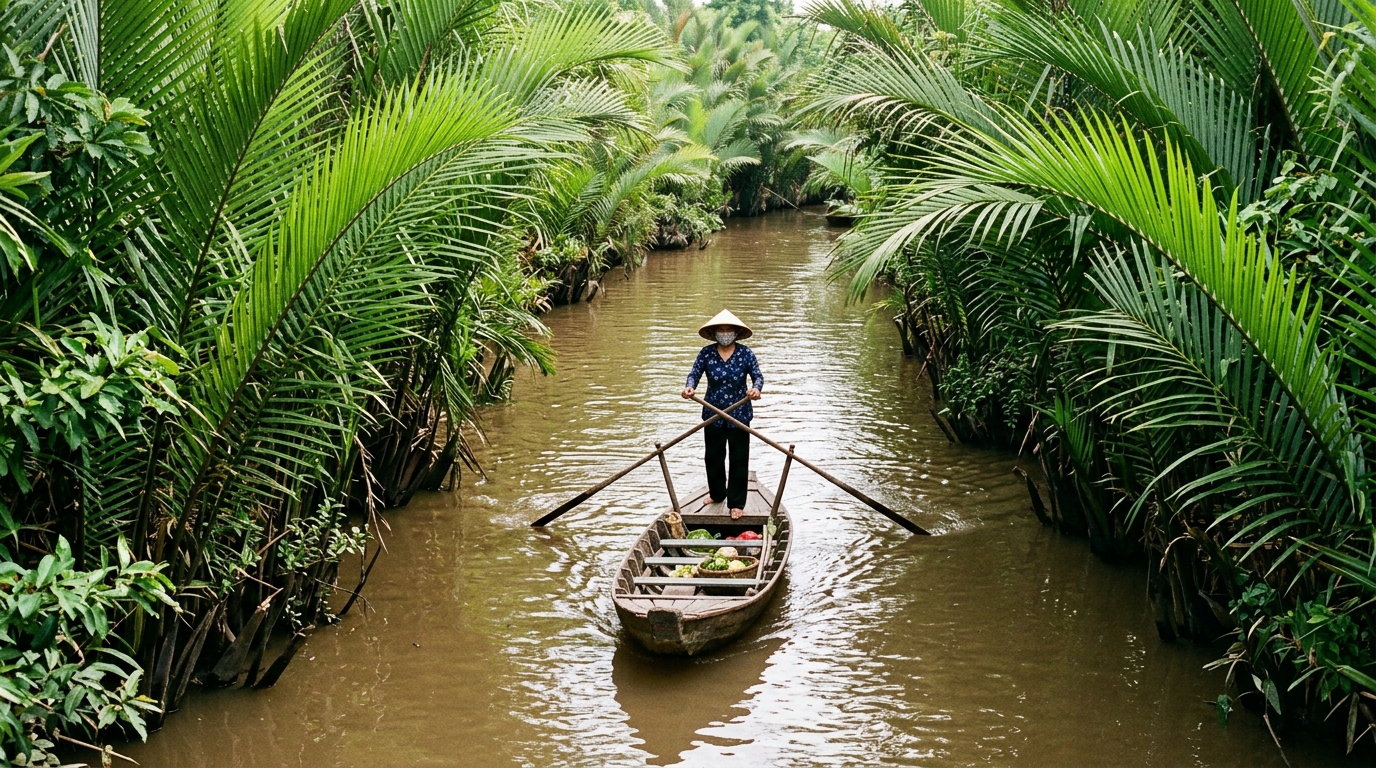
Rather than navigating the Delta independently—which requires complex local bus transfers—book a standard tour. You will spend the day riding traditional sampan rowboats along palm-shaded canals, visiting coconut candy processing workshops, and eating fresh tropical fruit in local orchards. It is a brilliant, hyper-local way to conclude the trip before doing your final souvenir shopping at Ben Thanh Market and flying home.
Transportation: The Truth About Domestic Transit
To execute this itinerary, you must rely on domestic aviation. Trains and buses offer spectacular scenery but require long, uncomfortable journeys that eat into your limited vacation time.
Vietnam Airlines, VietJet, and Jetstar offer incredibly cheap domestic flights (often under $50). However, budget carriers like VietJet are notoriously prone to severe delays and sudden schedule changes. Never book an important or expensive tour on the same day as a domestic flight. Always build buffer time into your transit days.
For getting around inside the cities, immediately download the Grab app. It operates exactly like Uber and allows you to book cars or motorbike taxis with transparent, upfront pricing. The app completely eliminates the risk of notorious taxi scams or language barriers when negotiating fares. You can link your credit card so you never have to fumble with foreign cash on the street.
Cost Breakdown and Realistic Budgeting
Vietnam offers arguably the best value for money in the world. However, prices vary wildly depending on your comfort threshold. Here is a realistic breakdown of daily costs per person (excluding international flights).
| Expense Category | Budget / Backpacker | Mid-Range Comfort | Luxury / Premium |
|---|---|---|---|
| Accommodation | $15 – $25 (Hostels/Guesthouses) | $50 – $90 (Boutique 4-Star) | $200+ (5-Star Resorts) |
| Food & Drink | $10 – $15 (Street Food/Markets) | $30 – $50 (Nice Local Restaurants) | $100+ (Fine Dining) |
| Transportation | $5 (Local buses/Grab bikes) | $20 (Grab cars/Short flights) | $60+ (Private drivers) |
| Activities | $10 (DIY walks/Temple entry) | $40 (Group tours/Cooking classes) | $120+ (Private guides) |
| Total Daily Estimate | $40 – $55 | $140 – $200 | $480+ |
Note: Mid-range accommodations in Hanoi and Hoi An frequently include exceptional service and full breakfast buffets at the $60 price point, offering tremendous value compared to Western standards.
Who Should Use This Itinerary (And Who Should Not)
This itinerary is ideal for:
Travelers who want a comprehensive overview of Vietnamese history, food, and distinct geographical landscapes.
First-time visitors to Asia who want accessible tourist infrastructure alongside authentic cultural experiences.
People perfectly comfortable taking short domestic flights to maximize their ground time.
You might want to skip this if:
You exclusively want a static beach vacation. If your goal is strictly resorts and cocktails, skip the major cities entirely and fly directly to Phu Quoc island or Da Nang.
You have severe mobility issues. The sidewalks in Hanoi and Ho Chi Minh City are chaotic, uneven, and often blocked by parked motorbikes and street food vendors. Walking requires constant vigilance and physical agility.
You hate heat and humidity. Unless you travel in deep winter, the central and southern regions will be intensely hot and physically draining.
Common Mistakes to Avoid
Even experienced travelers make simple errors when planning a trip here. Avoid these massive pitfalls.
Mistake 1: Ignoring Regional Weather Zones
Vietnam is roughly the size of Italy and features three distinct climate zones. Do not assume the weather is uniform. I packed only tropical clothes for a late December trip, assuming all of Southeast Asia was perpetually hot. I was painfully wrong.
Hanoi drops to 10°C (50°F) in the winter, accompanied by a damp, bone-chilling drizzle. I had to buy a heavy jacket on my second day. Meanwhile, Ho Chi Minh City was roasting at 34°C (93°F). Generally, Spring (March/April) offers the most balanced national weather. If you travel in Autumn, have backup plans ready for sudden typhoons and flooding in Central Vietnam.
Mistake 2: Missing the Rice Harvest Seasons
If your primary goal is to see the iconic, golden terraced rice fields in the northern mountains (like Sapa or Pu Luong), you cannot just show up at any time of year. Pu Luong experiences two harvests (Early June and Late September/Early October), while Sapa only experiences one (Late August to Early September). If you arrive in December, you will be staring at brown, empty mud pits.
Mistake 3: Sticking Exclusively to Western Food
Many first-time visitors are intimidated by the street food scene and retreat to westernized restaurants. This is a culinary tragedy. Local Vietnamese food is significantly cheaper, incredibly fresh, and complex. The mediocre versions of western food served in tourist areas pale in comparison to a $2 bowl of authentic Pho or a crispy Banh xeo pancake. Eat where the locals eat—if a plastic-stool street stall is packed with residents, the turnover is high, and the food is safe.
Frequently Asked Questions
Do I need a visa to visit Vietnam?
This depends entirely on your nationality. US Citizens require a visa, with the easiest method being an e-visa applied for online several weeks prior to travel. UK citizens currently do not require a visa for stays of 45 days or less. Always verify current entry requirements through the official government portal, and ensure your passport is valid for at least 6 months from your date of entry.
How much cash should I carry?
While major hotels, upscale restaurants, and modern cafes readily accept credit cards, Vietnam remains heavily reliant on cash. Small street vendors, local markets, and family-run shops operate exclusively on Vietnamese Dong. Carry the equivalent of $50 to $100 USD in cash daily. Do not exchange all your money at the airport; in Hanoi, visit the gold shops on Ha Trung Street for the best exchange rates.
Is the street food safe to eat?
Yes, but apply common sense. Eat at stalls that have a high turnover rate and are crowded with locals—this guarantees ingredient freshness. Watch how the food is handled. Stick to cooked, boiling foods like Pho or Bun cha* for the first few days before venturing into raw herbs or iced drinks while your stomach acclimates to the local bacteria.
Should I take the overnight sleeper trains?
While romanticized, overnight sleeper trains (like the one from Hanoi to Da Nang) are loud, jerky, and often result in terrible sleep. Unless you are an absolute train enthusiast or traveling on a razor-thin budget that requires combining transit and accommodation costs, spend the extra $20 for a domestic flight. It saves you 14 hours of travel time.
Conclusion
A successful trip requires accepting that you cannot conquer the entire country in two weeks. By strictly focusing on the structural pillars—Hanoi’s deep historical roots, the natural grandeur of the northern coast, Hoi An’s preserved charm, and Ho Chi Minh City’s modern drive—you create a balanced, highly rewarding experience.
Book your international flights strategically (into the north, out of the south), secure your internal domestic flights well in advance, and prepare for the sensory intensity. Embrace the chaotic scooter traffic, sit on a tiny plastic stool to eat a bowl of steaming noodles, and let the country reveal itself at its own pace. If you follow this route, your first trip here will almost certainly not be your last.