
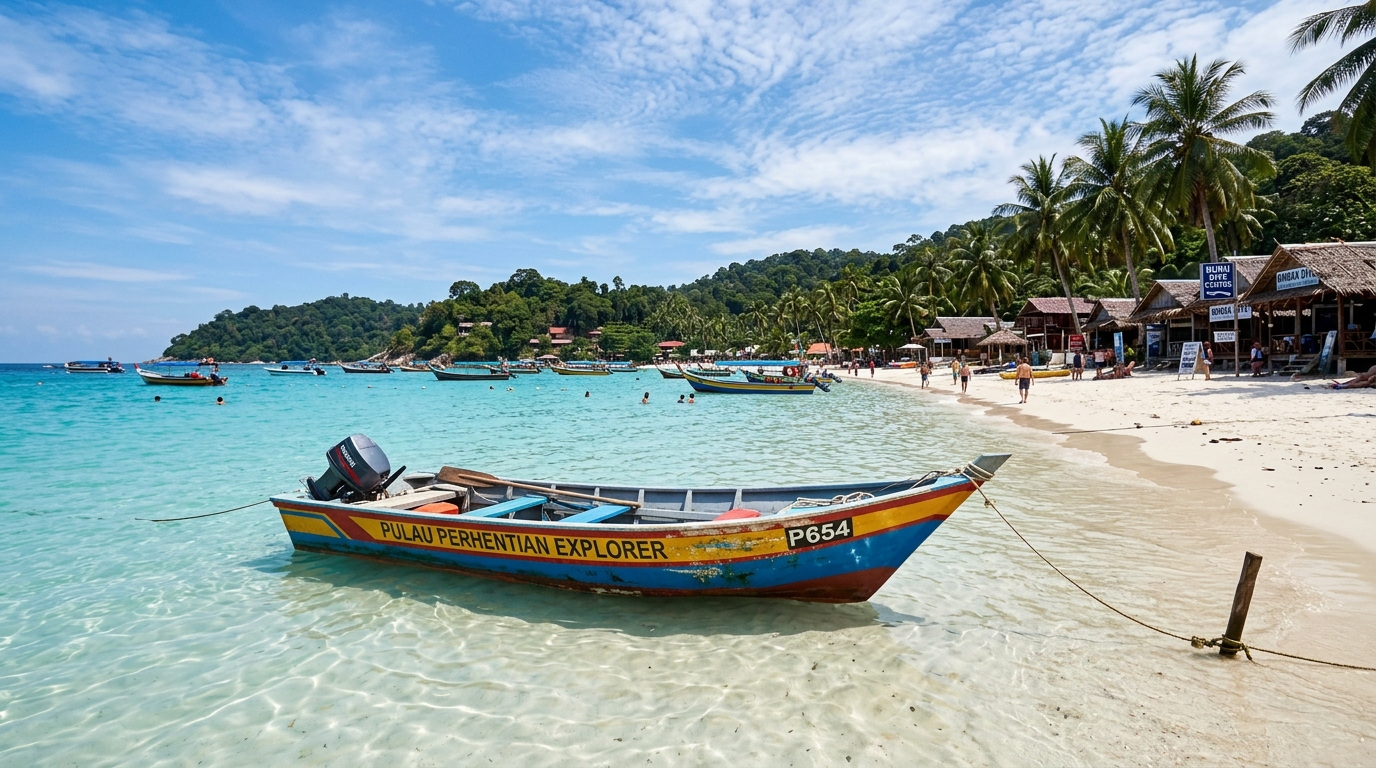

Finding an accurate Perhentian Kecil travel guide that actually prepares you for the raw, unpolished reality of this Malaysian island is tougher than it should be. When I first started mapping out my trip to the east coast of Malaysia, I kept reading polished brochures that made the islands sound like a manicured resort paradise. The reality is far more interesting, but it requires serious preparation. Perhentian Kecil—meaning “Small Stopping Point” in Malay—is an island entirely free of cars, paved roads, airports, and ATMs. It operates on a chaotic network of fast boats, jungle trails, and diesel generators.
I spent days hauling my backpack across its sweaty interior paths, diving its thriving reefs, and learning the hard way how to navigate its unique quirks. This island will test your patience with its spotty infrastructure, but it will reward you with some of the cheapest scuba diving on the planet, pristine turquoise waters, and an authentic backpacker atmosphere that much of Southeast Asia lost two decades ago.
Quick Summary
Cash is your lifeline: There are absolutely zero ATMs on the island, and very few places accept credit cards without a massive surcharge. Bring all the Malaysian Ringgit you need from the mainland.
Prepare for limited power: Most budget accommodations run on generators, meaning electricity (and your room’s ceiling fan) only operates from 6:00 PM to 9:00 AM.
The boat drops you in the water: There are no concrete piers. Speedboats pull up to the sand, and you will have to jump into knee-deep water with your luggage. Pack accordingly.
Mind the monsoon: The island completely shuts down to tourists between November and March due to dangerous seas and heavy rain.
Incredible value: You can get your PADI Open Water scuba certification here for under $300 USD, making it one of the most cost-effective dive hubs in the world.
The Direct Answer: Is Perhentian Kecil Worth It?
If you are willing to trade reliable air conditioning and high-speed Wi-Fi for wild jungle treks, spectacular coral reefs, and a laid-back lifestyle, Perhentian Kecil is absolutely worth your time and money. It serves as the rugged, budget-friendly alternative to its neighbor, Perhentian Besar, which caters almost exclusively to families and higher-end resort guests.
Kecil is designed for the adventurous traveler. You will encounter monitor lizards the size of dogs on your walk to breakfast. You will sweat profusely. But you will also pay just $20 USD for a boat dive, sleep in hillside chalets overlooking the South China Sea, and swim with black-tip reef sharks just offshore. If you demand luxury and seamless service, book a flight to Langkawi instead. If you want a raw tropical adventure, Perhentian Kecil is exactly what you are looking for.
Understanding the Two Islands: Kecil vs. Besar
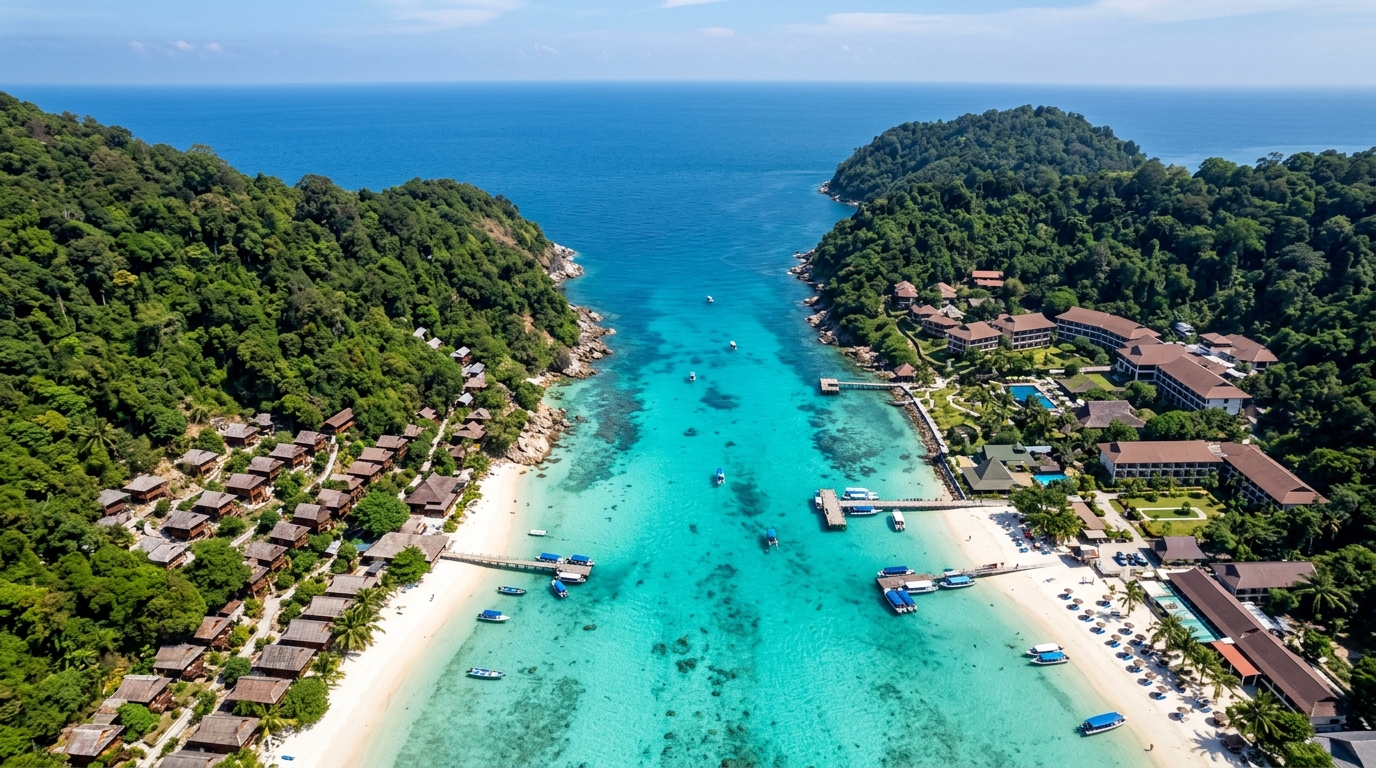
Before you commit to your boat ticket, you need to understand that the Perhentian archipelago is split into two primary islands, each serving distinctly different demographics of travelers.
Perhentian Besar (The Big Island):
This island is larger, quieter, and boasts a more secluded, peaceful ambiance. It heavily favors families, older travelers, and honeymooners. The accommodation here skews toward mid-range and luxury resorts (like Tuna Bay Island Resort or Perhentian Island Resort). The nightlife is virtually non-existent after 9:00 PM.
Perhentian Kecil (The Small Island):
This is the undisputed hub for backpackers and budget travelers. It features a much livelier atmosphere, extremely cheap dining options, and a dense concentration of budget dive schools. It is louder, rougher around the edges, and far more social.
Getting There: The Logistics of Reaching the Island
Reaching Perhentian Kecil is a multi-step process that requires a bit of patience and a willingness to embrace Southeast Asian transit logistics. Your jump-off point for the islands is the sleepy mainland port town of kuala Besut.
Step 1: Reaching Kuala Besut from Kuala Lumpur
You have two primary options to reach the coastal jetty from Malaysia’s capital:
The Budget Route (Overnight Bus):
You can take a direct bus from Kuala Lumpur’s Terminal Bersepadu Selatan (TBS). The journey takes between 8 and 9.5 hours and costs roughly 40-50 RM ($10-12 USD). Taking the overnight bus is the standard backpacker move. However, be warned: Malaysian buses crank their air conditioning to freezing temperatures. I spent my 9-hour ride shivering because I packed my hoodie at the bottom of my bag. The bus typically stops at 4:00 AM for a bathroom break and drops you at the Kuala Besut bus terminal just after dawn.
The Fast Route (Flight + Taxi):
If you prefer to skip the long bus ride, book a cheap domestic flight on AirAsia from Kuala Lumpur to Kota Bharu airport (roughly a 1-hour flight). From Kota Bharu, you can hire a taxi or book a Grab ride directly to the Kuala Besut jetty. The taxi takes exactly one hour and costs around 80 RM ($20 USD). I highly recommend this route to avoid the strict, slow local bus connections in the conservative mainland state of Terengganu.
Step 2: The Speedboat Transfer
Boats to the island officially start running at 8:00 AM, with definite departures at 8:00 AM, 9:00 AM, and throughout the afternoon until roughly 5:00 PM.
The ticket costs exactly 70 RM ($15 USD) for an open return, plus a mandatory 30 RM ($7.50 USD) marine park conservation fee that you must pay at a separate counter before boarding. Keep your return ticket safe in a dry bag—you will need it to leave the island.
When you board the small fiberglass speedboat, the captain will ask exactly which beach you are staying on. Pay close attention here. There is no central pier on the island. The boat will drive directly onto the sand of your specific beach.
I packed a cheap, hard-shell rolling suitcase on my first trip, assuming I would be walking off a dock. Instead, the boat operator yelled “Long Beach!”, cut the engine, and motioned for me to hop over the side. I ended up dragging a ruined, waterlogged suitcase through deep sand for twenty minutes. Bring a proper travel backpack.
Navigating the Island: Two Distinct Worlds
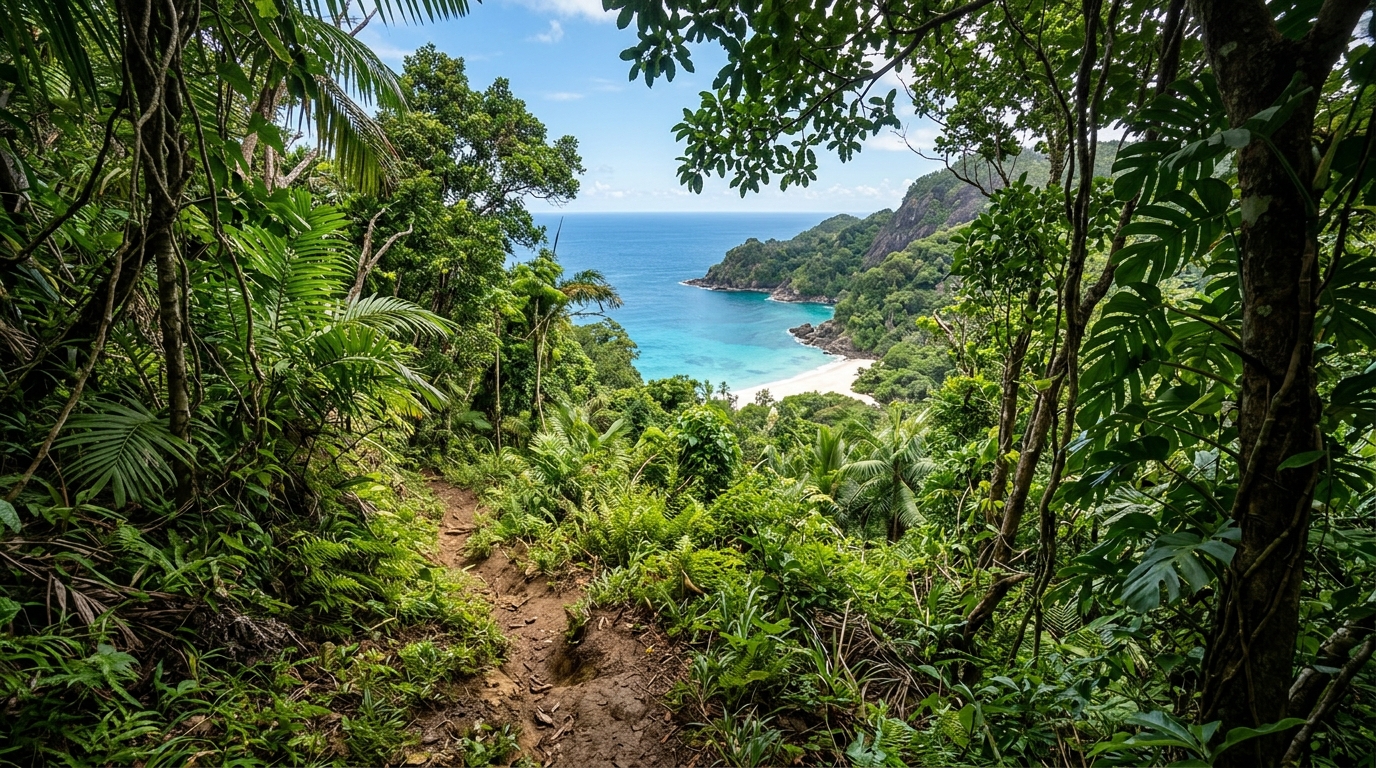
Perhentian Kecil is defined by two primary beaches, connected by an unpaved, ten-minute walking path that cuts directly through the jungle interior. You will spend a lot of time walking this path, swatting mosquitoes, and dodging giant lizards.
Long Beach (The Social Hub)
Long Beach sits on the eastern side of the island. It features fine, white sand and a distinct lack of coral near the shore, making it the best place on the island for actual swimming without water shoes.
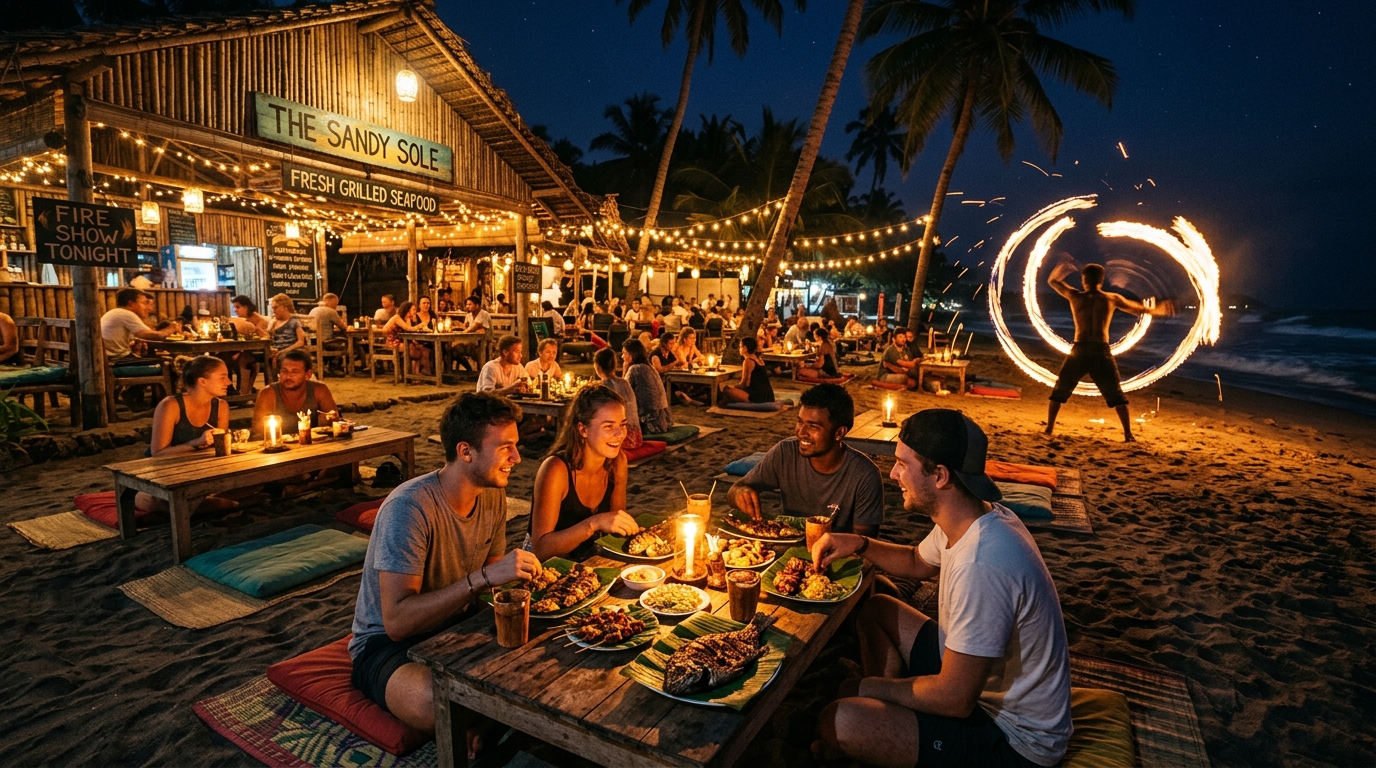
This is the energetic heart of Kecil. The strip is lined with dive shops, makeshift tiki bars, and budget restaurants. At night, Long Beach transforms. Locals set up small tables selling cheap beers and hip flasks of local liquor. At around 10:30 PM, depending on the tide, massive fire-spinning shows kick off in front of bars. The music pumps until around 1:00 AM or 2:00 AM.
A word of warning: If you book accommodation directly on Long Beach, do not expect a quiet night of sleep. The bass from the beach bars will rattle the walls of your wooden chalet.
Coral Bay (The Quiet Retreat)
Located on the western side of the island, Coral Bay is significantly smaller and much more relaxed. As the name suggests, the shoreline is rocky and loaded with dead coral, which makes wading in bare feet slightly painful, but it means you can snorkel right off the sand.
Coral Bay shuts down completely by 10:00 PM. It is the premier spot for watching the sunset, eating a quiet seafood barbecue, and relaxing. It also features slightly better budget accommodations, like Senja Bay Resort and Ombak Resort. If you want to sleep well but still access the Long Beach parties, book your room in Coral Bay and simply walk the 10-minute jungle path at night (bring a headlamp, as the path is completely unlit).
Into the Wild: Jungle Trekking and Hidden Beaches
Most visitors never leave the two main beaches, but the interior of the island is crisscrossed with rugged trails leading to spectacular viewpoints and totally isolated coves.
The Windmill Point Hike
The most famous hike on the island takes you to Windmill Point on the northern tip. To start, walk past the Santai restaurant on Long Beach and look for a trail marker nailed to a tree.
Let me be completely honest about this hike: the Malaysian jungle is intensely, oppressively hot. I attempted this trek at noon in 35-degree Celsius (95-degree Fahrenheit) heat with nearly 100% humidity. Within ten minutes, my clothes were entirely soaked through. You must wear aggressive mosquito repellent and bring at least a liter of water per person.
After about 40 minutes of climbing over steep roots and rocks, you reach the top of the island where massive, defunct wind turbines stand. The panoramic view of the blue ocean from this elevation is outstanding.
Adam & Eve Beach
Near the windmills, you will see a faded wooden sign pointing right, written in pencil: “Adam And Eve Beach.” Following this dirt path for another 30 minutes will spit you out onto an absolutely stunning, completely isolated stretch of white sand. After the brutal heat of the jungle canopy, walking into the cool ocean water here feels like a religious experience.
Mira Beach (Keranji Beach)
If you want paradise without the brutal hike, take the southern trail from Coral Bay for about 20 minutes. You will arrive at Mira Beach. It features pure white sand, crystal clear water, a few small huts, and a great little cafe. It is significantly less crowded than Long Beach and offers excellent swimming.
World-Class Scuba Diving and Snorkeling
The primary reason people tolerate the lack of infrastructure on Kecil is the ocean. The water is a permanent, bath-like 30 degrees Celsius (86 degrees Fahrenheit), with excellent visibility and very little aggressive current.
However, the marine ecosystem here is fragile. According to the Global Coral Reef Monitoring Network, roughly 14% of the world’s coral was lost between 2009 and 2018. The Perhentian reefs face serious threats from rising sea temperatures and irresponsible tourism. Never stand on the coral, and never feed the marine wildlife.
Cheap Scuba Certification
Perhentian Kecil is a global hotspot for budget diving. Dive shops like Anti Gravity Divers, Oh La La Divers, and Panorama operate highly professional outfits with a mix of local and foreign instructors.
Prices are almost aggressively cheap. A single fun dive will cost you around 90 RM ($20 USD), and if you book a package of three or more, the price drops to 85 RM per dive. If you want to get your PADI Open Water certification, you can complete the four-day course for roughly 1150 RM ($250 USD).
Top Dive Site – Temple of the Sea:
If you only have time for one dive, make it Temple of the Sea. It is a massive underwater rock formation jutting from the seabed, featuring vibrant corals and dense layers of diverse marine life, including bamboo sharks and massive schools of trevally.
Snorkeling Excursions
If you do not want to strap on an oxygen tank, the snorkeling is still phenomenal. Small local boats advertise standardized trips on sandwich boards scattered across the beaches.
The Rawa Island Tour (60 RM / $13.50 USD):
This half-day trip is widely considered the best snorkeling excursion available. It takes you further out from the main islands to Seringgi and Rawa. On my trip, we spotted roughly 15 baby black-tip reef sharks swimming just 10 meters from the shoreline. They are completely harmless to humans and incredible to watch in the wild.
The Point Tour (40 RM / $9 USD):
This shorter, 3-hour trip typically hits Turtle Point, Coral Point, and Shark Point. At Turtle Point, the sandy sea bottom is a massive grazing ground for green sea turtles. I personally counted three massive turtles lazily chewing on seagrass during a single 20-minute swim.
Logistics and Survival Tips for the Island
Living on an island without public utilities requires a bit of strategy. If you understand how the local economy works, you can save a lot of money and frustration.
Power Outages and Hot Nights
Unless you are paying premium prices at a luxury spot like Bubu Resort or Mimpi Resort, your accommodation will run on generator power. My budget room cost 80 RM a night and offered an incredible balcony view, but the power was strictly cut at 9:00 AM and did not turn back on until 6:00 PM.
This means your ceiling fan will not work during the hottest part of the day. You cannot sleep in your room in the afternoon—it turns into a humid oven. You must plan your itinerary so that you are out in the water, diving, or lounging in the shade of a cafe from morning until dusk.
The Wi-Fi Situation
Do not plan on taking Zoom calls or doing remote work here. The Wi-Fi at most cafes is practically nonexistent—often struggling to load basic text messages. Cellular data (Maxis or Celcom) works sporadically on Long Beach but drops off entirely on the jungle paths. Buy a Malaysian e-SIM before you arrive, but prepare to be largely disconnected.
Eating on a Budget
Food on the island is marked up compared to mainland Malaysia because everything must arrive by small boat, but you can still eat very cheaply if you know where to look.
Fatima Cafe: Located on Coral Bay, this spot serves the absolute best authentic roti canai (a flaky flatbread served with curry) on the island for breakfast.
Crocodile Rock Bistro: Located near Rainforest Beach (a 15-minute walk from Coral Bay), this is the best spot for sunset views and Western-Malay fusion. Try their Mushroom Tikka Masala for an incredible vegetarian option.
Pit Stop Station: Located right in the center of Long Beach, this is your best bet for quick, cheap fried rice or an ice-blended tropical fruit shake between swims.
Bring Your Own Alcohol
Because Malaysia is a Muslim-majority country, alcohol is highly taxed nationwide. On a remote island, those prices double. A single can of beer at a Long Beach bar will cost you up to 15 RM ($3.50 USD), and wine is astronomically expensive. If you are on a tight budget, do what the locals and long-term backpackers do: buy a case of beer or a bottle of liquor at a supermarket in Kuala Lumpur and carry it over on the boat.
Cost and Budget Breakdown
To help you plan your travel finances, here is a realistic look at what things cost on Perhentian Kecil in 2024. Prices are listed in Malaysian Ringgit (RM). At the time of writing, 1 USD is roughly equal to 4.5 RM.
| Item / Service | Estimated Cost (RM) | Notes |
|---|---|---|
| Speedboat (Return) | 70 RM | Departs from Kuala Besut. |
| Marine Park Fee | 30 RM | Mandatory one-time fee paid at the mainland jetty. |
| Basic Fan Room | 60 – 100 RM | Prices fluctuate heavily based on weekends/season. |
| Local Malay Meal | 12 – 18 RM | Nasi goreng, roti, or basic curries. |
| Western Meal | 25 – 35 RM | Burgers, pizzas, or pasta at beachfront cafes. |
| Rawa Island Snorkel Trip | 60 RM | Includes boat transit, local guide, and mask/fins. |
| Single Scuba Dive | 90 RM | Gets cheaper if you book multiple dive packages. |
| Water Taxi | 15 – 25 RM | Price per person, highly negotiable based on distance. |
Who Should Visit Perhentian Kecil (And Who Should Not)
This destination is ideal for:
Budget Backpackers: If you are willing to sleep in a basic wooden chalet and eat local food, you can live on very little money here compared to Thai islands.
Scuba Divers: Absolute beginners looking for a cheap PADI Open Water certificate and veterans looking for affordable fun dives will be in heaven.
Social Travelers: The laid-back fire shows, lack of Wi-Fi, and communal diving culture make it incredibly easy to meet people.
You might want to skip this if:
You need 24/7 Air Conditioning: Unless you pay premium resort prices, you will be sweating. The daily power cuts are a reality of budget travel here.
You have mobility limitations: There are no paved roads. The jungle paths are steep, full of tree roots, and getting off the ferry requires jumping into the surf.
You expect immaculate infrastructure: The island’s waste management system is flawed (often resulting in trash fires), and medical infrastructure is limited to basic first-aid clinics.
Common Mistakes to Avoid
1. Arriving without enough cash.
I cannot stress this enough: there are no ATMs anywhere on the Perhentian Islands. A few high-end resorts and dive shops will let you pay by credit card or do a “cash advance” via card, but they will charge a steep 3% to 6% commission fee. Calculate your accommodation, food (roughly 60 RM a day), and diving costs, add a 20% emergency buffer, and withdraw all of it in Kuala Lumpur or Kota Bharu before arriving at the port.
2. Visiting during the wrong season.
Do not attempt to visit between November and March. The monsoon season brings powerful storms that sweep in nightly. The South China Sea becomes incredibly rough, making the speedboat crossing dangerous or entirely impossible. Nearly all hotels, dive shops, and restaurants board up their windows, and the workers move back to the mainland. The island is effectively closed.
Frequently Asked Questions
Is it safe to leave my belongings on the beach?
Generally, yes, the main beaches are safe, and the tight-knit dive community looks out for each other. However, if you are hiking to remote spots like Adam & Eve Beach, be extremely cautious. Never leave your passport, phone, or large sums of cash sitting in a bag on the sand while you swim for extended periods.
Can I drink the tap water on the island?
Absolutely not. The tap water on Perhentian Kecil is not safe for human consumption and will ruin your trip with severe stomach issues. You must rely exclusively on bottled water or large filtered water dispensers provided by some dive shops and cafes.
Do I need to book accommodation in advance?
If you are traveling in July or August (peak season), yes, you absolutely must book ahead as the island reaches 100% capacity with European backpackers and local weekenders. If you travel during the shoulder season (April or September), you can often get significantly better prices by taking the 8:00 AM boat, walking directly into the chalets, and negotiating in person.
Are there dangerous animals on the island?
The massive monitor lizards you see wandering near the jungle paths look intimidating, but they are generally afraid of humans and completely harmless. Your biggest threat is the local mosquito population. Dengue fever is a reality in Southeast Asia; buy strong repellent in Kuala Lumpur and apply it generously every evening.
Conclusion
Navigating Perhentian Kecil requires a willingness to embrace a bit of physical discomfort. You will sweat, you will curse the slow Wi-Fi, and you will likely get a few mosquito bites on your walk to dinner. But you will also find a thriving, affordable underwater ecosystem and a relaxed island culture that is becoming incredibly rare in the modern travel landscape.
If you are planning your itinerary, skip the heavy roller bags, withdraw plenty of Ringgit on the mainland, and target the shoulder month of April for the best balance of perfect weather and low crowds. Grab your snorkel mask and enjoy one of Malaysia’s best raw adventures.