
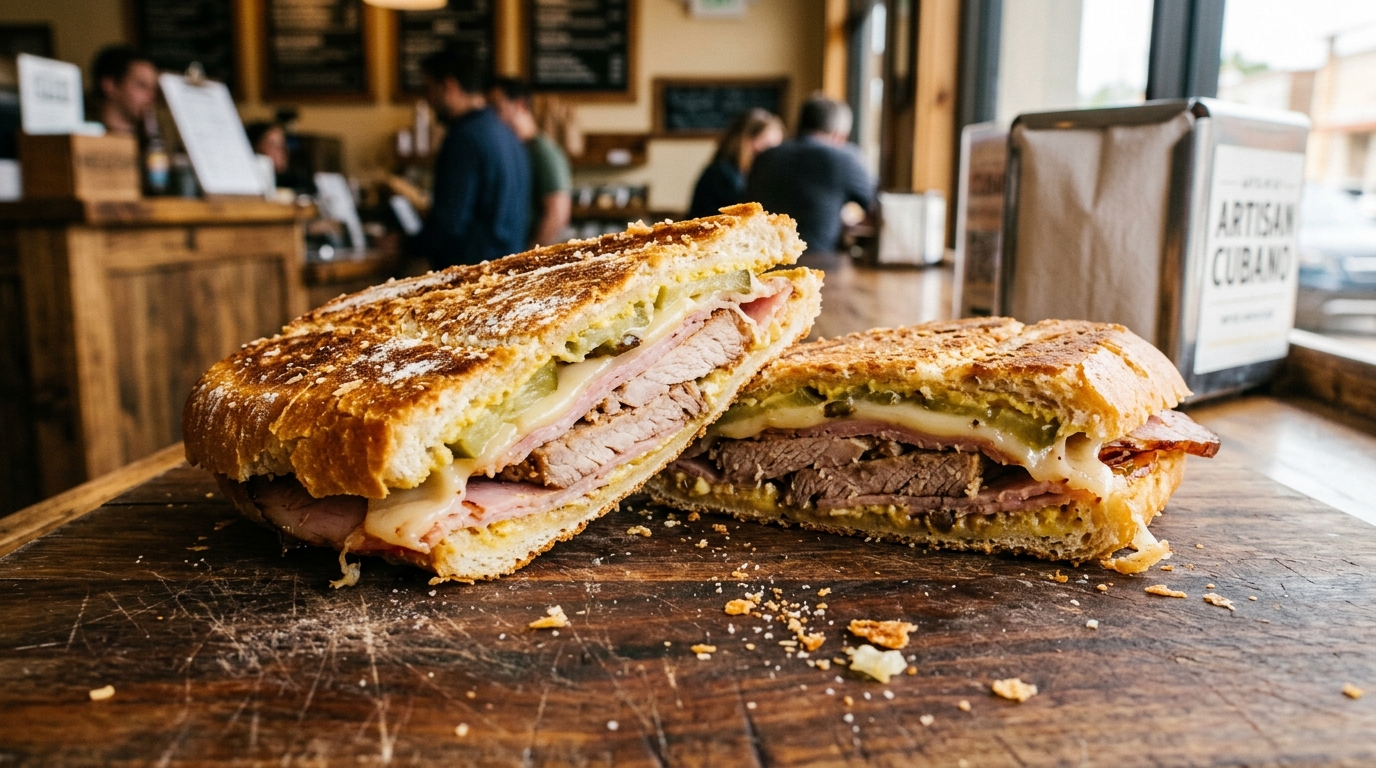

Finding an authentic cuban sandwich in a landscape of mass-produced deli fare can feel like a culinary scavenger hunt, but once you identify the essential markers, you will never settle for a mediocre lunch again. When I first visited Tampa, Florida, to chase the history of this pressed masterpiece, I realized that the magic isn’t just in the ingredients; it is in the relentless commitment to technique. Whether you are navigating the historic streets of Ybor City or searching for a hidden gem in a bustling metropolis like Seoul, the anatomy of a perfect Cubano remains non-negotiable. Many restaurants attempt to cut corners, substituting standard hoagies for proper Cuban bread or skipping the slow-roast process for the pork, but a genuine experience is defined by the balance of texture, heat, and acidity that only a master practitioner can achieve.
Quick Summary
The Bread Standard: Authentic Cuban bread must be light, airy, and contain a palmetto leaf during baking, allowing it to compress perfectly under a press without becoming dense or overly chewy.
The Salami Controversy: While Miami purists often reject salami, the original Tampa-style “mixto” sandwich mandates the inclusion of Italian-style salami as a nod to the region’s diverse immigrant history.
The Power of Mojo: The pork must be marinated in a citrus-garlic mojo sauce, providing the acidity necessary to cut through the richness of Swiss cheese and ham.
Pressing Technique: The sandwich is designed for a precise press that melts the cheese and crisps the exterior crust while keeping the interior tender.
Strategic Ordering: Always ask if the pork is roasted in-house and if the bread is baked locally; these two factors serve as the ultimate litmus test for quality.
Direct Answer: What Makes it Authentic?
If you want the most direct answer possible, a truly authentic Cuban sandwich relies on three pillars: house-roasted pork, fresh Cuban-style bread, and a proper press. If you are standing at a counter and the pork looks like generic deli meat, walk away. An authentic Cubano is a hot-pressed meal where the bread undergoes a transformation—it should be thin, crispy, and slightly sweet. If the bread is thick or tastes like a standard supermarket sub roll, you aren’t eating a Cuban sandwich; you are eating a ham and cheese toastie. For the best experience, seek out establishments that act as their own butcher, roasting fresh pork butt daily. This level of freshness ensures that the mojo marinade actually permeates the meat, rather than just masking the taste of pre-packaged product.
The Anatomy of the Perfect Cubano
When I dissect a sandwich to test its authenticity, my first focus is the bread. True Cuban bread is not like a baguette; it does not have a chewy, thick crust. It has a thin, crackly exterior and a fluffy, nearly weightless interior. This specific crumb structure allows the sandwich to compress down to half its height under the grill press, creating a concentrated flavor profile where the mustard, Swiss cheese, and meat fuse into one cohesive bite.
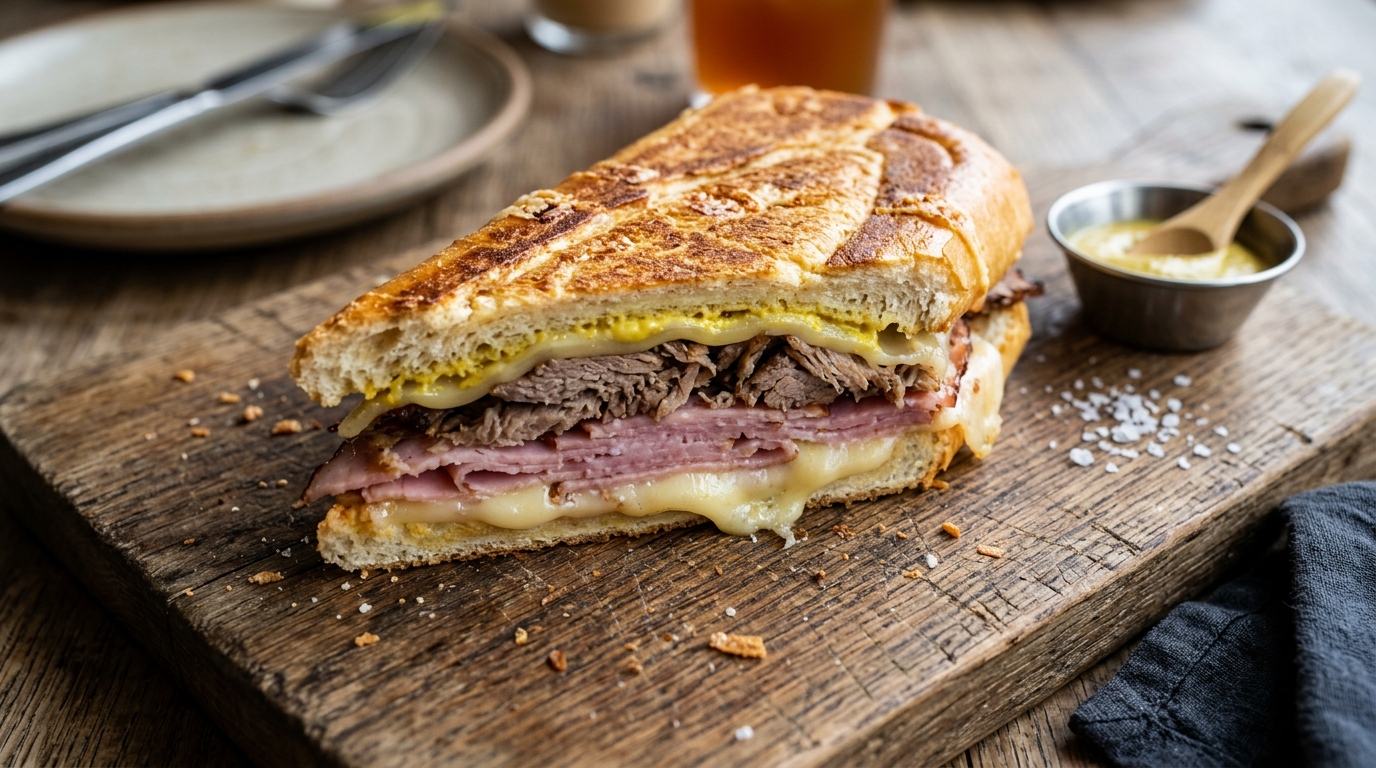
Next, consider the meats. You need high-quality, thin-sliced ham and the star of the show: the slow-roasted, garlic-heavy mojo pork. The garlic and sour orange notes in the pork provide the essential acid that balances the saltiness of the ham and the creaminess of the Swiss cheese. If you are in a city like Tampa, you will often find salami added to the mix. There is a long-standing debate between Miami and Tampa over this, but historically, the Tampa version includes it to honor the Italian immigrants who worked alongside Cuban laborers in the 20th-century cigar factories. If you are looking for the ‘mixto’ experience, don’t be afraid to embrace the salami.
The Philosophy of the Press
I once made the mistake of eating a Cubano that was simply heated in a toaster oven, and the experience was entirely flat. The press is not merely a heating tool; it is a structural necessity. When you press a sandwich for exactly the right amount of time, you are forcing the ingredients to mingle. The fat from the ham and pork begins to render and seep into the bread, which, combined with the mustard and the heat, creates a flavor bridge that makes the ingredients taste greater than the sum of their parts.
If you see a restaurant using a panini press that leaves distinct, deep grill marks, be wary. A proper Cuban sandwich press is usually flat, ensuring even, edge-to-edge browning without the charring that comes from deep grill marks. You want a uniform, golden-amber crust. When you bite into it, the sound should be audible to someone sitting across from you. If it doesn’t crunch, the press-work was insufficient. It is an exercise in heat management—the goal is to melt the cheese completely before the bread starts to burn, which requires a finely tuned temperature control that only experienced chefs master.
Navigating the ‘Purist’ vs. ‘Innovator’ Debate
In my travels, I have found that culinary purism can sometimes be a barrier to enjoyment. While I will always defend the integrity of the classic recipe—mustard, pickles, Swiss, ham, and pork—I have also encountered excellent ‘innovative’ versions. For example, some high-end butchers are now experimenting with double-smoked ham or custom-made pickles that are brined in-house for a sharper vinegar profile. These deviations work when they respect the original spirit of the sandwich.
However, there is a line that, once crossed, renders the sandwich something else entirely. Adding mayonnaise is the most common point of contention. Purists argue that the mustard already provides the necessary acid, and adding mayo creates a heavy, greasy mouthfeel that ruins the crispness of the bread. I tend to agree. When you add too many ‘extras,’ you mask the delicate balance of the mojo-marinated pork. If you are looking for an authentic experience, stick to the classics first. Once you have established a baseline for what a great Cubano should taste like, you will be much better equipped to judge whether a chef’s ‘bold’ new version is a creative triumph or a marketing gimmick.
Who Should Seek Out the Authentic Experience (And Who Should Not)
Understanding whether a high-quality, labor-intensive sandwich is worth your time depends on your personal food philosophy. I have found that it is often a divisive topic among casual diners.
This is ideal for:
Food Purists: If you appreciate the mechanics of a recipe and want to taste the history behind a dish, this is for you. You will respect the sourcing of the bread and the time taken to roast the pork.
The Texture-Obsessed: If you appreciate the sensory experience of a perfectly pressed, crispy-then-tender sandwich, the Cubano is unmatched.
Lunch Enthusiasts: For those who want a meal that is filling, savory, and requires no silverware, this is the gold standard.
You might want to skip this if:
You require variety: If you get bored eating the same core ingredients, a menu centered on a single, classic recipe might feel repetitive. There isn’t much room for customization without ruining the sandwich’s integrity.
You have strict dietary restrictions: This is a meat-heavy, gluten-rich, and dairy-inclusive meal. While some places offer vegetarian adaptations, they are usually a pale imitation of the original experience.
- You are in a rush to eat ‘fine dining’: Do not mistake a high-quality Cubano for a formal meal. It is a handheld, unpretentious staple of working-class culture, and it should be treated as such.
- The ‘Burger’ Eating Technique: Many people treat a Cuban sandwich like a burger, attempting to eat it with both hands from the side. Because of the long, thin structure and the specific way it is sliced, it is meant to be eaten as a ‘stick.’ Always eat it horizontally from one end to the other. If you try to bite into the side, the filling will slide out because the pressed bread has less structural integrity than a bun. My first time eating one, I made this mistake, and the cheese ended up on my shirt. Learn from my failure.
- Ignoring the Side Dishes: Do not ignore the side menu. A proper Cubano is intensely savory and acidic. It needs a companion. Traditionally, this is either plain potato chips or something like plantain chips or black beans and rice. I have seen people try to pair a Cuban sandwich with something heavy like a potato salad, which completely overwhelms the palate. Stick to the traditional light, salty sides that cleanse your tongue between bites of the pork.
- www.bbc.com
- tampabaydatenightguide.com
- 10best.usatoday.com
- tampabaydatenightguide.com
- www.thrillist.com
- miami.eater.com
Cost and Value Analysis
When you see a price tag on a high-end Cubano, you aren’t just paying for the ham and bread. You are paying for the labor of the roast, the specialized sourcing of the bread, and the daily maintenance of the grill equipment. A mediocre sandwich at a chain deli might cost you $9, but you are eating processed pork and mass-produced bread. A quality version will typically range from $14 to $20.
In my experience, the price delta is almost entirely justified by the effort involved. At an authentic shop, the kitchen team is starting their day by roasting pork for five hours and slicing pickles that were brined days prior. You are paying for the overhead of that culinary preparation. If you find a place charging under $12, it is often a red flag that they are sourcing pre-cooked, industrial pork. Always aim for the $15-$18 range if you want to ensure you are getting fresh, hand-pulled pork rather than sliced deli meat.
Common Mistakes to Avoid
After years of analyzing sandwich culture, I have noted two primary mistakes that consumers make, which significantly impact their enjoyment of the experience.
Frequently Asked Questions
Is a Cuban sandwich healthy?
While ‘healthy’ is subjective, it is a high-protein, calorie-dense meal. The primary concerns for health-conscious diners are the salt content in the ham and the fat in the cheese and pork. However, because it is essentially a whole-muscle roast, it lacks the processed preservatives found in most deli sandwiches. If you want to make it lighter, opt for a smaller portion size rather than looking for a ‘low-carb’ version, which rarely succeeds.
Can I make a good version at home?
Yes, but you will need a heavy press. The biggest hurdle for home cooks is the bread. You cannot use standard Italian bread. You must source bread that is thin and light. If you cannot find authentic Cuban bread, a high-quality, airy ciabatta can work in a pinch, provided you slice the top and bottom to make it thinner before pressing it. The marinade (mojo) is also vital—use real sour orange and plenty of fresh garlic.
Why does the quality vary so much between cities?
The main issue is the supply chain. Because Cuban bread is so specific, it is difficult to ship over long distances while maintaining its texture. Unless a city has a local bakery producing the bread daily, the sandwich will fail. Cities with strong Caribbean or Southern US roots have the local infrastructure to support these bakeries, which is why you see such high quality in places like Tampa or Miami compared to other regions.
Is the ‘Media Noche’ just a different name for the same thing?
Not exactly. A ‘Media Noche’ is the direct cousin of the Cubano, but it uses egg-enriched, slightly sweet bread—similar to challah or brioche. It is traditionally served late at night, hence the name. The filling is identical, but the bread profile is significantly softer and sweeter. It is worth trying if you find a shop that offers both, as it provides a totally different mouthfeel.
Conclusion: The Pursuit of Quality
My ongoing research into what makes an authentic Cuban sandwich has taught me that the best food is often the most simple. It is a dish that relies on the harmony of basic, quality ingredients rather than complex, avant-garde culinary techniques. When I find a shop that gets the mojo pork right and sources the bread from a local bakery, I know I am in for a memorable experience. While it is easy to find ‘good’ sandwiches in most cities, a truly great Cubano requires a specific dedication to craft that is becoming increasingly rare in our fast-food-dominated landscape.
If you find yourself in a neighborhood with a high density of small, independent sandwich shops, look for the one that smells of roasted garlic and citrus. Look for the flat press sitting on the counter. When you find it, order the classic. You don’t need fancy toppings or experimental sauces; the traditional recipe has survived for over a century because it is, simply put, perfect. Do not settle for the easy option. Seek out the place that takes the time to do it the right way, because the difference in flavor is not just subtle—it is the difference between a mediocre meal and a piece of culinary history.