
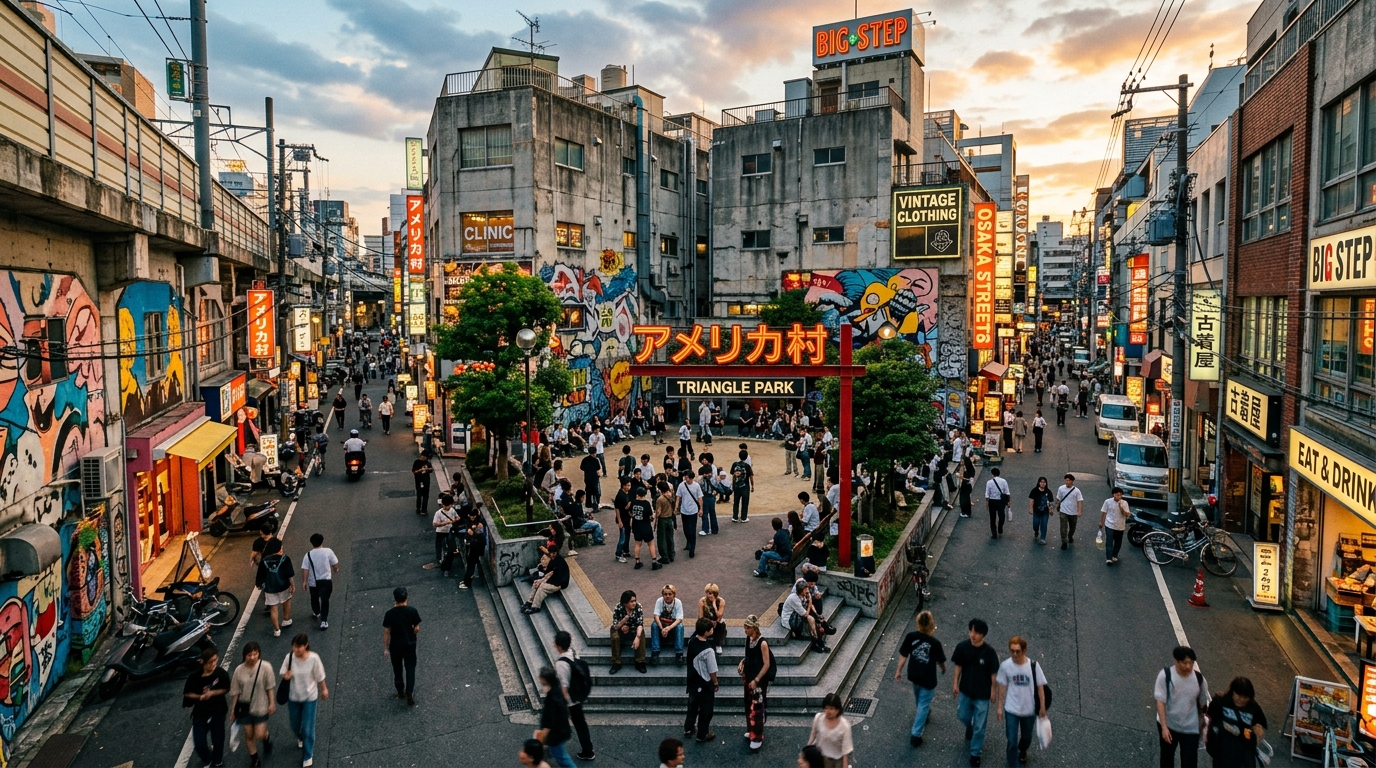

Discovering Amerikamura: osaka’s Youth Culture Epicenter
Amerikamura serves as the undeniable pulse of contemporary Osaka, standing apart from the city’s more polished shopping districts. Known by locals as Amemura, this compact zone situated between Shinsaibashi and Namba functions as the city’s primary center for street fashion, vintage clothing, and independent music. Unlike the serene temples of Kyoto or the massive department stores in Umeda, this district operates on a raw, late-night schedule that requires a bit of planning to navigate successfully. During my first visit, I made the mistake of arriving at 10:00 AM, only to find myself walking through shuttered streets in total silence—a lesson learned quickly about the local tempo.
Quick Summary: Essential Takeaways
Timing: Do not arrive before 12:00 PM; the energy hits its stride between 2:00 PM and 7:00 PM.
The Hub: Start at Triangle Park (Sankaku Koen) to get your bearings; it acts as the district’s social anchor.
Logistics: Many of the best shops reside on the second or third floors of nondescript concrete buildings; look up.
Payments: Carry between 5,000 and 10,000 yen in cash, as many independent vintage boutiques remain strictly cash-only.
The History of Japan’s American Village
I vividly remember stumbling upon a miniature Statue of Liberty perched atop a building and wondering how such a visual appeared in the middle of Osaka. During the late 1960s and 70s, this area functioned as a gritty warehouse zone for charcoal storage. Eventually, merchants began importing lifestyle goods directly from the United States, giving the neighborhood its identity and the name “American Village.”
In 1969, the opening of a cafe called Loop changed everything, drawing in creative thinkers and musicians who wanted to move away from mainstream retail. By the 1990s, the district had firmly cemented its status as the epicenter of Japanese street style. Today, the area reflects a collision of the past and the hyper-modern, where narrow alleyways house world-class record shops and independent fashion labels that define the current local aesthetic.
Navigating the Neighborhood: Timing is Everything
One common frustration for first-time visitors is arriving too early. If you try to fit this into a morning itinerary, you will miss the point. Most shops in Amemura do not open their doors until noon. The following table illustrates the daily cycle of the district:
| Time Window | Activity Level | Best For |
|---|---|---|
| Before 12:00 PM | Minimal | Street photography and empty lanes |
| 12:00 PM – 2:00 PM | Waking Up | Browsing shops with smaller crowds |
| 2:00 PM – 7:00 PM | Peak Energy | People-watching and major shopping |
| After 8:00 PM | Nightlife | Bars, izakayas, and late-night eats |
If you want the best experience, I recommend pairing your visit with a morning stop at Kuromon Market to sample seafood. Once you finish your meal, head toward Shinsaibashi Station in the early afternoon to begin your deep dive into the shops.
The Art of the Hunt: Vintage and Streetwear
Shopping here is less about convenience and more about the hunt. You will find that many of the best stores hide on upper floors or tucked-away basements. WEGO remains a local staple for affordable, reworked apparel, while Kinji at BIGSTEP offers a cavernous floor plan filled with well-organized, retro fashion pieces.
For those interested in subcultures, Angelic Pretty Osaka is a required stop for its iconic, lace-heavy designs. If you have a passion for analog media, King Kong Honten—located in the basement of BIGSTEP—is a legitimate sanctuary for rare vinyl records. Do not be afraid to duck into stairwells; some of the most specialized denim and streetwear brands in Japan are found behind unmarked industrial doors.
Local Dining: Eat Like an Insider
Dining in this district often happens in small, cramped spaces that barely accommodate four people, but that is exactly where the charm lies. My favorite spots are usually tucked away on upper floors of buildings like Mitsudera Kaikan.
Critters Burger: They offer a genuine, high-quality burger that pays incredible attention to detail, far better than most standard chain options.
Tachibana: If you want a standing-only experience that captures the chaotic energy of the neighborhood, this is the place to be.
- Amemura Shainshokudo: An ideal choice if you want an all-you-can-drink option paired with rich, hearty sukiyaki.
- www.japannakama.co.uk
- www.eater.com
- www.nationalgeographic.com
- www.going.com
- www.preview.ph
Be warned: many of these spots have limited seating and rarely take reservations. If you arrive during peak dinner hours (7:00 PM), prepare to wait in a narrow stairwell for your turn. It is not an experience for those who need comfort or privacy.
Practical Tips for Your Visit
Planning your trip to Amerikamura requires acknowledging a few logistical realities. First, keep your cash on you. While massive malls like BIGSTEP accept credit cards, the best vintage spots often stick to cash-only policies. Nothing ruins a shopping trip faster than finding a one-of-a-kind vintage jacket only to realize you are out of yen.
Second, keep an eye on your mobile connectivity. I found that public Wi-Fi is patchy at best, so downloading your offline Google Maps or using an eSIM is critical for navigating the maze-like blocks. Lastly, do not rely purely on street addresses, as they can be confusing. Memorize key visual landmarks like the Triangle Park plaza or the distinctive entrance to the BIGSTEP mall to keep your bearings.
Frequently Asked Questions
1. Is Amerikamura suitable for families with young children?
While the area is safe, it is extremely dense, loud, and focuses on youth culture rather than child-centric attractions. The sensory input—loud music, flashing neon signs, and tight alleyways—might overwhelm younger children. If you prefer a calmer experience, visit before 2:00 PM when the streets are quieter, or spend your time in the more spacious shopping districts of Umeda instead.
2. Can I use my IC card for all shopping and dining in the area?
Not necessarily. While you can use your ICOCA or Suica cards for all trains and buses leading to the area, many of the smaller, independent vintage shops and underground bars in the district are strictly cash-only. It is always wise to keep at least 5,000 to 10,000 yen in cash on your person when exploring this specific neighborhood to avoid any awkward moments at the register.
3. How much time should I set aside for a full visit?
For a casual stroll and a quick snack, two hours is sufficient. However, if you are a fan of vintage shopping, record collecting, or exploring the hidden izakayas, you should block out 4 to 5 hours. Because the area is located just a 15-minute walk from Dotonbori, many travelers combine a 3-hour shopping block here with an evening of food tours in the neon-lit canal district to maximize their time in Osaka.
Conclusion: Embrace the Chaos
Visiting this neighborhood is not about checking off a tourist list; it is about leaning into the fast-paced, sometimes messy reality of modern urban Japan. Whether you are hunting for rare vinyl records, scoring a vintage deal at 2nd Street, or just watching fashion trends evolve in real-time at Triangle Park, the district offers a perspective on what makes the city tick. By moving past the main streets and exploring the floors above you, you will discover the creative engine that drives Osaka forward.