
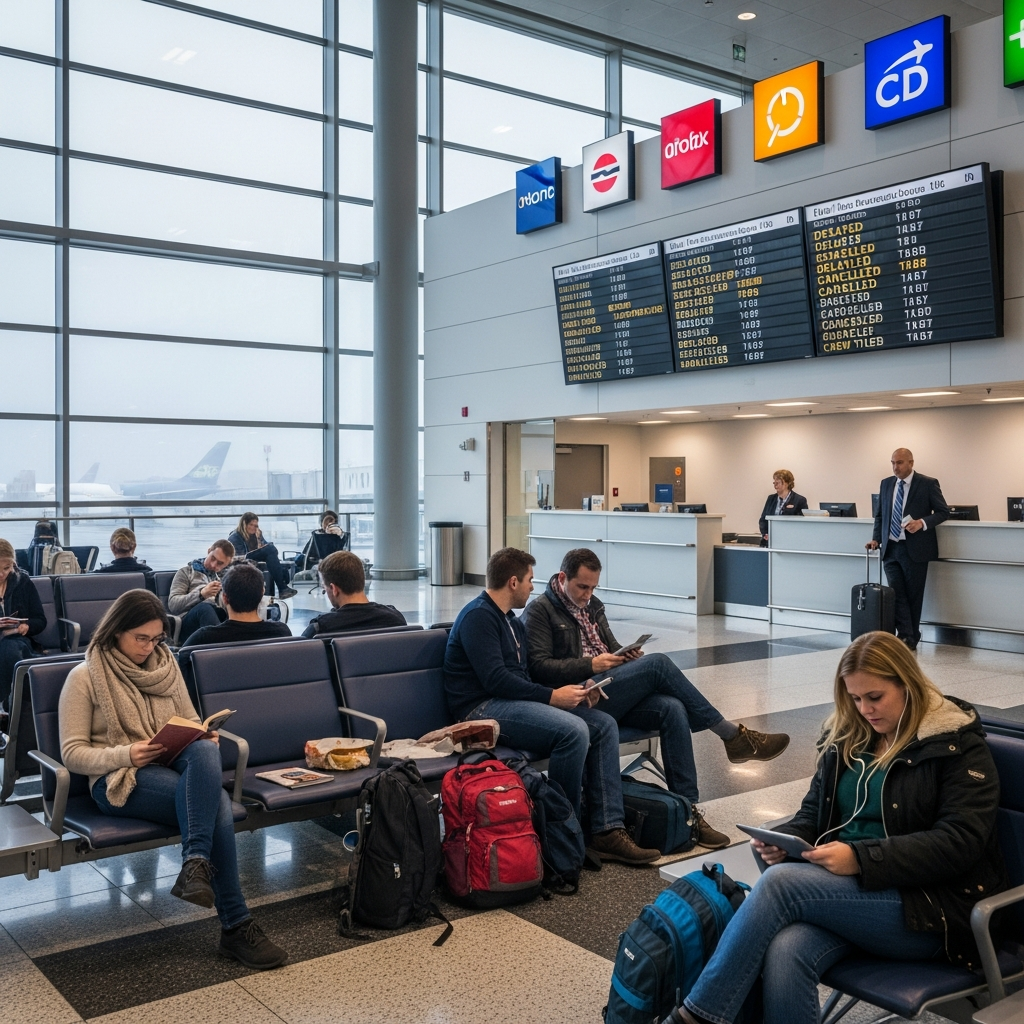

Europe Flight Chaos: Navigating Delays & Your Rights
European skies were plunged into widespread flight chaos on March 24, 2026. This unprecedented disruption left thousands of travelers stranded. Facing unexpected overnight stays and critical missed connections, passengers experienced significant uncertainty. With 1,838 flights delayed and 90 cancelled, this massive air travel disruption primarily hit major hubs. These included airports in the Netherlands, France, and Germany. The ripple effect stretched across the entire European air network. This essential guide delves into the intricate causes of such extensive European flight disruptions, highlighting affected airports and offering vital advice for travelers.
Unpacking the Scale of the Crisis: Delays & Cancellations Soar
The impact was immediate and far-reaching. Bustling airport terminals quickly transformed into scenes of frustration. Long queues and increased wait times became the norm. Key destinations like Paris, Munich, and Amsterdam faced severe bottlenecks. Aviation analysts pointed to a complex interplay of systemic vulnerabilities, not a single incident. Europe’s tightly interconnected air network meant problems in one hub rapidly escalated. Airlines operate with extremely tight punctuality margins. This leaves little room to absorb unexpected external pressures.
European Hubs Under Immense Strain: A Detailed Overview
From the UK to the Mediterranean, major European airports struggled to manage the operational strain. Each critical junction in global air travel encountered distinct challenges. These collective issues fueled the continent-wide disruption.
London Heathrow (LHR): UK’s Busiest Gateway Battles Delays
London Heathrow, one of Europe’s most active gateways, bore a substantial brunt. The airport recorded 13 cancellations and 156 delays. This left countless passengers scrambling for rebookings. Long-haul flights were particularly affected. Notable cancellations included services to Bahrain, Tel Aviv, and Raleigh-Durham. British Airways, American Airlines, and Air India passengers faced significant inconvenience. This demonstrated the global reach of these localized issues.
Amsterdam Schiphol (AMS): A Critical Hub Overwhelmed
Amsterdam Schiphol, a pivotal European transfer hub, experienced severe turmoil. The airport saw 27 cancellations and 179 delays. This created a profound domino effect on connecting flights. KLM, the Dutch national carrier, was particularly impacted. They reported 80 delays and three cancellations, including key short-haul services. Disruptions extended across Europe. Flights to cities like Nuremberg, Paris, and Oslo were affected. Several long-haul routes, such as Qatar Airways’ service to Hamad International, also faced issues. Schiphol’s capacity was clearly overwhelmed.
Paris Charles de Gaulle (CDG): France’s Gateway Faces Backlogs
Paris Charles de Gaulle, another major European aviation hub, also suffered extensively. It recorded 23 cancellations and 238 delays. This surge created substantial backlogs in airport lounges. It also led to incredibly long queues at check-in counters. Travelers were advised that delays could stretch for hours. Additional disruptions were expected as the airport worked to stabilize operations. The situation highlighted the fragility of high-volume air traffic management.
Germany’s Key Airports: Frankfurt & Munich Under Pressure
Frankfurt International, Germany’s busiest airport, contended with 5 cancellations and 198 delays. As a critical transfer point, delays here generated a vast ripple effect. Munich International, typically known for smoother operations, saw 6 cancellations and 94 delays. This raised concerns about connection reliability. Travelers through these German hubs were advised to allow extra time.
Ripple Effects Across the Continent: Other Major European Airports
The disruption extended far beyond these primary hubs. Numerous other critical airports felt the strain:
Zurich Airport: Recorded 1 cancellation and 101 delays.
Madrid-Barajas Adolfo Suárez: Experienced 4 cancellations and 191 delays.
Rome Fiumicino: Italy’s busiest, reported 4 cancellations and 158 delays.
Copenhagen Airport: Faced 4 cancellations and 87 delays.
Oslo Gardermoen: Had 10 cancellations and 50 delays, with higher regional impact.
Stockholm Arlanda: Experienced 7 cancellations and 54 delays, causing long waits.
Brussels Airport: No cancellations but 65 flights delayed.
Lisbon Humberto Delgado: Recorded 1 cancellation and 130 delays.
Athens Eleftherios Venizelos: Reported 5 cancellations and 70 delays.
Even airports with fewer cancellations grappled with significant delays. This showed how localized issues quickly strained the entire network.
Decoding the Causes: Why Europe’s Airspace Stalled
The root causes of this widespread Europe flight chaos were multifaceted. They stemmed from a convergence of environmental, operational, and systemic factors. This created a “perfect storm” for air travel disruption.
The “Perfect Storm”: Weather, Capacity, and ATC Issues
Adverse weather conditions played a substantial role. Across the UK and the Netherlands, fog, heavy rain, and strong winds severely hampered visibility. Heathrow, for example, experienced low visibility. Simultaneously, significant airspace congestion plagued several European corridors. Air traffic control (ATC) limitations, especially in France, forced reroutings. This further prolonged travel times and contributed to holding patterns.
Staffing & Operational Challenges Exacerbate Problems
Extensive schedule instability was worsened by existing capacity constraints. Many airports and airlines continue to face lingering staffing shortages. These impact ground handling, security, and air traffic control. This leads to logistical bottlenecks and slower processing times. With consistently high travel demand, airlines often operate schedules near maximum capacity. This leaves minimal “slack” to absorb sudden shocks. The underlying global context further complicates matters. Reports from early March 2026 revealed similar staffing concerns in the US. A Department of Homeland Security (DHS) shutdown, for instance, led to reduced TSA officer pay, threatening security checkpoint delays for the Spring Break period. Such widespread staffing fragility indicates a systemic vulnerability that can easily cascade across continents.
The Cascading Effect of Network Vulnerability and Global Tensions
Europe’s aviation network is inherently tightly interconnected. Disruptions at key hubs like Amsterdam or London rapidly cascade. The cumulative effect of earlier delays, where aircraft and crews arrive late, triggers widespread knock-on effects. This displaces aircraft and personnel, often resulting in missed connections. The situation is further complicated by broader geopolitical factors. Just weeks prior, an escalating US-Iran conflict caused significant Middle East airspace closures. This forced widespread rerouting of international flights and even led to damage at Dubai and Abu Dhabi airports. Such events, while geographically distant, add immense pressure to global air traffic management. They limit routing options and contribute to airspace congestion worldwide, indirectly straining European operations already dealing with their own “perfect storm” of issues.
Navigating the Chaos: Essential Advice for Travelers
For those planning to travel through Europe, preparedness and flexibility are crucial. These practical takeaways can help mitigate the impact of European flight delays.
Real-Time Information: Your Best Ally
Passengers are strongly advised to closely monitor their flight status. Use official airline apps, websites, and airport information channels. Subscribing to email or SMS alerts can provide crucial real-time updates. During large-scale disruptions, app-based rebooking tools are often faster. They are more effective than waiting in long queues at overwhelmed customer service desks. Proactive checking can save hours of uncertainty.
Prepare for Contingencies: Flexibility is Key
Building flexibility into your travel plans is essential. Consider allowing more generous connection times. This is especially true when relying on a single airport or during peak travel. Have contingency plans for accommodation. Research alternative routings in advance. Examples include rail links between nearby hubs or flights from secondary airports (e.g., Gatwick, London City). Remaining adaptable to itinerary changes is crucial.
Understanding Your Passenger Rights (EU261)
Under European Union passenger rights regulation EU261, travelers are entitled to assistance. This applies during significant flight delays or cancellations. This typically includes meals, refreshments, and communication access. For extended waits, hotel accommodation is also provided. Depending on the specific cause (airline-controlled vs. extraordinary circumstances like severe weather) and delay duration, passengers might also be eligible for financial compensation. Consumer advocates emphasize the importance of understanding these passenger rights and documenting all disruptions.
Airline Performance Amidst the Turbulence
The impact of the Europe flight chaos affected various airlines differently. This highlighted varied operational resilience. Major carriers like Lufthansa and British Airways reported minimal overall* disruptions for some flights. However, their passengers at hubs like London Heathrow and Amsterdam Schiphol still faced significant inconvenience. KLM, operating extensively from Amsterdam Schiphol, reported 80 delays and three cancellations. This shows a direct and substantial impact. American Airlines, Air India, Gulf Air, and El Al also experienced notable issues for long-haul services through London Heathrow.
Europe’s leading low-cost carriers navigated the chaos with mixed results. easyJet reported 15 delayed flights but no cancellations. Ryanair also showed efficiency, with only 1 delayed flight and no cancellations. Finnair also maintained a smooth experience. However, SAS faced considerable pressure managing disrupted schedules. Generally, shorter regional segments often bore the brunt of cancellations. Airlines prioritized restoring core hub and longer-haul services.
Frequently Asked Questions
Why was European air travel so disrupted on March 24, 2026, considering global factors?
The widespread Europe flight chaos on March 24, 2026, stemmed from a “perfect storm” of adverse weather, significant airspace congestion, and persistent operational challenges like staffing shortages. This local vulnerability was exacerbated by a broader, ongoing global instability in early March. Previous weeks saw severe disruptions in the Middle East due to geopolitical conflicts, forcing extensive international flight rerouting. The North American continent also experienced significant flight chaos and staffing issues. These global stressors put additional strain on an already fragile European aviation system, limiting routing options and reducing operational resilience.
What are the best strategies for travelers facing significant flight delays or cancellations in Europe?
Travelers should prioritize vigilance and flexibility. Immediately check official airline apps and websites for real-time flight status updates and rebooking options; these digital tools are often more efficient than airport queues. Prepare for contingencies by booking flights with generous connection times and researching alternative travel routes like high-speed rail. Consider secondary airports for flexibility. Always be aware of your passenger rights under EU261, which mandates assistance and potential compensation for significant European flight disruptions, and keep all travel documentation organized.
What compensation and assistance can I expect under EU261 for Europe flight chaos?
Under EU261, if your flight is significantly delayed or cancelled, you are entitled to “right to care.” This includes meals, refreshments, and communication access. If an overnight stay is necessary, the airline must provide hotel accommodation and transport. For flight delays exceeding three hours (and depending on the distance), or cancellations, you may also be eligible for financial compensation ranging from €250 to €600, provided the disruption was within the airline’s control and not due to “extraordinary circumstances” like severe weather or unforeseen security risks.
The Path Forward: Resilience in European Air Travel
The extensive Europe flight chaos on March 24, 2026, served as a stark reminder. Modern air travel is inherently vulnerable to concentrated periods of operational strain. While the immediate peak of disruption eased, residual effects persisted for days. Carriers worked tirelessly to reposition aircraft and crews. For current and future travelers, the lessons are clear: vigilance, flexibility, and a thorough understanding of passenger rights are your most valuable assets. As Europe’s aviation industry continues to adjust to high travel demand amidst ongoing infrastructure and staffing considerations, a commitment to resilience in both airline networks and personal travel planning will be paramount for minimizing future air travel disruption.
“,
“imagegenerationprompt”: “A bustling, modern European airport terminal during a period of significant flight disruption. Show a mix of frustrated and patient travelers, some looking at departure boards showing multiple ‘Delayed’ or ‘Cancelled’ statuses. Include subtle hints of bad weather outside a large window (e.g., fog, rain). The scene should convey a sense of controlled chaos but with an underlying theme of resilience. Use a slightly muted color palette with pops of airline branding colors