
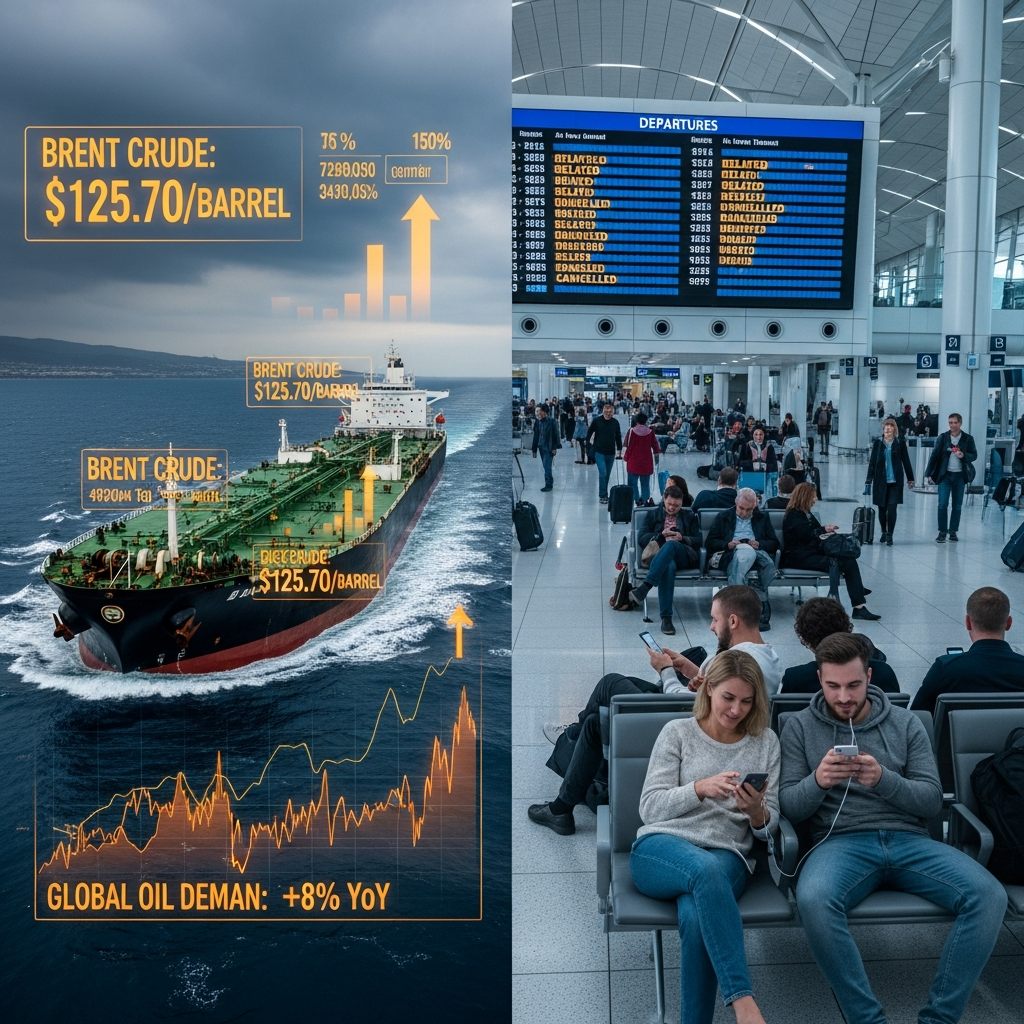

The intensifying Iran-Israel conflict has thrust global energy markets and the tourism sector into unprecedented turmoil. Since late February 2026, escalating Middle East tensions have severely impacted critical oil routes, notably the Strait of Hormuz, which facilitates nearly 20% of the world’s oil and gas flows. This disruption has catapulted crude prices well above $100–$126 per barrel, driving jet fuel and transport costs dramatically higher. In response, nations worldwide, including the UK, US, Canada, Germany, France, Spain, and Italy, are urgently deploying comprehensive tourism resilience strategies to counteract surging travel and energy expenses. This article delves into the geopolitical shifts, economic ramifications, and innovative solutions emerging as the world navigates this profound global travel and energy crisis.
The Geopolitical Earthquake: Choking Global Energy Flows
The Strait of Hormuz crisis stands as the epicenter of this global travel and energy crisis. Heightened geopolitical risks, including alleged attacks on commercial vessels and threats to vital infrastructure like Qatar’s LNG complex, have compelled oil tankers to reroute or remain idle. This creates significant supply shortages and pushes oil market disruption to historic levels.
Strait of Hormuz: The Crucial Chokepoint
Normally, about 20 million barrels per day of crude oil and products pass through the Strait of Hormuz. However, conflict has reduced this vital flow to a mere trickle. This instability directly translates to higher operational costs for airlines, hotels, and local transport systems globally. The International Energy Agency (IEA) has warned that without immediate intervention, these disruptions could lead to unsustainable price hikes, severely impacting global economies and causing widespread aviation disruption. IEA Executive Director Fatih Birol describes the situation as “the greatest global energy security threat in history,” surpassing the 1970s oil shocks.
Global Response: Emergency Oil Releases
In a historic, coordinated effort, the IEA and 32 member nations, including Spain, Canada, Japan, the UK, Germany, the US, and France, initiated an emergency oil release. This commitment involved releasing a record-breaking 400 million barrels of oil over 90 days from emergency reserves. This represents the largest stock draw in the agency’s history. The United States leads with 172 million barrels from its Strategic Petroleum Reserve (SPR). Germany, the UK, and France contribute 19.5 million, 13.5 million, and 9 million barrels respectively. Canada is also boosting its oil sands production by 140,000 barrels per day. These combined actions aim to stabilize global oil markets and mitigate the severe Strait of Hormuz impact, though IEA notes supply-side measures alone are insufficient.
Aviation Under Pressure: Soaring Jet Fuel Costs & Airfare Hikes
The surge in jet fuel costs has forced airlines globally to implement significant airline fuel surcharges, directly eroding travel affordability. Fuel and labor are airlines’ two largest expenses, and jet fuel prices have nearly doubled since the conflict began, with no immediate relief in sight. Many carriers, often with limited fuel hedging, pass these increased operational costs directly to passengers.
The Cost of Flying: Fuel Surcharges & Dynamic Pricing
Major airlines like British Airways, American, Lufthansa, Air France-KLM, SkyWest, and Vueling are adjusting pricing strategies to cope. Airspace restrictions and rerouting due to the geopolitical conflict travel also lead to longer journey times and increased operational expenses. The substantial reduction in available airline seats, with millions removed from key routes, further exacerbates price increases. Airlines utilize “dynamic pricing” algorithms to determine maximum fares, leading to extreme examples such as a Cathay Pacific business class return ticket from Sydney to London advertised at nearly A$40,000.
Route Disruptions & Fare Impacts
The impact across global routes has been dramatic:
US Domestic Routes: Transcontinental fares saw sharp increases. New York (JFK) to Los Angeles (LAX) surged by 148% (from $167 to $414). Washington Dulles (IAD) to San Francisco (SFO) jumped 237% ($149 to $502).
Transatlantic Routes: New York (JFK) to London (LHR) saw Delta fares climb 94% ($285 to $553) and United fares by 177% ($305 to $846).
Caribbean Routes: Leisure travel routes experienced significant inflation. JetBlue fares from New York (JFK) to Santo Domingo rose up to 243% ($165 to $566).
Asia-Europe Routes: Cathay Pacific doubled fuel surcharges on Hong Kong-Europe routes by 108% (€62 to €129). Flights like Bengaluru to Munich saw fare increases up to six times due to rerouting.
India-US Long-Haul: Air India introduced phased fuel surcharges, leading to economy return fares rising by up to 125% (₹45K-1L to ₹1.3L-2.25L).
Despite these substantial price hikes, demand for air travel has largely remained resilient, particularly ahead of peak travel seasons. This allows airlines to sustain higher pricing without significant declines in passenger load factors, though passengers are urged not to proactively cancel flights, but wait for airline cancellations for better rebooking or refund options.
National Strategies for Tourism Resilience: A Global Overview
Facing these challenges, diverse national strategies are emerging to protect the tourism industry and ensure tourism resilience.
Leading with Domestic Strength: US & Canada
The United States leverages its formidable $895 billion domestic leisure market. This makes it less dependent on long-haul inbound traffic. Domestic road trips, regional aviation, and short-haul travel sustain demand. The upcoming FIFA World Cup 2026 is projected to attract 1.24 million incremental international visitors, helping offset global route disruptions. Airlines are redistributing capacity towards domestic and transatlantic corridors, ensuring occupancy stability for hotels.
Canada recorded 90.6 million domestic trips in Q2 2025, a record high. This compensates for any decline in international arrivals. Government initiatives like the Canada Strong Pass and free national park access in 2026 stimulate internal tourism. Beyond this, Canada contributes 23.6 million barrels to the IEA’s emergency oil release and strategically increased its oil sands production, further supporting global energy stability.
European Adaptations: UK, Germany, France, Spain, Italy
The United Kingdom is enhancing its tourism resilience through targeted marketing and regional development. Initiatives like the “Starring GREAT Britain” campaign promote diverse destinations, reducing reliance on traditional hotspots like London. Despite rising fuel costs, the UK’s strong brand and cultural appeal attract international travelers, with domestic tourism providing a vital buffer.
Germany’s tourism resilience is rooted in its €425 billion domestic tourism market, contributing €499 billion to its GDP. This minimizes dependence on volatile international arrivals. The National Tourism Strategy (January 2026) prioritizes sustainability, digitalization, and regional development. Domestic tourism continues to drive demand, supporting hotels and transport.
France, a top destination with 102 million international visitors, secured 87% fuel hedging for Air France-KLM to stabilize ticket pricing. Simultaneously, France accelerates its shift towards high-speed rail and “slow travel” for intra-European movement. This reduces reliance on expensive flights and aligns with sustainability goals, cushioning fuel volatility.
Spain has shifted to a “quality over quantity” model, targeting higher-spending visitors. New visitor levies, up to €15 per night in the Balearic Islands, generate additional revenue to offset rising operational costs. Spain’s strong brand continues to attract high-value travelers, maintaining economic returns despite global travel volatility.
Italy, with 185 million total arrivals, leverages scale and diversification. Prime Minister Giorgia Meloni’s strategy redistributes tourists across Italy’s vast, underutilized regions (96% under-visited). Encouraging longer stays and regional exploration mitigates the impact of higher travel costs, partially offsetting aviation disruptions with domestic and intra-European travel.
The Energy Security Divide: Dependence vs. Self-Sufficiency
The ability of major tourism economies to withstand this global travel and energy crisis is closely tied to their energy independence. The United States and Canada are structurally protected by strong domestic oil production and regional supply chains. In contrast, European economies—France, Germany, Italy, and Spain—are heavily import-dependent, sourcing up to 90–100% of their crude oil. While diversification towards suppliers like the US, Norway, and Africa has reduced single-supplier reliance, natural gas markets remain fragile due to LNG dependence, linking European energy security directly to geopolitical tensions. The UK holds a hybrid position, benefiting from North Sea production and Norwegian imports.
Amidst this crisis, several tourism-dependent nations are pivoting their energy strategies. Countries including China, Turkey, Brazil, South Korea, Singapore, and India are increasingly relying on discounted Russian crude and petroleum products. This strategic shift is facilitated by a 30-day US sanctions waiver in March 2026 and Russia’s “shadow fleet” of tankers. For example, China’s imports of Russian crude surged by 40.9% year-on-year in February 2026, stabilizing jet fuel costs for Chinese airlines. India, facing disrupted Middle Eastern supply, saw its Russian crude imports jump 45–50% in March 2026, ensuring stable aviation fuel. This re-alignment is critical for maintaining stable operating costs for aviation, hotels, and transport networks in these economies.
IEA’s Urgent Call: Strategies to Curb Demand & Save Energy
The IEA emphasizes that supply-side interventions alone are insufficient. Addressing demand is a critical and immediate tool to alleviate pressure and bolster energy security. The IEA, through its executive director Fatih Birol, has issued urgent guidance to governments, businesses, and individuals, outlining 10 practical measures to curb global energy consumption.
These IEA recommendations largely focus on reducing demand, particularly in transport:
Reduce driving speed limits: Lowering highway speed limits by at least 10 km/h (6 mph) for all vehicles.
Encourage working from home: To reduce daily commuting, directly displacing oil use.
Promote public transport: Shifting from private cars to buses and trains.
Alternate private car access to city centers: Limiting vehicle numbers on specific days.
Encourage car sharing and efficient driving habits: Maximizing vehicle occupancy and optimizing fuel use.
Avoid air travel where possible: Especially business flights, to ease pressure on jet fuel markets.
Switch to electric cooking: To reduce reliance on gas.
- Preserve liquid petroleum gas (LPG): By switching bio-fuel converted vehicles to gasoline.
- www.bbc.com
- www.blackenterprise.com
- theconversation.com
- www.travelandtourworld.com
- dailypioneer.com
Some Asian countries have already implemented similar energy-saving measures, such as imposing minimum air conditioning temperatures (25-26 degrees), implementing shorter hours for schools and universities, limiting air travel for public officials, and even adopting a four-day work week for public servants. Historically, similar crises spurred nuclear power construction and significant car industry efficiency improvements; this crisis is expected to boost renewable energy and battery technology.
Beyond the Crisis: The Rise of Sustainable Tourism
Amidst global energy and travel challenges, Costa Rica presents a contrasting success story, demonstrating the power of focused sustainable travel and eco-tourism. In early 2026, the country experienced five consecutive months of rising international arrivals, welcoming over 600,000 visitors in January and February alone—a 14.1% year-on-year increase in February. This boom is fueled by a global appetite for its rainforests, pristine beaches, and diverse wildlife, differentiating it in the competitive global market.
North America remains the dominant source, with the US as the top individual market and Canada showing a remarkable 32% increase. European markets also contributed significantly, with a 12.7% increase. Costa Rica’s unwavering focus on sustainability and environmental protection, alongside well-preserved ecosystems, is a major draw. This solidifies its status as a leading global travel destination and offers a valuable model for resilience during widespread crises.
Navigating the Future: Challenges & Outlook for Global Travel
The immediate goals of the IEA’s oil release have shown positive impact, with global oil prices stabilizing and supply disruptions easing slightly. However, the global oil market remains inherently vulnerable due to ongoing political instability in the Middle East. The effectiveness of combined national and international strategies will be crucial in restoring full balance to energy markets and safeguarding the global tourism industry. The contrast with Costa Rica highlights that unique value propositions, especially in sustainable travel, can offer significant resilience even during widespread crises. Without a prompt resolution to the underlying conflict, the economic and market repercussions are destined to escalate further, making demand-side interventions indispensable for mitigating immediate and prolonged impacts. Adaptability, strategic planning, and collective global action will be paramount for nations and travelers alike in the years to come.
Frequently Asked Questions
What are the direct impacts of the Middle East conflict on global fuel prices and travel costs?
The ongoing Iran-Israel conflict, intensifying since early 2026, has severely disrupted critical oil transit through the Strait of Hormuz, a chokepoint for 20% of global oil flows. This disruption has caused crude oil prices to surge past $100 per barrel, directly inflating jet fuel costs and transport expenses. Airlines are imposing significant fuel surcharges and increasing airfares, with some routes seeing price hikes of over 200%. Rerouting flights due to airspace restrictions also leads to longer journey times and higher operational costs, translating to more expensive and complex international travel for passengers.
What specific measures is the International Energy Agency (IEA) recommending to reduce energy consumption amid this crisis?
The IEA is urgently calling for demand-side measures to mitigate the global travel and energy crisis. Key IEA recommendations include promoting working from home, lowering highway speed limits by at least 10 km/h, encouraging the use of public transport and carpooling, and avoiding non-essential air travel, especially business flights. Additionally, the IEA suggests switching to electric cooking where feasible and preserving liquid petroleum gas (LPG) by shifting bio-fuel converted vehicles to gasoline. These measures aim to alleviate pressure on energy markets and improve affordability.
How are major tourism economies adapting their strategies to maintain travel sector stability despite rising costs?
Major economies are implementing diverse tourism resilience strategies. The US and Canada leverage their strong domestic tourism markets and event-driven travel, with Canada also increasing oil production. European nations like France utilize airline fuel hedging and promote “slow travel” via high-speed rail. Spain focuses on revenue optimization by targeting high-spending visitors and introducing levies, while Italy and the UK diversify their tourism offerings geographically. Furthermore, several nations, including China and India, are strategically pivoting to discounted Russian crude and petroleum products to stabilize aviation and other travel sector costs.