
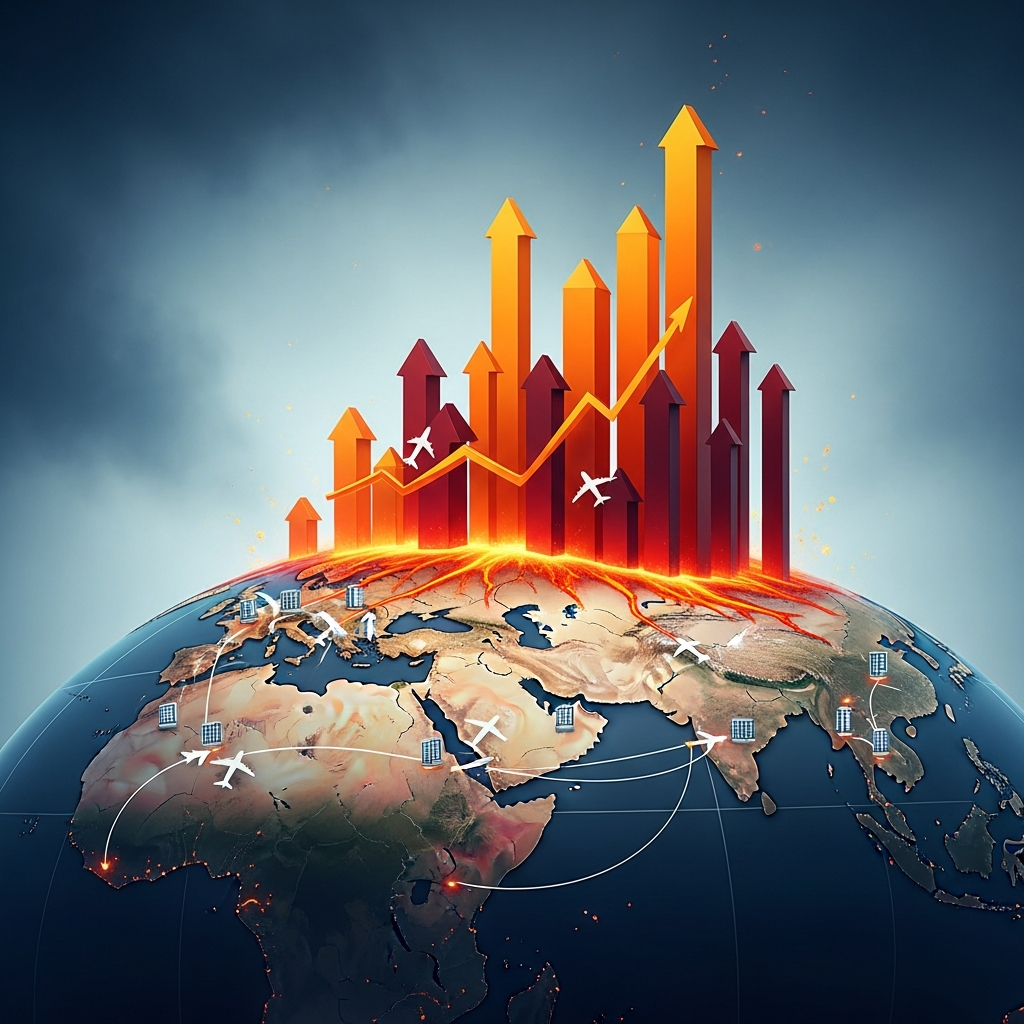

Global Travel Shock: Oil Surge Redefines Asia & Europe’s Tourism
The global travel industry is navigating its most significant challenge in decades. An unprecedented oil surge, fueled by escalating geopolitical tensions and critical supply disruptions, is fundamentally reshaping the tourism landscape across Europe and Asia. Nations from the UK to Japan are grappling with sky-high aviation fuel costs, inflating airfares, and straining the entire hospitality sector. This isn’t just a temporary blip; it’s a structural shift demanding immediate adaptation from travelers and businesses alike.
The Unprecedented Fuel Crisis Unfolds
Crude oil prices have surged dramatically, often trading between $110-$114 per barrel, far surpassing the $100 mark. Experts warn prices could fluctuate from $100-$130 in the near term, potentially soaring to $150-$200 if disruptions persist. This sharp increase is largely due to an embedded war-risk premium stemming from the “US-Israel war on Iran,” which commenced on February 28, 2026. Devastating strikes on critical energy facilities in the Gulf region, including Iran’s retaliatory actions and an effective closure of the vital Strait of Hormuz—a chokepoint for nearly 20% of global oil trade—have created a severe supply shock.
Supply disruptions are estimated at an alarming 8-10 million barrels per day, marking the most severe market shock in decades. The impact was dramatically highlighted by Iran’s strike on Qatar’s Ras Laffan Industrial City on March 19, 2026. This facility, responsible for approximately 20% of global LNG supply, suffered extensive damage with repairs potentially spanning three to five years. Similar strikes on the UAE’s Habshan gas complex and Bab oil field further intensified the crisis, threatening a global recession, as noted by external analyses. To mitigate immediate price spikes, the International Energy Agency (IEA) has authorized the largest coordinated release of strategic petroleum reserves in history. However, a gradual normalization toward $60-$80 is only anticipated by late 2026 if supply routes stabilize.
Aviation Industry Under Siege
The aviation sector is bearing the brunt of this evolving tourism crisis. Jet fuel, typically accounting for 25-35% of an airline’s operating expenses, has seen its costs skyrocket, jumping from $85-$90 per barrel pre-conflict to $150-$200. This dramatic spike has forced airlines across Europe and Asia to recalibrate their operations.
Carriers are implementing a range of urgent measures:
Recalibrating routes: Airlines are adjusting flight paths to minimize fuel burn and avoid conflict zones.
Reducing flight frequencies: Fewer flights are being offered, particularly on less profitable long-haul routes.
Introducing fuel surcharges: Many airlines are adding extra fees to tickets to protect their razor-thin margins. Hong Kong Airlines, for instance, increased surcharges by up to 35.2% on some routes, while Korean Air tripled long-haul surcharges.
Long-haul routes are particularly vulnerable, leading to reduced connectivity between key tourism markets. Budget airlines face an even greater squeeze, often passing costs directly to consumers. Rising aircraft leasing, maintenance, and insurance costs further compound financial strain. While some carriers like Lufthansa and Ryanair had hedging in place, others like SAS were vulnerable, having no fuel consumption hedged for the following 12 months. Air New Zealand suspended its financial outlook for 2026, raising one-way economy fares significantly (NZ$10-90) across domestic, short-haul, and long-haul international flights. The conflict has also created “airspace chaos,” with rerouting due to missile attack threats, further exacerbating challenges from the Ukraine war and making Europe-Asia routes longer and more costly. The industry faces constrained capacity and elevated pricing, fundamentally reshaping global travel flows and limiting affordability.
Europe’s Varied Resilience to the Travel Shock
European nations are showing diverse responses and vulnerabilities to the energy crisis, impacting their tourism sectors differently. The continent, still reeling from previous energy shocks, is particularly susceptible to these renewed disruptions.
UK: High-Risk Outlook
The United Kingdom, heavily dependent on imported energy, faces significant travel and tourism headwinds. Gas prices have surged over 60% since the Iran conflict began, directly impacting aviation fuel, transport, and hospitality operations. GDP growth forecasts for 2026 have been downgraded to 1.0–1.1%, with inflation potentially climbing toward 4–5%. Economists warn that sustained Brent crude prices at $140 per barrel could tip the UK into recession. Higher household energy bills, expected to rise at least 10% from July, will reduce disposable income, weakening both domestic and outbound travel. A weaker pound further increases the cost of international travel for UK residents, while government support remains limited by fiscal flexibility.
Germany: Moderate Challenges
Germany’s tourism sector is experiencing a moderated recovery. Projected GDP growth of around 0.8% (with downside risks to 0.6%) indicates slower economic momentum. Inflation is expected to peak just below 3%, increasing travel and hospitality costs. While higher fuel prices impact aviation, strong government spending on infrastructure and climate initiatives provides partial support. Domestic tourism may remain stable, but outbound travel could soften due to higher living costs. Lufthansa has introduced 30-50% surcharges on long-haul routes. Germany’s manufacturing-heavy economy is deeply vulnerable to these rising energy costs.
France: Buffered Stability
France stands out as one of Europe’s best-buffered economies. Government-regulated electricity tariffs shield consumers and businesses from extreme energy price volatility, keeping inflation comparatively low (2.2–2.5% in 2026). This supports consumer spending and helps the hospitality sector manage costs effectively. While GDP growth is revised down to 0.9–1.1%, inbound tourism is likely to remain resilient due to relative price stability. Air France-KLM has seen fare increases, particularly on Asia routes (+40-80%), but domestic rail travel is boosting. France is positioned for a softer adjustment rather than a disruptive downturn.
Italy: High Vulnerability
Italy’s tourism sector faces a high-risk phase due to structural vulnerabilities and heavy dependence on imported gas. A debt-to-GDP ratio exceeding 135% limits fiscal flexibility. Inflation is tracking towards 2.5–3%, with GDP growth lagging the eurozone average. Higher energy costs directly increase airfare, transport, and hotel expenses. Potential ECB rate hikes further constrain fiscal support, creating a stagflation risk. While globally attractive, sustained cost inflation threatens Italy’s competitive pricing advantage. Italy’s crucial manufacturing sector is similarly exposed to high oil and gas reliance.
Spain: Resilient Growth Amidst Pressure
Spain emerges as one of Europe’s more resilient tourism markets, supported by diversified energy sourcing and policy mechanisms. GDP growth is projected at a robust 2.0–2.2% in 2026, with inflation in the 2.3–2.7% range. The “Iberian Exception” gas pricing mechanism caps energy costs, aiding hotels and tourism infrastructure. Reliance on LNG from the US and Algeria, combined with a strong renewable energy base, reduces its vulnerability to Hormuz disruptions. Despite higher jet fuel costs, strong post-pandemic demand helps offset pressures, ensuring continued, albeit moderated, sector growth.
Asia’s Shifting Travel Landscape: Navigating Energy Dependency
Asian economies face varying degrees of impact based on their energy profiles, with many highly exposed to Middle Eastern crude.
China: Controlled but Risky
China’s travel sector appears partially insulated in the short term, but underlying risks are accumulating. With 40-50% of oil imports transiting Hormuz, prolonged disruption could significantly impact aviation fuel. A 25% increase in oil prices is projected to shave 0.5 percentage points off GDP growth. Beijing has raised domestic fuel price ceilings by 8% and holds substantial LNG reserves, but these merely delay cost transmission. While domestic travel remains stable due to state support, outbound tourism could soften if economic uncertainty persists. International airfares to Europe are higher due to rerouting, adding 2-4 hours to flight times.
Japan: Dramatic Reversal
Japan faces one of the most dramatic turnarounds among developed economies due to its near-total dependence on Middle Eastern energy, with nearly 90% of crude imports via Hormuz. This translates directly into higher aviation fuel and surging electricity prices, increasing airline operating expenses and hotel energy bills. A weakening yen amplifies imported inflation, making both outbound and inbound travel more expensive. The peak spring travel season is severely disrupted, with Europe-bound fares rising 40-80% and airlines imposing emergency surcharges. Japan is accelerating nuclear energy restarts to mitigate LNG price spikes, seeking to alleviate inflationary pressures and the weak yen’s impact on daily life.
South Korea: Managed Stability
South Korea balances strong government intervention with persistent structural exposure. With 70% of crude from the Middle East and over 95% via Hormuz, it’s highly vulnerable. A $68 billion market-stabilisation program and temporary fuel price caps help contain immediate shocks. However, a weaker Korean won amplifies imported inflation, raising operational costs. A $15 per barrel oil rise could widen the current account deficit by 0.7% of GDP. While domestic travel is supported, international travel may become more expensive. Korean Air has tripled long-haul surcharges, and the government has introduced a fuel price cap. South Korea aims for managed stability, but sustained high oil prices could still lead to gradual demand softening.
Thailand: Deep Vulnerability
Thailand emerges as the most vulnerable tourism market in Southeast Asia, with net oil imports accounting for 4.7% of GDP and limited policy buffers. A 10% oil price increase could worsen the current account by 0.5 percentage points, impacting currency and travel affordability. Rising fuel costs have prompted government measures like remote work mandates. Higher aviation fuel costs translate into increased airfare, potentially reducing inbound travel, especially from price-sensitive markets. Hotels and resorts face rising operational costs, threatening competitive pricing. The vital India-Gulf corridor is “nearly frozen,” with airfares surging 3-4 times normal levels, and inbound tourism down 10-12%. Overall sector growth is expected to slow significantly.
Broader Economic Ripples and Global Travel Shockwaves
The ripple effects of soaring oil prices extend far beyond direct travel costs. Households and businesses face pervasive rising inflation, drastically reducing discretionary spending on tourism. Countries heavily dependent on imported energy experience currency depreciation and widening current account deficits, limiting their ability to cushion the impact. Even resilient economies see moderated growth and cost pass-through effects that reshape travel patterns. The crisis is also leading to a significant shipping gridlock and an insurance shock, with war-risk insurance premiums surging. This impacts global supply chains and logistics essential for the tourism sector, threatening a severe global recession as all economic tiers feel the pressure.
Strategies for Survival and Resilience
To navigate this turbulent landscape, nations and businesses are employing various strategies, though most offer only partial relief:
Strategic petroleum reserve releases: Coordinated actions by the IEA to inject supply into the market.
Government-regulated energy tariffs: France’s model helps shield consumers and businesses from extreme price volatility.
Market-stabilisation programs and fuel price caps: South Korea and Spain are using these to contain immediate shocks.
Diversified energy sourcing and renewable energy investments: Spain’s strong renewable base and Japan’s nuclear restarts are examples.
Promoting domestic tourism: Countries like China, Germany, and the UK are encouraging local travel to offset international declines.
- Accelerating Sustainable Aviation Fuel (SAF) adoption: The aviation sector is exploring longer-term solutions, though SAF cannot address the short-term shock.
- www.travelandtourworld.com
- www.usatoday.com
The global tourism sector is fundamentally recalibrating, demanding agility and innovative solutions. The industry must adapt to a new era of elevated energy costs and heightened geopolitical risk, prioritizing efficiency and a deep understanding of evolving economic realities.
Frequently Asked Questions
What key factors are driving the current global travel crisis?
The current global travel crisis is primarily driven by an unprecedented oil surge, with crude prices soaring past $100 per barrel. This is directly linked to escalating geopolitical tensions from the “US-Israel war on Iran” (commencing February 28, 2026). Iranian retaliatory strikes on critical energy facilities, such as Qatar’s Ras Laffan and the UAE’s Habshan, coupled with the effective closure of the Strait of Hormuz—a crucial chokepoint for global oil trade—have caused severe supply disruptions. These events have embedded a substantial war-risk premium in oil prices, leading to dramatically higher aviation fuel costs and widespread economic uncertainty affecting global travel demand.
Which European and Asian nations are proving most resilient or vulnerable in this challenging period?
Among European nations, France and Spain demonstrate greater resilience, benefiting from government-regulated energy tariffs, diversified energy sourcing, and protective pricing mechanisms like the “Iberian Exception.” They are better buffered against extreme price volatility. Conversely, the UK and Italy are highly vulnerable, facing significant inflation, reduced disposable income, high debt-to-GDP ratios, and limited fiscal space to cushion the impact. In Asia, Japan and Thailand are particularly exposed due to their extreme reliance on Middle Eastern energy and limited policy buffers, leading to dramatic tourism turnarounds and cost inflation. China and South Korea exhibit managed stability, with government interventions partially insulating their domestic markets, though international travel remains sensitive to costs and rerouting.
How can travelers and tourism businesses adapt to sustained high energy costs and potential travel disruptions?
Travelers should anticipate higher airfares and accommodation costs, making careful budgeting essential. Consider prioritizing domestic or regional travel alternatives that rely less on aviation. Booking flexible tickets and securing comprehensive travel insurance that covers disruptions due to geopolitical events can provide crucial financial protection. For tourism businesses, adapting involves optimizing operational efficiency to reduce energy consumption, exploring renewable energy sources, and leveraging available government support programs. Diversifying market focus to less price-sensitive or more resilient segments, alongside investing in strong digital platforms and flexible booking options, can help maintain customer loyalty and operational viability amidst this uncertainty. This proactive approach is crucial for navigating the evolving travel shock.
Conclusion: Navigating a New Era for Global Travel
The current energy crisis, meticulously detailed and driven by intricate geopolitical dynamics and supply chain vulnerabilities, signals a profound and lasting shift for the global tourism industry. As crude oil prices remain elevated and the Strait of Hormuz continues to be a flashpoint, the cascading effects—from soaring aviation fuel costs to reduced consumer spending—are undeniable. While some nations demonstrate greater resilience through strategic policies and diversified energy sources, the overall landscape demands adaptation, innovation, and a fundamental re-evaluation of business models