
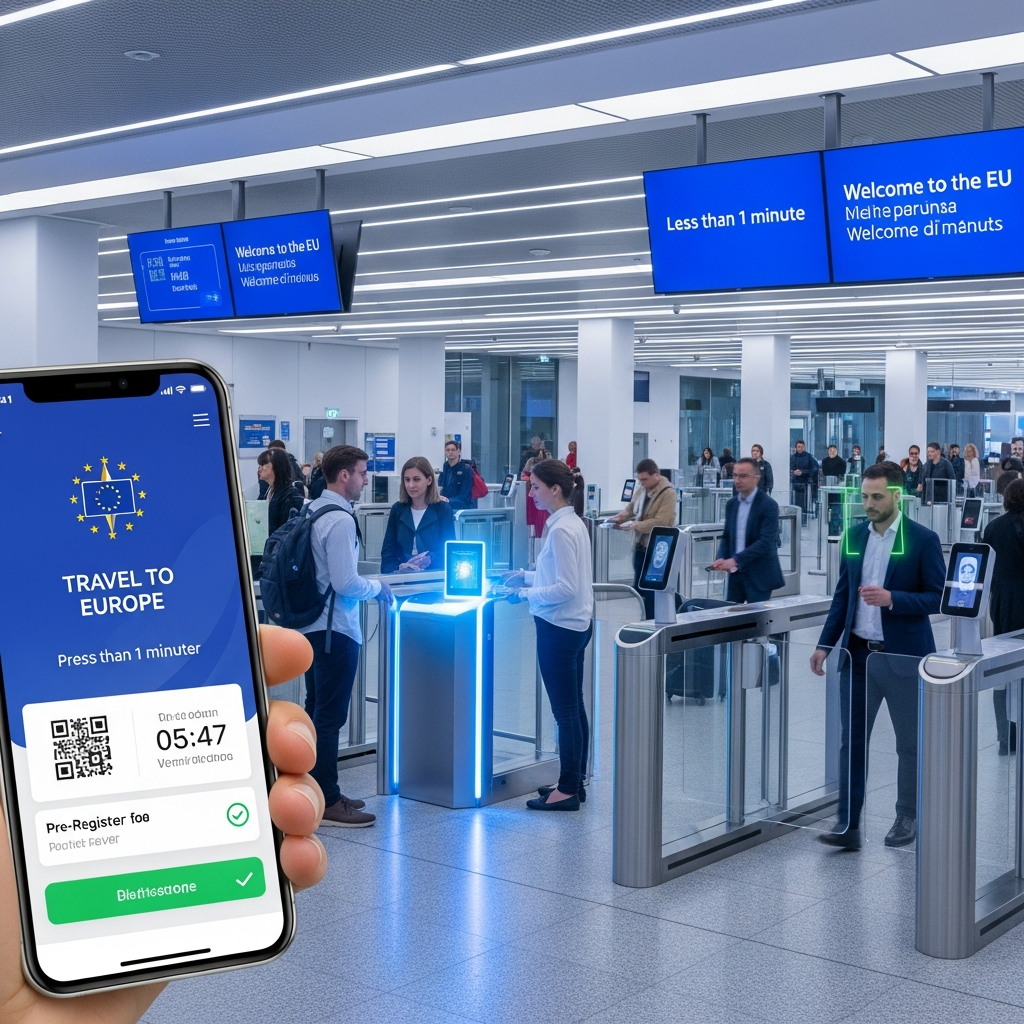

Navigating European borders for non-EU travelers often means long queues and frustrating delays. But a groundbreaking digital solution is changing the game: Portugal’s ‘Travel to Europe’ app. Launched by Frontex, the European Border and Coast Guard Agency, this innovative tool allows international visitors to pre-register essential travel data. It significantly fast-tracks border controls into the Schengen Area, ushering in a new era of efficiency and security for millions.
The Dawn of Digital Borders: Portugal’s ‘Travel to Europe’ App
Portugal is at the forefront of a major digital revolution in European travel. The ‘Travel to Europe’ app, unveiled in March 2026, is a strategic response to modernizing border management. Its core mission is straightforward: to transform the entry process for non-EU nationals by enabling proactive data submission. This powerful digital tool redefines both border security and traveler convenience. It streamlines what was once a time-consuming manual process into a swift, pre-verified procedure.
Decoding the EU Entry/Exit System (EES): A Digital Shift
The ‘Travel to Europe’ app works hand-in-hand with the broader EU Entry/Exit System (EES). This pivotal system, officially launched on October 12, 2025, completely overhauls how the EU manages its external borders. The EES replaces traditional passport stamping with a digital record-keeping system. Under EES, your entry and exit times, alongside biometric data like facial scans and fingerprints, are automatically stored in a centralized EU database. This modernization aims to enhance security, prevent overstays beyond the permitted 90 days within any 180-day period, and maximize efficiency across 29 participating countries, excluding Ireland and Cyprus. Data collected is generally stored for three years or until passport expiry, whichever comes first.
Navigating Your EU Journey: A Step-by-Step Guide to the App
Using the ‘Travel to Europe’ app is designed to be exceptionally user-friendly. Travelers can pre-register their information up to 72 hours before their planned arrival. This proactive submission dramatically reduces processing times at physical border control points. It allows for much of the data entry and initial verification to occur before you even step off the plane.
Here’s how non-EU travelers with a biometric passport typically use the app:
Create a Planned Entry: Within 72 hours of your journey, specify your border entry point and expected arrival time.
Input Personal and Travel Details: Enter passport number, date of birth, and planned itinerary.
Biometric Data Submission: Upload biometric data, such as a facial scan. Some trials, like Portugal’s initial phase, focused primarily on questionnaire and personal details without immediate in-app passport scanning or facial uploads.
Complete Entry Questionnaire: Answer a short questionnaire concerning entry conditions.
- Generate QR Code: Once all required information is submitted, the app creates a unique QR code.
- www.travelandtourworld.com
- www.nomadlawyer.org
- <a href="https://www.thetimes.com/travel/advice/what-is-the-eus-new-entry-system-and-what-will-it-mean-for-my-holiday-8grrwsgk9?gaaat=eafs&gaan=AWEtsqd6MmuQKjKmXxyegeL5SYooCwjJNhWssAIuC2EQGvpdGyFyv8l5w-&gaats=69bc83ff&gaasig=zlJAoomc3Lnh572Gd2KH8cQiOnZ9FHmmQkfwbq7S7nfcA54WjV2al6auJADzd7elGnmGT1P74W_RmDtMwYsA%3D%3D”>www.thetimes.com
- www.visahq.com
- www.travelandtourworld.com
Upon arrival at a Schengen border, for instance, Lisbon Airport, this QR code is scanned by border officers. This enables rapid verification of your pre-registered data and identity, leading to a much faster and smoother entry experience. The app doesn’t replace physical border checks but significantly streamlines them.
Portugal’s Pioneering Role: From Delays to Digital Efficiency
Portugal has proudly positioned itself at the vanguard of this digital transformation. It was one of the first countries, alongside Sweden, to trial the ‘Travel to Europe’ app. This proactive measure directly addresses previous significant challenges at its borders. Lisbon Airport, for example, once faced “serious deficiencies” in border security control, leading to considerable delays and even a temporary suspension of EES biometric data collection. Wait times sometimes ballooned to an agonizing seven hours, causing immense frustration for international visitors.
To combat these issues, Portugal reinforced Lisbon Airport with additional personnel and adopted urgent technological measures. The ‘Travel to Europe’ app is a strategic, cutting-edge solution designed to prevent such bottlenecks. Its impact has been remarkable, with average immigration processing times for app users plummeting by 60%, from 10.5 minutes to just 4.2 minutes. This efficiency boost has enabled a 31% increase in daily passenger processing capacity, now handling 24,200 travelers, and a 68% improvement during peak hours. By embracing this advanced technology, Portugal demonstrates a strong commitment to making travel quicker, safer, and more seamless for its millions of visitors.
Varied Implementations: A Glimpse into Country-Specific Features
While the core purpose of the ‘Travel to Europe’ app remains consistent, its functionality has shown variations across trial countries. In Sweden, for example, travelers could pre-register passport data via scanning, upload a facial image, and complete an entry questionnaire. Portugal’s initial trial phase, however, focused more on completing the questionnaire and entering personal details, without immediate in-app passport scanning and facial image upload. This flexibility highlights that different entry points and countries may adapt the app’s features based on their specific operational needs, existing infrastructure, and security priorities.
The Wider Impact: Benefits, Challenges, and the Future of Schengen Travel
This digital transformation creates a crucial “win-win” scenario for all involved. For non-EU travelers, it offers an unprecedented level of convenience, drastically reducing time spent in immigration queues. This means more time to enjoy their destinations, with the promise of a quicker, hassle-free passage regardless of their entry point into the Schengen Area.
For European border authorities, the system delivers enhanced security and accelerated processing capabilities. It enables them to manage increasing passenger volumes more effectively without compromising safety. Accurate, automated records generated by the EES are instrumental in reducing overstays, thereby strengthening the integrity of the Schengen Area’s external borders. Major airlines like TAP Air Portugal, Ryanair, EasyJet, and Lufthansa also benefit from faster aircraft turnarounds and improved schedule reliability.
Overcoming Hurdles: EES Delays and Implementation Complexities
Despite immense promise, the full rollout of the EES and the ‘Travel to Europe’ app across all EU member states presents significant complexities. Initial implementation of the EES faced substantial disruptions, with reports of up to four-hour queues at airports like Geneva and a three-month suspension of EES checks at Lisbon Airport due to congestion. Airports Councils International warned that overall processing times at airports increased by up to 70%, with peak waiting times reaching three hours in several countries. Consequently, the full implementation of the EES, initially slated for April 2026, has been pushed back to September 2026 to better accommodate the busy summer travel season. During this delay, traditional passport stamping will continue.
The Future of EU Entry: ETIAS and Standardized Biometrics
The optional nature of the app’s adoption by EU nations also means its availability and precise functionalities may vary. Italy, Greece, and the Netherlands have expressed interest, and countries like Spain, France, and Belgium are closely monitoring Portugal’s success. The ultimate goal remains a continent-wide, seamless digital border experience, standardizing biometric identification, making fingerprint scans and facial recognition the norm for non-EU travelers.
The delay in EES implementation has also postponed the introduction of the European Travel Information and Authorisation System (ETIAS). This visa waiver, similar to the US ESTA, will cost €20 (approximately £17) and be valid for three years. ETIAS is now expected to come into effect in the last quarter of 2026. Non-EU nationals will need to apply for ETIAS at least three days before travel. For UK travelers, new pre-departure steps will also be required at juxtaposed border controls like Dover and London St Pancras.
Frequently Asked Questions
What is the ‘Travel to Europe’ app and how does it benefit non-EU travelers?
The ‘Travel to Europe’ app is a digital tool developed by Frontex to work with the EU Entry/Exit System (EES). It allows non-EU travelers to pre-register their personal and travel details, including some biometric data like facial scans, up to 72 hours before arriving in the Schengen Area. This pre-submission generates a unique QR code, which border officers scan upon arrival. The primary benefit is a significant reduction in physical border control processing times, dramatically cutting down wait times and making entry into countries like Portugal far more efficient and less stressful.
Where is the ‘Travel to Europe’ app currently implemented and how do I download it?
The ‘Travel to Europe’ app was initially trialed in Portugal, specifically at Lisbon Airport, and also in Sweden. Portugal began a phased rollout across Lisbon Airport terminals in March 2026, with plans to expand to other major Portuguese airports like Porto and Faro by September 2026. While more EU countries are expected to adopt it, its availability and specific features may vary by location. The app is generally available for free download on major mobile platforms such as Google Play and the App Store. Travelers should check official EU travel advisories for the most current information regarding country-specific support.
How will the ‘Travel to Europe’ app and EES affect my overall travel experience?
The ‘Travel to Europe’ app and the broader EES are designed to significantly enhance your travel experience by making border crossings quicker and more predictable. By allowing you to pre-register information, the app aims to reduce the time you spend in queues upon arrival. However, initial implementation of EES has caused some delays, with the full system rollout pushed to September 2026. While the goal is faster passage, especially after initial registration, travelers should still allocate extra time, particularly for their first entry, and be prepared for evolving procedures as the system matures across all Schengen countries.
Embracing a Digitally Enhanced European Journey
Portugal’s proactive adoption and trial of the ‘Travel to Europe’ app signify a major leap forward in modernizing EU border management. This innovative tool, coupled with the overarching EU Entry/Exit System, promises a future where travel into the Schengen Area for non-EU citizens is not only more secure but also remarkably more efficient. As other European nations follow Portugal’s lead, the vision of a seamless, digitally-enhanced travel experience across the continent is rapidly becoming a reality. Travelers are encouraged to utilize these tools to ensure a smoother, more enjoyable journey through Europe.